From Litigator to Connection Expert, Shari Leid's Flip the Box Story | Shari Leid
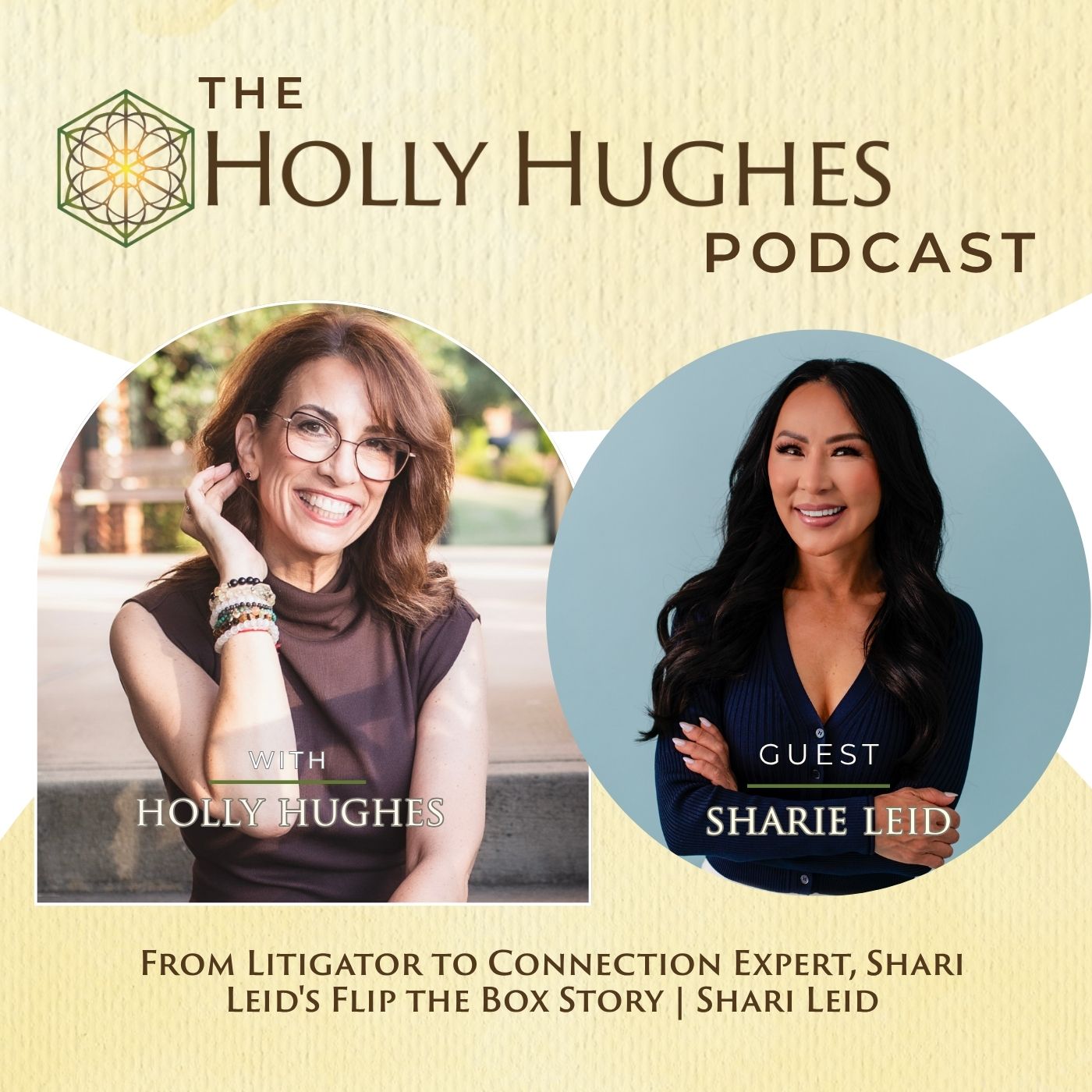


How to make friends as an adult is the question at the center of this episode of The Holly Hughes Podcast, and Shari Leid has spent the last several years answering it one stranger at a time.
If you've moved to a new city, gone through a divorce, or feel invisible in your own life right now, this conversation names exactly why connection feels harder than it used to and what actually rebuilds it.
Shari was found as an infant in a cardboard box in Seoul, South Korea, with no name, no birth date, and no family record, and that origin shaped a lifelong search for belonging that became her signature Flip the Box framework.
Holly Hughes, TEDx speaker and former Hollywood producer, sits down with Shari Leid, four-time author of Table for 51 and founder of the Flip the Box movement, to talk about eye contact, friendship, reinvention, and what it means to walk into a room heart forward instead of head down. Shari shares the exact opening line she uses with any stranger, why she left a 27-year marriage and a career as a litigator, and the one question a mentor asked her that she still can't shake: do you realize you're enough.
This is a conversation for anyone rebuilding a sense of home, at any age.
What you’ll learn in this episode:
-
Shari Leid's exact opening line for starting a conversation with any stranger, one that works whether you just moved to town or have lived there for decades.
-
Why eye contact and heart forward body language, not perfect small talk, are what actually signal openness to connection, drawn from watching how injured animals move.
-
Shari Leid's plain Webster's definition of friendship, mutual admiration, and why she believes friendships are allowed to ebb and flow without guilt.
-
How being found in a cardboard box as an infant in Seoul, South Korea became the foundation for Shari's Flip the Box connection framework.
-
Why leaving a 27-year marriage gave Shari the confidence to rebuild a life and community from scratch in a city where she knew no one.
-
The single question a mentor asked Shari, do you realize you're enough, and how it changed the way she leads her Flip the Box retreats.
-
Holly opens up about a recent diagnostic mammogram scare and how taking care of your health is its own act of connection and self-trust.
If you enjoy conversations about creativity, storytelling, personal growth, podcasting, and authentic living, be sure to subscribe for more episodes of The Holly Hughes Podcast.
We talk about:
00:00 Welcome and introducing Shari Leid
01:06 Found in a cardboard box in Seoul, South Korea
03:18 Growing up with Japanese American adoptive parents
06:18 Why did Shari become a litigator instead of a writer
08:01 The funeral that changed how Shari saw her own legacy
11:57 What does the word weird actually mean
15:00 Why eye contact matters more than you think
16:17 Heart forward versus head down
18:06 Leaving a 27 year marriage and moving to Dallas
25:24 Redefining friendship using the Webster's definition
28:07 Why hello is the hardest word to say
44:00 Shari Leid's new book Flip the Box coming in 2027
Connect with Shari
-
Instagram: https://www.instagram.com/an_imperfectly_perfect_life
-
Podcast: https://sharileid.com/podcast
-
Facebook: https://www.facebook.com/Sharileidbiz
-
Website: https://sharileid.com/
Connect with Holly
#HumanConnection #FlipTheBox #TableFor51 #KoreanAdoptee #AdopteeStory #FriendshipExpert #ConnectionCoach #GrayDivorce #ReinventionAfter50 #MidlifeReinvention #WomensRetreat #BelongingMatters #EyeContactMatters #HeartForward #TEDxSpeaker #AuthorInterview #WomenOverFifty #CreativeLifePodcast #HollyHughesPodcast
0:10 Welcome to the Holly Hughes Podcast, where creative people come together to explore our lives outside of the corporate box. Today, I'm very excited to speak with author and connection expert Sherry Lead. Thank you for coming today. Yeah, it's nice to finally connect. We've been following each other on social media for a while, so this feels great. It feels like we know each other. Yeah, I know. I'm so excited because you are busy. I want to know how you do it. I want to learn so much from you. But I have so many things that when I read your work and that I've been listening to you, I was like, Oh my God, we have a parallel. Oh my God, we have a parallel. Because I say I have a thing about boxes, like don't put me in it because I'll smash it and dance on top.
0:53 But you started life in one. And I love that you're taking ownership. And then you always speak about flipping it. So for people who don't know your origin, which is amazing, can you share a little bit about how you started? Sure. Well, I was orphaned in Seoul, South Korea, and I was found in a cardboard box with no identifying information, so no name, no birth date. And you know, my throughout my life, I was adopted by an American couple. And throughout my life it was good. But that box kept on kind of popping up saying you don't belong here. And finally, in 2023, I got tired of that, and I traveled across the USI met a stranger in every state. I was looking for connection and belonging. I didn't.
1:37 Yeah. Oh, you're my book. Yeah. And so I didn't necessarily know that was what I was looking for at the time. I wanted to believe I was welcome everywhere. We had just come out of the pandemic and all of our political and racial strife in our country that I wanted to demonstrate that we can have have a meal and a conversation with anybody. If we look different, if we're on different economic levels, different education levels, etcetera. And in this process, why I was having these organic conversations, I realized a question I kept asking was what feels like home? Where feels like home? What's family, what's community?
2:17 And I found that connection through these conversations, the connection to self and belonging. And I realized I had symbolically taken that box that told me I didn't belong and flipped it and became a table or connection. Belonging was found and that's where the term put the boxes come from and everything has been built after that upon that. Yeah, I love that because I have this whole thing about the idea of home and home is safe. I've lost my home to a fire and an earthquake. I had a starter marriage lost, you know, divorce like so to have nothing is very hard to explain to people like to or not being settled. So like when I saw that about you, I was like, Oh yeah, I'm like so curious about that.
3:01 And like you're adoptive parents, right? Their life was interesting to their home was taken away as well. So like how did that impact like the home that you grew up with? Were they private or were they super welcoming? Like where was that balance? Yeah, what you're referring to? So I said I was adopted by American parents. Well, my parents were born in America, my dad in Seattle and my mom in Bainbridge Island, a 30 minute ferry ride from Seattle. But they were also of Japanese descent. Their parents were immigrants. And so my parents, you know, grew up, went through American schools, had never even to their dying day, gone outside the country except to visit Canada.
3:43 But because of their Japanese descent and there was a generation between us, so they were the age of my friend's grandparents growing up. Because of their lineage, they were placed in internment camps during World War 2. So that was part of this project is because of their experience and the racism they found and experienced. During World War Two. We stayed to the West Coast as a family for family vacations. And I grew up with this basically unset belief that I would not be welcomed everywhere in the US because of the way I looked. And I want to personally rewrite that belief. And so this travel was also for my parents. They have since passed and my dad was very close to.
4:25 Interesting thing is, his second career was a instructor for the deaf, so he taught deaf students math at Seattle Central Community College. They had a deaf program and nowadays you don't see deaf schools around the US. You don't see signs for them. I saw three different signs randomly in places I was as I traveled the US And some of these were smaller towns, smaller cities. And I would say, you know, Texas school for the deaf or whatever the place was. I thought, OK, yeah, my dad is here on this trip around this US with me and being welcomed everywhere. I really love that because I also have daddy issues, but like for me, when I meet people who have that connection, like that's not has No Fear or no strings attached. I'm just so happy that it exists. You have this amazing upbringing. You are probably feeling a little different. Like I also identify with that as well. I also think like my parents were first and second generation immigrants from people escaping the Holocaust or like they're just a different mindset.
5:27 And like what we're brought up learning, which is people are judging you, you have to do better. You have to do better than me. If a generation ahead doesn't heal those wounds, it gets passed on. So it affects, you know, even though I was adopted, you know, not biologically this couple's child, what they experience is passed down. And if I don't heal it, I'm going to pass that down to my kids. So absolutely it affects us. That was. Like a big thing for me. I'm like, I'm going to give her different reasons to go to therapy. Yeah, I'm sure you'll be annoyed at me for something, but you are going to therapy for different things that I went through. Let's go back to like, you were a litigator, so why did you choose that? Like, what part of your personality did that fit? Because you're flipping the box, but you kind of snugged yourself right into that box for a while.
6:18 Yeah, and nothing of my personality. That's that, you know, like everyone, not everyone, I guess. Like many people, I was a checklist person. And you mentioned earlier that with our upbringings, we were taught that we needed to, you know, perform very well. And so I thought I had no choice but to go to college. If I could have chosen back then my 17 year old, 18 year old self, I would want to do at that time, I would have wanted to do hair. But I thought there was no way you could do hair. You know, you couldn't, you couldn't make any money doing that. I would want to write at that time, didn't think you could make money writing. So go to college, check. I think I need to do something after college.
6:59 What will make money? Well, my science grades were OK, but I didn't see myself going that way, didn't see myself in business. So by default it had to be law and went to law school. I don't regret it, but I will tell you for a while I would worked as a litigator for 14 years and if there was a time period when I drove to work, my theme song of the morning would be I Will Survive by Gloria Gaynor. So that tells you what a good fit it was, not. Did you feel like you were helping? Like what kind of investigation was it specifically? I was a criminal prosecutor for about 7 years and then after that I was a civil defense attorney for a large insurance company defending their insurance in different areas from personal lines to professional lines for another seven years and went on my own for a couple of years doing personal injury and a little family law. Did I feel like I was helping and making a difference compared to now?
7:54 No way. Not even close. I love that you say that because that would be really hard for a lot of people to own. Yeah. In fact, I'll have to tell you, when I was practicing law, my dad was close to passed away. I was 32 years old. And his first career, he was an electrical engineer. He worked for Boeing, and he switched careers and became a teacher to deaf students. His pay, he told me, got cut down by 1/4 of what he was making as an engineer. But that was what he was meant to do. And at his funeral, he had died suddenly. And so, you know, funerals happened quickly. But because AOL was the e-mail system at the time, I was able to contact some of his students that he was in contact.
8:36 And he'd been retired for a good ten years at that point. Some of his students flew from across the world. I mean, like, dropped everything and came. So half the church was filled with former deaf students and the hearing side of the church, I didn't realize all these people would come from everywhere around the world. And they were signing hymns and it was just so beautiful that the hearing side was crying. I looked over and I thought if I died tomorrow, the clients that I'm helping or working for right now as an attorney would not come to my funeral and look at what my dad left as a teacher. And I remember thinking about that and the difference his life was making versus my life at the time. I love your ability to reflect.
9:19 Have you always been able to evaluate yourself? I was so insecure when I was younger. My dad's a chemical engineer. I thought I'd do that, but I got into like a certain level of math and whatever, and I was like, no, my brain does not do that at all. Like I can understand it. I can physically do it. But when you asked me to explain it, no, that's, that's not happening. I wanted to to write. My mom is an artist and she said, how do you make a living doing that? It's like, what a horrible question to ask. I don't know. So journalism was my thing, but I always liked Andy Rooney, like back in the day, 60 Minutes, which are really personal essays. And my professors in DC were like, you don't write like a journalist. I was like, why can't journalism show humanity, still show two sides of the story, but have humanity, which is what I think is lacking. Yes, absolutely.
10:09 This side of the story, this side of the story, the human aspects of it and the truth as much as we can find nowadays, and then share that. But that disappeared. You were ahead of your time. Always am because I'm an Aquarius. I'm an Aquarius so I know we don't know your birthday. Yeah, I know. It comes up so often in conversation. It's right. It's. Surprising thinking about that. I was like, would you make one up? If I was you, what would I do? Like do you know your? Do you know which day you were found, I'm assuming? Actually, I don't. I don't really. Maybe I can find that if I've dug deep in some of the records, but they gave me December 16th as a birthday, so 9 days before Christmas.
10:49 It's like I could have, you know, could have been March. I could have competed with Saint Patrick much easier, you know, But right there, right there, I. Don't know, I have a January birthday and I can tell you like a lot of my gifts coming up. Yeah, it's because everyone's burned out. But that's funny. I I can give you. I'm like, I'm thinking, you know, Sagittarius, fiery, charismatic. I think you're those things. It comes up so often in conversation and you wouldn't realize because it's just natural and it's a flow of conversation that comes up a lot. It's our identity. Part of it for sure, but like when I look at you, you're not missing anything. I look at you and you own who you are. You look amazingly comfortable in it and you're stunning, like inside and out. You really are.
11:35 You're compelling. And I'm so grateful that there are women like that right now when in the world there is so much. Not that, right? There's that thing where you have to sell and what sells and what gets people's attention. And then there's that authenticity part. And people sell authenticity without being authentic. Yeah, isn't that crazy? You know what what happened is? I finally embrace my weird. And the root of weird is WYRD is how it's spelled, and it means fate or destiny. That's the root meaning of the word weird. And when you realize that everything that makes you not fit in and makes you look different than everyone else, then you're like, oh gosh, that's my favorite or destiny. And This is why I'm supposed to be here because I I have this thing that someone else might not have. It's weird because it's different. But man, if I embrace it, this is what I can offer the world. Yeah, I've been called weird most of my life and Corky. And so like, I've been owning Corky. I love that word Corky.
12:37 Because I had people like my TEDx experience wasn't the best, but but the people there were like, you're so quirky and I was like, I'm a grown up. Why are you talking to me like that? That was like the strangest. That's. Hilarious. I was like the street. I was like that you're trying to put me down or like there's everyone was always like, Holly, you're so weird. So when I moved to LA, for me, I was like, I'm so not weird. I'm so not weird compared to them. But like, now I'm kind of in the South and I'm a bit of an outlier. But when I'm not fully me, I am so unhappy. So I think that's part of what you bring out in these conversations that you had at your table for 51, right?
13:17 Like, so did you start it because you decided to get divorced? Like, was that all part of your awakening? How did you go to litigator to connection expert? Fell into it, really. You know, I was a litigator. I ended up staying home with my kids for a while, for a long while. And then I fell into writing between my 49th and 50th birthday, I decided, well, what do I do to make this big thing special? And I decided to sit down with 50 women in my life that lived in my area just to tell them what I learned from them. And there were women that I knew very well or something I just met briefly. And I did this and I was over sharing like I used to do.
13:58 I do over share a little less now, but was really over sharing social media. People start asking me though, what gave you this idea? And I start to challenge people to do this as well because I noticed what a difference it made to actually sit down with someone and have them feel seen and share with them what I learned, even if it was the smallest thing. And from that built this career of writing. Then wrote another book and another book and I'm learning how to write. I would say read my last book because it's better than the ones before because I've become more intentional about it and really learning what my message is. I started doing interviews like we're doing here and found that I really enjoy that piece of this.
14:39 And now I I speak and I've moved into hosting retreats for women. And that's really where my heart, I find my heart really like sings during these retreats and be able to have that time, this intimate space, really working with a groups of five to 10 women at a time. That's really smart. I've done retreats and I, I think small is the way to go because then you, you get to have that real experience of getting to know someone intimately for a short amount of time sometimes and then a longer perhaps conversation keeps going after that. You talk a lot about eye contact and I love that because I do that like I have my real, not perfect Academy. And for me, I talk about eye contact a lot and what I often ask women are similar questions to you. Like I have them, when they come, it's because they feel like they've lost themselves.
15:29 Everything that used to define them doesn't fit. Or they've been people pleasing and defining themselves as to what was needed as opposed to who they are. And there's like a balance between that, right? Like life happens. So I often ask them to ask a family member and a friend, give them 3 words that they would use to describe them, and then would those be words that they would ever use to describe themselves to just show how either disconnected they've become or how much of A persona they're living. And the other thing I love to ask is notice where you look when you're walking because a lot of people will be looking at the ground and not looking at people. And so every time I see and listen to you speak about eye contact, I'm like, yes.
16:16 Yeah, You think of, you know, talk about looking at the ground. We're looking at our devices, we're looking down. And when you think of animals in the wild, the ones that are hurt, that are injured, their body language is, you know, hunched over, it's down versus the ones that are the leaders. You could just tell by the way these animals are walking. They're walking hard forward. And it's so different. And so I always remind these women that I'm working with, when you walk into the room, think walking hard forward. Never walk in looking at your phone because you're walking and as a wounded animal and there's just something different with the energy you're able to bring when you you consciously physically think of how you're carrying yourself throughout the day. Heart forward versus head down. I love.
16:58 That I'll either look really up or I'll look down, right? You're just like, what is that? What is that? What is that? And I judge myself. Like I take dance classes and I'll record it. And I can tell when I don't know something because I'm kind of looking down because I'm trying to remember. I don't know, like maybe there's more memory in the front of my head. I'm like, come here, come here, join me. Come make my body move the way I want it to. What type of dance? Mondays are TAP classes. I just started TAP. That was so exciting. I feel like like a 5 year old girl just shuffling my that's hard. It is. I was like oh that works my knees. Duh of course it works my knees. Then I do AK pop dance class. Wow, I know I but. It's so fun. And then I'll do a drop in class. But I am, you know, firmly in my middle age, so I learn a little slower.
17:45 And so I always feel like if I only had another week because we do a new thing every week. It's like. So good for the mind and body. It is, and then I'm in a room full of 20 year olds, right? So you're just like, I wish I could still move like that. I wish I could still move, but there's no way I could not do it. I love. It it like I feel you and I remember part of your question that you asked. I had forgotten you asked about the divorce. So I've been married for 27 years and got divorced and moved to Dallas from Seattle with no anger here, no friends or relatives. But part of my divorce happened because, well, it didn't happen because of this.
18:26 But I had the strength to leave a marriage that wasn't working because of my conversations with these women around the US and learning about their lives. And so that gave me the strength and the confidence that I could do this on my own. Because of course, if you've been with someone that long, you've grown up with them. And my parents had passed away. I was adopted as only. So other than my two kids who are still in their 20s, still launching themselves, I really don't have family. But this woman I met in South Carolina, she said that her husband, when they moved there, asked her, Are you ready to plant roots? And when she did, that's when her community started.
19:08 It was the first time in my life I realized because I always saw myself as kind of rootless given my beginnings. I thought, wait, that doesn't have to be my story. I can have fruits and I can choose where to plant them. And I decided I could plant them anywhere now. And hello, Dallas. I'm like, that is like a big like the the change in climate and the vibe is. Vastly. It's like moving to a different country, the culture, everything. Of course, sure. So how many years has it been now that you've done that? I moved here in September. Oh, it's brand New Girl. So I've married about 24 years.
19:49 I never get that right. People think I'm weird that way, but whatever. Yeah, it gets hard to remember after so long, but. We were in LA and we had a conversation that when our daughter was just a toddler so we don't have an extended family really that's exists whatever. And so it's just like me and him, and I didn't want anyone to raise my child. So with me, my one very traditional value probably in the world was like, I really wanted to be a mom when I could be a mom. And I waited a really long time to be 1. But like living in LA and like the reality of having a family there is it's a tough, right? So we had that conversation of do you want a life where we have to work hard to get by or one we can enjoy? And then we said, let's try to enjoy it. And everyone's like, you're crazy. You don't leave where you're at.
20:37 And I was like, or you do right, Like you do you just get up and go. Now we hit a whole lot of message, like it was not easy moving across the country, starting over. And when I first moved here, I felt like a jellyfish tossed in the ocean. I was like, I have no mountains to ground me, right? Like that I could see like everything is kind of just woods. I'm a city girl. Like what was I thinking? And I think it took me like 9 months to kind of find some people. And I only found people because I put my daughter in preschool a little bit because we were so alone. I was like, I can't isolate this toddler, right? She's like three. I have to have her play.
21:19 So like I I love that you were doing this old badass woman. It's been amazing. And you know what happened is I was laying a good life for so long. I mean, my marriage was good in the sense that the lifestyle was good, great community of friends. I still have that community of friends in Seattle. But I let a good life stop me from a great life. And I finally had the strength to close the door. And once I closed that door, I'm not saying it was easy to do. It's not easy to close the door on 27 years, but once that door was closed, doors have continued to open for me over and over again, and it's incredible. So I always tell people, I ask, are you letting a good life stop you from a great life?
22:02 There's something about that level of realizing that, OK, no matter what, I've always been taken care of. And when you start to absorb that, and I don't mean taking care of like somebody's paying for everything, but just like in life in general, you know, as we talked off camera, I'm a breast cancer survivor, was still taken care of. I'm here today. You know, different things have happened just like they do in all our lives, but still, OK, still breathing, you know, so no matter what life is thrown, I've always been taken care of. And once I really got that concept, things didn't become as scary. I I love that I I want to tell people because I share too much, but I had just came from a see I'll get emotional because I was afraid. I had a diagnostic mammogram today just before actually came home and to talk to Sherry is I found multiple lumps and so I I want women to take care of your own health. Like I am not a person with health insurance because I'm a freelancer and my husband is as well. So it sometimes you make choices, whatever, but it, it matters.
23:08 It ended up everything is fine and benign, but I haven't even like breathe because my coping mechanism is work hard. And then like in two hours after I'm done all the work I want to do today, I'll probably just go and then I'll go to tap class and I'll be really happy. But I, I hope that people take the time to do the thing that's uncomfortable for your health too, because no one likes a mammogram. They're the worst things. Ever. And diagnostic mammograms are something else you think of. Regular mammogram is something diagnostic mammograms are a different beast. And I'm so glad it turned out well for you because I know part of the whole process is surprising, how long sometimes the diagnostic process takes. And no matter what you do, all the self talk in your head, it's in your head, it's always in your head until you get to the next step. So I'm so glad the next step has turned out fine for you. Also fight because it took me a while to get in. Like, you know, that's the part that's madding, but that's a whole other.
24:08 Like Healthcare is different. I want to like direct because you are supportive, kind person with like power. And what I like about your strength, it is like amazingly feminine. Also, when I work with people, when I tell them to surrender to their femininity, it doesn't mean that you're weak or whatever, but like there's this power and our femininity that men can't touch because there are men. And when you do, it is a light, it's a beacon, it's strength. There's just so much. Your intuition comes into play a lot more. You begin to trust yourself and listen to your instincts. If you're at a transition point in your life and you're wondering, how do I go from point A to point B?
24:51 I'm tired of being defined by what other people think of me. Read my book Real, not perfect. How to become your happy, authentic self. It's a step by step guide to help you reclaim your voice, your passion and yourself worth. Available at all booksellers and in the links below. I also want to give you a crown for that because everywhere you go, you're coming across the same. And I can see like this evolution and I can't wait to watch like what you do more. I'm going to maybe like be in the book of 110. But like, I love this idea of friendships that you have as well because friendship is something personally I've struggled with in my life. Like you can be super intimate and then it disappears.
25:33 And I had to learn much later in my life that there are different kinds of friends. Do you talk about that or like explain that in some of what you do? Yes, We've gotten to the point where we put so much pressure on what a friend should be and what a friend needs to be. The Webster's definition is simply having mutual admiration for another person, period. And so if we think of a friend like that, we've realized that's a great entry point and we don't have to put so much pressure on ourselves, let alone someone else, that we have to show up for everything and we have to act correctly. And our house has to look nice and we have to buy presents for a friend. And it's expensive to have a friend.
26:14 And we have to go to everything together and invite every, every lack of that pressure, it makes friendships so much easier. And also understanding friendships ebb and flow. We focus so much on teaching our kids how to make friends that when friendships break up, we don't know how to break them up. We feel terrible about break up. People want to get to the drama, but it's a natural flow of life because we all grow and change together. Sometimes friends come back together, sometimes they go away. And I simply think we put too much pressure on what a friend needs to be rather than really looking at that person and appreciate what a friendship becomes.
26:54 I love that. So you're like looking at their humanity? Yeah, and it was interesting when I traveled across the US and I would contact these women, especially women that I absolutely had no anchor to or no one referred me to. It's like a cold call. Hey, I'm this woman from Seattle. Let's have lunch. And I thought the objection would be because I explained I'm going to write a book about this. I'm going to try to get some media. So there may be some of that. There'll be waivers for you to sign. I thought the objection would be, I'm sorry, I'm a private person. Thank you. Go on your way. But the only thing that's came up more than once was I don't know if I'm interesting enough for you. And it was I was just a regular person wanting to have this experience.
27:37 And that made me think. Many of us are walking into rooms thinking we're not good enough for other people to show ourselves that we're putting up these Shields before we could even let connection happen. What's your favorite way of like initiating a connection now? Well, now I, you know, it's so easy now. So I'm just moving to Dallas. I always say, Hey, I just moved here. How long have you been here? Are you from Dallas originally? And people then are, you know, we have a common thing to talk about. They either want to share with me what their favorite restaurant is, ask me what caused me to move here. But you could do that anywhere. If somebody that's been in the same town for a long time, they could say, hey, I, I'm, you know, I'm a lifelong resident of Seattle. Did you move here or did you grow up here as well? I think that's a great starter.
28:24 It's always worked for me. I love that I moved as a junior in high school from a smaller school to a school that was really big. So the school that I originated in, if someone showed up who was new, everyone wanted to meet them, right? When I moved, no one cared. Like when I moved to school, the school was so big that I was like just faceless basically, right? And I was like, oh Dang, this is hard. So I learned that the hardest word is just hello, that if you say hello, more times than not, people will respond. And then that really served me, like when I went to college and the world because walking into a room and not really knowing anyone and being the weird one, right?
29:06 It's kind of amazing. I met one of my dearest friends. She actually, I'm going to see BTS with her. Yeah, I walked into a mommy group, which is so not my thing, but I was like, I need to meet some new people. Like I was too insulary because I'm an introvert. So like, if I get a loan and I start writing, then I'm like in this world too much my own private Idaho. And I was like, well, I'll just go, I'll go for 15 minutes. If it's awful, I can just leave and like, not a big deal. And I went in very Holly. I was in like I, I really love that bright green love. That color. So I was in pants that that color and I had AT shirt on and I don't really know. This is like I love dressing up so that I'm wearing this is weird anyway, but it's like my eat, sleep K drama repeat T-shirt.
29:55 I forget where I was coming from that I was dressed like that, but I really just thought I was going to duck in and duck out. And I walk in and this statuesque, gorgeous woman is standing there and she's in like a leopard dress, like stunning. And I walk in and she goes, she raises an eyebrow and she just gives me like the little K drama heart. Like the little before everyone was doing it. And then I did it back. She's like, my husband told me I can talk about beating us, but Oh my God, I was like, so anyway, I made a friend that way and I did duck out because it wasn't really my thing. But you never know it. Just one person, one person, one question makes a huge difference. So like, what do you think that you've been charged with right now?
30:37 I feel like you have your own mission and you are full going for it. So did it just like just keep one step, one door open after the other because writing a book is hard. I don't know, like I know a lot of our listeners are writers. So I mean, I've written a bunch. I got to and edits over there. But like finishing it, it's a big deal. Getting editing, publishing, doing all of this publicity that you're doing. I don't even know how you have the energy. Tell me how you're keep going. OK, it's interesting because I could work from like 6:00 AM till midnight and it doesn't feel like work. I mean, it feels like work, but it doesn't feel like work, right?
31:18 I'm creating it. It feels so aligned with me now. I don't, I'm trying really hard not to do that because I also realize and having relationships with people are important to me. So I try to stop at 6:00 PM every night and just go. 5:50 is actually why I try to do sometimes if I don't have anything, any event, I'm impressed. I'm impressed. I do have an event, I say I'll stop, but otherwise, and I did, I did a comparison chart to see what's really important in my life and relationships especially especially a new romantic one came up high. So I realized I need to make time and invest in what is important to me in the long run. But this work, it just feels so mined and it is for the first time in my life that I feel like I'm doing what I'm meant to do. And in college, I wanted for, you know, when I started, I kind of wanted to be a writer.
32:07 I wanted to be the next Connie Chung. I didn't have the confidence to be Connie Chung. I had a teacher that really put red marks all over. My first college creative writing paper destroyed my confidence and also told you can't make money as a writer, and I majored in psychology. Fast forward, I'm doing kind of all those three things in this career that's been sort of pushed towards me without much thought. So that just to me means that this was this is what I'm supposed to do. I love that. Do you ever have that feeling of I'm a little older than you, but we're in we're in our middle age track right where there I I. Would doubt that you're older than.
32:48 I am older than you do. You know that for a fact. Yeah, you do. I'm 57. Well. I turned 57 in a couple months, come on. No, no. No, I turned 57 later this year. So high school, class of 8887, OK, I was, I was older for my year. You were young. I was older for my year too. Are you? Older. Yeah, see all these fun things, but I would have liked you in high school too. Yeah, but I think like what I was struggling with is that I'm always me. And I think if you meet me, you'll be like, Oh no, she's not faking that. That is like her, right? Like I let people, I like to say I'm a little bit Moody, that I know I'm having an emotional day.
33:30 I'll just let the person know because I'll probably retreat a little bit because I need to take care of myself. And other times I'm super gregarious and I was like, you're such an extrovert. I'm like, no, I'm using all my words right now. And then I'm not going to talk for like 7 hours. I'm going to go sit and read or be in my hole and just like decompress. That's like what I've learned about myself as I've aged. But I found out when I realized that I was looking at the ground, right, that I had become so and so's mother or so and so's wife. And I was like, well, that like, yeah, those are choices I made and I I liked them. And I'm still me. And what does this whole little bit of invisibility that I'm feeling now is different than just becoming mom, like, right, I went from being ATV producer, telling 250 people what to do every day to being home with an infant that screamed that I couldn't make better, right?
34:24 That was, oh, that was an ego slap, right? But now I'm also in this space and what's why I also really admire and I'm so glad that you're speaking. And again, because I mean, like, I do fall in love with everybody, but just how you care Like me, I was like the other day, I was like, oh, I get to talk to Sherry on social media. I was like, I think like showing up as we are with our personalities matters. To start erasing the invisibility of what word are we using for mature women? Because mature women just sounds like What is that? That's not my word. Yeah, and I really don't like the term grey divorce. Can we say something different than Grey Divorce? I don't know, sexy cougar woman I don't have, I don't know, We're both writers.
35:13 Let's come up with a better. I mean, I keep seeing the memes of like, your 50s are the adolescent of old age and like that. That kind of works for me, but it's like that's not exciting. No. Well, it's interesting because we will have friends that are younger. My parents did not have friends that were younger, and I could easily hang out with a group of women that are in their early 30s or, you know, even my my daughter's friends or something in their 20s. I mean, they might not want me there all night. But yeah, I feel like our generation, we're able to cross generations a lot easier than our parents generations were.
35:54 And I met this woman who was 93 in Arizona, and of course, all of her friends were younger, but she was steady on her feet and really sharp and even now constantly making friends. I thought, oh, that's the secret of getting older, is that you know you live long enough to make more friends. I love that. Yeah, and that's just, and then when you look at her, that gives us another 40 years, 30 something. Years, you know to. Make more So it's all relative, right? It's all relative what we have going. In my last retreat, I had a woman in her early 70s and she came on my retreat because she said something told me inside to come on this retreat because I know I have to keep curious and be around people who might think differently than me.
36:37 I thought, wow, that's exactly how I want to continue to think as I get older. And she had seen older, you know, other than physically, maybe a little bit, but other than that, mentally, emotionally right there and offered so much substance to us. Yeah, I think curiosity is what I say is like one of my driving forces in life. It's just what keeps me going. I can't imagine just being like, satisfied. Yeah, I mean, then what do you do, right? Is there like a commonality that you've seen in your retreats with the women who come like a a singular thing that they all share? There's a synergy. So I always know that the right people and that's part of being small because man, they leave and there's this bond that's been created that they don't want to leave each other. And just like when I traveled to all of the states originally, I said, OK, I'm going to find some common thing with everybody. But as I traveled what I realized is it felt like it was 1 teacher, just a voice and the appearance changed but the conversation seemed to be so connected as we went through. And granted, part of it was I was the common denominator, but I swear I meet one person.
37:50 They would tell me the story of like I wouldn't know that they were adopted, but they would tell me a story that they were adopted and they found their birth father through the birth father's sister. Next day I meet someone else. They found their birth father through their birth father's sister. I mean, it was just or somebody would say something. Next day, another person would say another proverb that relate to the night before. So there was this beautiful pattern or synergy that I sought just amongst us as human beings. I love that. I also, what I found fascinating about your writing is your ability. And I was like, oh, I wonder if this is the lawyer part of you is your ability to, like, sum up the interactions. Yeah, I tried to.
38:33 You know, it's interesting because I'm doing a fifth book. I'm coming up with a fifth book in February. It'll be my first book that I'm writing on my own, and it's not about anyone else, so I don't have to be careful not to, you know, and the way I'm doing it. But part of that is my own becoming because I am now realizing this is a process. That's my first book, that I'm enough. And yeah, I lead all these things and and speak. But there's a piece of me that I didn't realize how this year that was saying I need other people to make this more interesting. I need something else. And I had a person who's somewhat of a mentor. She's done other retreats. And I was telling her about these vendors I want to bring in.
39:14 And she said, well, Sherry, just wait. That's fine if you do that. But I understand that you're enough. You've been there as a leader is enough. And that's just really sad with me. I've been thinking about them. I even now as I create my next one. OK, confidence you're enough. You're you're here. How many days are your retreats 3. 3. That's a lot of work. I've done retreats. I always do it with someone else as well. It's like I need someone, someone is back up because again, I have to. Go yeah, it's nice. And I did bring in I did bring in people to I close the days I had a tea ceremony Reiki practitioner sound back that I can't do. I'm not trained to do that.
39:55 But the actual workshopping pieces they were me. And I don't know that I would have quite got there in the way I did if she hadn't just said that one thing or asked me that one question. You know that. Realize you're enough. I love that you keep getting these messages. Yeah, I try. Yeah, I might. I had my first true little gossip here. I had my first argument with my new boyfriend a little while ago, and he asked me a question. Because The thing is, he was able to open up a conversation, which I appreciate, and open up the space for us. But he said, well, you know, is this something, What do you think of this? Basically, what's what's going to happen from this? And all I could say is all I know is I keep trying to learn. I keep trying to learn about myself and learn how to do things differently.
40:42 And so that's my goal. So if I, you know, even as a leader, when somebody says something like, oh, now shoots, I wasn't thinking that. OK. And then now let me pass this on to you and ask you this question. You know, do you realize you're enough? I love that I think like when my mom comes to visit, my marriage is hard for her because we're super honest because my dad was such a liar. I can't tolerate lies like at all. There's such a betrayal for me because if you're lying about this, what else are you lying about? And I don't mean like, you know, like someone lives in outfit and you're not going to be rude. I'm not talking about that. I mean like a significant whatever.
41:24 I mean, it could be anything. So like for us, we are able to say now like, because I was the most ridiculous people pleaser, because daughter of an alcoholic, I was like, let me make everything better for everybody. And then I was like, oh, I'm really unhappy. This isn't working. What am I feeling? And am I allowed to say that out loud? Oh my, like, learning to be able to articulate how I actually felt and know that it wasn't going to be used as a weapon was like a very big turning point. And my mother is much more of, I would say like a lady. So it's much more like, I'll get to the point and like, can you just tell me the point? Because I'm going to insert all sorts of anxiety in there if you just don't tell me what's up. So are you direct like that as well or are you careful? I've learned to be and I'm learning to be outside of personal relationships.
42:17 I believe I'm pretty direct. It's interesting, the personal relationships, I am learning to create more, not boundaries, but be more direct like that. And you know, you mentioned alcohol and that was an issue with the demise of my marriage. And there is no with that disease. I've learned so much. There is that dishonesty that's there because there's that hiding of the disease and it just keeps on feeding and feeding, feeding and spiraling. And I didn't realize, because I consider myself a strong person, that I was codependent in that relationship. And I didn't understand what codependent meant. And it didn't mean that I was weak.
42:58 And then I was making this thing work, right? And so I've learned part of that was not speaking up when I needed to. And so I've really been aware of that now. And it is that that when you describe the type of relationship you have, I believe that's what I'm creating and moving towards something where I could say, hey, that's on you, that's not me. You know, the thing you're complaining about, that's actually think about that. That's my personality. But that, that's your issue, right? You know, I'm not going to be not polite, but let's look at where that comes from. Those are adult conversations. I think that's also part of what's missing in friendships and in the world because people are so busy.
43:41 This is what it should be, or this is how I should look or whatever. And and beyond like the trauma bonding that I think is everywhere on the Internet, like everyone's screaming about their pain. OK, you've identified it now adult it figure it out like is this really the cause? Is there some other thing? Is this the best way to handle it? There's a little bit more nuanced to it than just like being blunt, right? I'm not saying be blunt, people, because that could that could be rude. And you should also know your time and place that that plays into it. But yeah, I don't know. That's fascinating to me. So your next book is coming out. Do you already have your pub? Yeah, it's coming out in February 2027. It's going to be called Flip the Box. I've gotten everything now under the Flip the Box messaging, and it's about human connection.
44:28 It's about connecting to self, career, and community. And it's also focused on teaching people how to find that connection, whether it's in work with their teams, with their clients, their stakeholders, or in interpersonal relationship. So I appreciate you coming and talking with us. You are an amazing guest. I like to ask every guest to wrap up. If you came with a warning label, what would it be? My warning label would be warning fast moving train. One of my favorite sayings that comes to the format. The question is, if today with the last day of your life, would you be doing what you're doing now? And I asked myself that quite often. And so when I have an idea if it feels right, I go for it. And I start ugly because it's so much easier to make ugly pretty than perfect better.
45:12 So a lot of times you feel like, wow, you're just doing it, doing it, doing it. I'm like wow, you know, time is short and I want it. This speaks to me. So warning, fast moving train all. Right. I'm joining your train because I've made some big decisions. Last week I was like Oh my God, what did I just say yes to in my head but more. Awesome. It's a great ride. It's a great ride and we're so young still. We got like, you know, 50 more years of 50. Let's go, 50. Let's go, babe. Anyway, there you. Go thanks everyone for listening to the Holly Hughes podcast. Where can they find you? Where can you want everyone to go get your books? Amazon is good. My website I recently changed it. It's now just Sheri lead.com. SHARILEID as in David? Awesome.
45:57 Thank you so much.