How to Write About Family Without Repeating the Past | Monica Macansantos
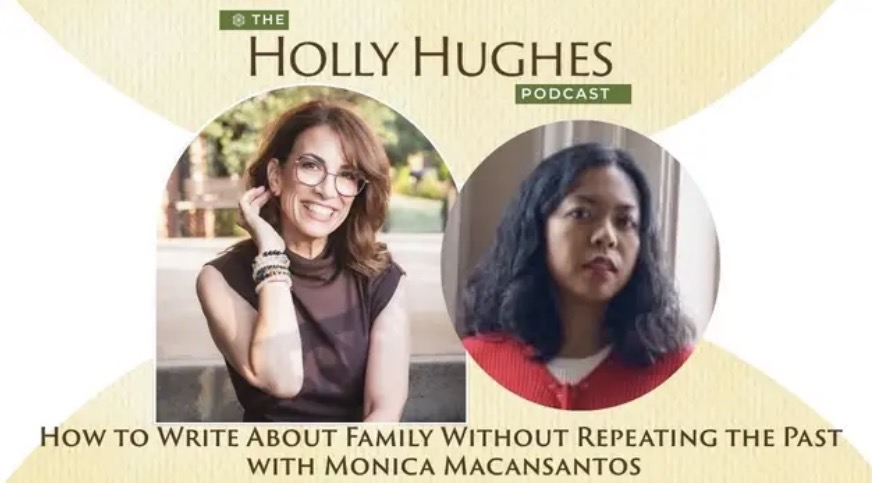


What if writing about your past didn’t mean reliving it?
In this episode of the Holly Hughes Podcast, Holly sits down with author Monica Macansantos, writer of Returning to My Father’s Kitchen and Love and Other Rituals, to explore how we tell the truth about family, identity, and the stories that shape us, without getting stuck inside them.
Monica shares how her father’s openness transformed pain into connection, and how writing became a way to process generational trauma without passing it forward. Through food, memory, and lived experience across the Philippines, the United States, and New Zealand, she reflects on what it means to belong, even when you feel like an outsider.
This conversation moves between the deeply personal and the universal. From complicated family dynamics and cultural identity, to the quiet ways we carry home with us, wherever we go. It’s about learning how to hold your past with honesty, without letting it define your future.
If you’ve ever struggled with where you come from, how to tell your story, or how to make peace with your past, this episode will meet you there.
What you’ll learn in this episode:
-
How to write about family without reinforcing generational patterns
-
Why storytelling can transform, not just revisit, trauma
-
The role of food and memory in shaping identity
-
What it means to feel like an outsider, even when you belong
-
How cultural identity evolves across countries and experiences
-
Why you don’t need labels to understand who you are
-
The connection between creativity, grief, and healing
-
How to process the past without letting it control your future
-
What “home” really means when you’ve lived in many places
We talk about:
-
00:00 Introduction to Monica Macansantos and her work
-
02:10 Writing about family, trauma, and healing
-
05:00 Tango, trust, and understanding complex relationships
-
07:20 Food, memory, and connection to home
-
10:00 Growing up between cultures and identities
-
13:00 Leaving the Philippines and expanding opportunities
-
16:00 Travel, belonging, and building a life across countries
-
19:00 Toxic environments and creative communities
-
22:00 Feeling like an outsider and finding your voice
-
25:00 Ghosts, memory, and being haunted by the past
-
28:00 Cultural trauma and historical silence
-
32:00 The “landlady” story and learning boundaries
-
36:00 Writing process, discipline, and current projects
-
39:00 Female friendships and power dynamics
-
42:00 Identity, labels, and being human first
-
45:00 Connection, understanding, and shared experience
-
49:00 Monica’s warning label and closing thoughts
Connect with Monica
-
Instagram: https://www.instagram.com/madamebutchay/
-
Website: https://www.monicamacansantos.com/
Connect with Holly
-
Instagram: https://www.instagram.com/holly_hughes_intuitive/
-
Get Holly’s book here: https://hollyhughesintuitive.com/my-book/
-
Website: https://hollyhughesintuitive.com/
#WritingAboutFamily #GenerationalTrauma #CulturalIdentity
0:10 Welcome to this episode of the Holly Hughes Podcast. Today I'm very excited to be speaking with Monica Makinsantos, who is the author of Returning to my Father's Kitchen and Love and Other Rituals. Yes, this book, this book had so many of my issues that I kind of feel like, you know, I am an intuitive healer as well and I have like my own self help book and all of that. But there's something about your stories that are so antithetical to my relationship with my father, right? That all my daddy issues that you have so much love. You have all these beautiful, I'm going to use the word savory stories of love in about a father and his daughter that it was kind of healing to read. I'm so glad that you felt that Holly. My father had a complicated relationship with his father and I mentioned that in the book I write about it. His was abusive, but art and writing enabled him to process that relationship and to find love for his father despite the abuse and despite the hurt.
1:22 So when his father died, like he still had love for his father. And I think that I guess it's like dangerous to say that you have to forgive your parents for abusing you. That's that's not something I agree with. But on the other hand, you can process this difficult relationship in the way that it doesn't poison your relationships with your children. It doesn't recycle generational trauma. So in one of the essays in this book, A Shared stillness, it's about like my grandparents, my father's parents, being the tango champions of their hometown in the Philippines.
2:03 And it's about like them finding joy amidst the hurt and how my father was able to see that because he was an artist, he was a writer. And I that's why I believe in the power of art and writing to, well, rescue our sense of hope in the world that feels so bleak. So crazy right now. I think what I also liked about that story is that you also learned to tango. Yeah. How was that for you? Because I talk about this with another guest of mine. Her name is Jamie Rose. She also studies tango and is an amazing dancer. But there is a surrender and trust with your partnership in that dance that you are leaning in and being a really good guide is applying.
2:56 I call it pressure on your back and and making you move. Did you always know the history of the trouble between your dad and his parents, or was that something you only learned later? Well, I learned about it when I was a kid. Like my father was an open book. He didn't believe in keeping secrets and this is not very common among Filipino parents and Filipino fathers like Filipinos are tend to be more reserved when it comes to like their like personal troubles but not my father. He didn't believe in that so. He was a poet, right? He and nonetheless, like I know a lot of children of writers who didn't like have the same relationship they had with my father. Like their their parents were open and frank on the page, but they weren't like open and frank with their kids. So in that sense, my father, I think. I identify with that just a little. Some things I want to shelter right, my own daughter from from my past.
4:00 I'm like, you don't really need to know that way, but it's there on the page whenever you're ready to explore that way. But I don't need to hoist that on you sometimes, like I go that way, yeah. Oh, yeah, and like I, I'm sure my father chose not to share certain things with me. Like we all share, choose what to share and what not to share. But he shared with me like I think of Port Fortune, like aspects of his story, his difficult relationship with his father. And he was, from the moment I learned that my grandparents were the tango champions of Zan Blanca, like, I knew that my father was like very proud of them. Like, he saw that as like one of their shining achievements. And I think it's also because he saw that he understood the reason why they stayed together despite the abuse from my grandfather.
4:55 And not that like I approve of people like staying with their abusive partners, but like he came to an understanding of the relationship and he saw the joy in it. And I didn't understand why they stayed together or until I learned to tango myself in New Zealand. Like that gave me another opening into a relationship that I knew about when I was since I was a kid, but which I didn't quite understand. Because like when I learned to tango in New Zealand, I was getting over this weird breakup. Like I was healing my heart. And the person who taught gave me at my first tango lesson happened to be that person who broke my heart. So.
5:45 It was very strange, but Lynn, I liked the dance. And then after we broke up, I was like, that's it. Is that the final tango lesson I'll ever take? So I was intrigued and I was taking other dance lessons like Lindy and I actually enjoyed Lindy a lot. It's just that they stopped giving the class at the university where I was doing my PhD. So like I think that if they continued that class, I would have gone on the Lindy route. That's. Very different movement, like the Lindy to tango. Your body is totally different, the rhythms are totally different. That's amazing. That's true. On the other hand, the guy who was teaching the Lindy class told me that Lindy is the North American sister of Tango. OK, We'll just let them have that like we don't need to. Like.
6:35 We'll just, we'll just go there. I'm trying to think now, how can I bridge all of that dancing with all the food, right? Like in your stories? I mentioned in my, my essay collection, I learned how to cook when I was living abroad because like in the Philippines, eating out is relatively inexpensive and they have what you would call they're like roadside eateries where you can get like a lunch for cheap. So, and like whenever I went home, like I was living away from home even in the Philippines, but when I'd go home for the weekend, like I'd go home like probably every month from work and my dad would cook for me.
7:21 So like I just care about cooking. But when you when you mentioned like sensory memories, I think about just sitting at my father's kitchen at his kitchen table watching him cook. And sometimes like he'll ask me to help like peel a carrot or stuff and stuff. But sometimes and but sometimes he would just ask me to sit there and accompany him because he'd feel lonely if he was just cooking alone. And I now I understand why he didn't want to ask me for help because now that I'm a cook myself, like I'm very controlling about the way like carrots are Julianned or like I can't have somebody else do it, like messing things up. Like I, it just has to be me in control. So, and I think that's one of the, it's one of the reasons why I ended up like as a cook abroad because there'd be Filipino restaurants abroad and some of them wouldn't be very good. So I was in Austin, TX in the early 20 tens for my MFA and there were like I guess 2 Filipino restaurants. I went to one of them.
8:33 It was not good. And then I think there was a new Filipino restaurant that opened up after I left and it was good, but I was gone. So. But anyway, like I wanted to make Filipino food the way my father made it for me. So I had to look up this fruit when I was reading your work because I know I'm kind of manic in general as a creative person. Like I have those moments where I'm so creative or I'm so in the flow and everything else goes away. And then there's times like, oh, I have life. I have all these bills I have to do, but I really love learning and experiencing other people and cultures. And I think you're a similar person because you have lived everywhere on the planet. But you talk about the the calamandi.
9:13 Calamansi. Calamansi, yeah, in the seeds. And so like, how would you describe this necessary ingredient for people who maybe have never tried it? Oh, so a lot of Filipinos actually don't use calamansi? Really, a lot of them use wait vinegar because it's just easier. You just fill your teaspoon with vinegar and then put in in the dish. But and it's if you're lazy, just use vinegar, but 'cause then Muncie just makes it special because it's well, it's a citrus fruit. It's tiny, it's like that big and it looks like a lemon, but it's rounder and it's, it's flavor is more tart and it's more earthy.
10:00 It's more rounded. So I write in my in that essay in the book about how my father told me, oh, in the States, you'll probably have to use lemons and they just, it's not the same, but it'll do and. I would like everyone who's not being able to watch this video if you could see her expression right now as she is explaining her father's utter disdain for the lemon. It's like a total disappointment of those Americans. It's a lemon, Yeah. What can you do? You have to. Turn on fish and in a drink, whatever. Oh yeah, but what Kalamansi like I I think in the Philippines they're making Kalamansi margaritas now.
10:43 They're really. Good, There you go. Yeah. But anyway, back to the Kalamansi fruit, like it's mainly available. It grows in Southeast Asia and I think that like it's earthiness brings you back home. It brings you back like to the ground from which it comes from. Like it's not well, it is like produced in industrial quantities in the Philippines, but it doesn't feel like an engineered fruit. It's. Yeah, I get that. I get that. I totally. So let's talk about home for you, because you travel and you go places and you have gotten your education all over the planet, right in the States and New Zealand.
11:30 But you are Filipino, you are from the Philippines and your father is an award-winning poet. Did you leave the Philippines because of the, how should I put it, the disappointing relationship that he had with the literary community? Did he tell you go somewhere else or was there just opportunities for you? I think it was both because, well, I spent my early childhood in the States. My mom was a Fulbright scholar in Delaware. That's how she learned her PhD math and we returned home after she finished her PhD. And I don't know how to explain it, but I guess Americans take it for granted.
12:13 Like the expansiveness of the United States and how there's this mentality that like, if you want to get something, all you have to do is go out and get it. And because the world is big, because the US is huge compared to that, the Philippines is a small country and you will feel the the limits of its borders pressing on you when you live in the Philippines. And I mean, I love. That I haven't even thought about that, you know, like America is ginormous. I have not thought about borders as limits. And I like that. I've talked to Englishmen who've said the same thing, and New Zealanders feel that like the reason why they left their countries and explored the States a little bit before going home, like New Zealand or England, is that they just felt a little limited.
13:04 And like, you can have a large life in the Philippines. But when I was a kid, like I wanted to expand my horizons a bit and to see the states again and to experience the largeness and the opportunities of the offered by the US. So I thought of doing my NFA in the States. But apart from that, like I feel that if conditions in the literary community were more favorable for my father and I, I may have gotten comfortable and I may have stayed in the Philippines. I may have gone to grad school in the Philippines, which would have been all right. I know a lot of like amazing writers who have done like their graduate studies in the Philippines and never really left or leave once in a while, but not for prolonged periods.
13:53 But so it's, I guess because the conditions were not ideal. I mentioned this in the book, there's a lot of nepotism in the literary community in the Philippines. And it's not like something that's unique to Filipino culture because like I have heard similar stories about like literary communities in smaller countries like New Zealand. I heard from friends who are writers in New Zealand can be like that too. But conditions were particularly toxic in the Philippines. And I wonder if it has something to do with our colonial experience and this sense of having to have a hierarchy and having to have a leader whom you suck up to and to whom you T through your entire career.
14:44 Like I hear like similar stories about Japanese society, how like you have your patron and you have to be loyal to that patron. And then if your patron, like, I mean like experiences some troubles, I mean, if shit hits the fan for that guy, then it's over for you too. It's, it's similar in the Philippines. And I I didn't like it, I think. It was like that in Italy back in the day too, or any place, right, Because our US artists don't get to make our own money, right? Without the patron, without the whatever. I think for me, like there's two things that's happening in my head as I'm listening to you. I was like, I grew up in a pretty small town, right? You know, And for me, I imagine those borders were the same where most of us talked about leaving and a lot of people actually moved back. And I find that fascinating.
15:32 Some of them have started listening to the podcast and I'm get messages from them saying it's so cool to have known you and see what you've become as if I'm so far away. I'm not that far, you know, I'm a couple states away. But I, I find those of us who feel places might trap us, that we look for other places to build and bridge communities. So I think what I really like about what I've learned about you is that you're like, I have a globe. There is a globe and I'm going to apply and I'm gonna go there and then I'm gonna find more community and and it's I don't know that it's surprising that you do.
16:15 Or do people call you brave and you're like, Oh my God, there she goes. Yeah, she's. New Zealand. And there she goes to Texas. And where'd she go? Oh, now she's in now in Georgia, of course, obviously. So yeah. Like before this, I was in Las Vegas for a year. What leads you so you apply? Do you like research? Where to apply? What brings you places? I'm so curious right? Like everyone knows I'm obsessed with Korea right? But like what started that? I watched AK drama during lockdown and I just have never left. Like my brain, there's some part of my heart that's there. I find it fascinating. So what makes you, if I was a student, I would probably try to find a way to be there for a semester. Do you know, to be able to like, absorb it all?
16:56 You know, we're talking about different languages, different accents, different cultures, and you're be bopping all through all of that. It's up for Europe, but it's like. They're a little slow on the upkeep. OK, We can't, we can't all be like us here in the South. But what made you throw the dirt in land? I don't know. It's just that as you have mentioned, it's hard to come by these opportunities, like these writerly opportunities in a single place. And what happens with me is that like I, I get tired of where I am. Like when I was applying to MFA programs in the States, I had a teaching job in the Philippines and it was, it was a good job.
17:39 Like I enjoyed teaching, but there weren't that many opportunities for advancement. Like they told us, like you can take your master's degree, but also while teaching and then we'd have to commute to Manila and then it I'd have to be on buses twice a week while teaching like a four, four load. I was like, I'm not doing that. Apart from that, like I was also ready to take the leap and why I think I'm reckless. I just look for the like how cushy the opportunity is more than where it is. So with Texas, like this MFA program that took me in, like the Mitchener Center, it had the best funding package of all the MFA programs I looked at.
18:27 And apart from that, like it was a little safe because I have relatives in Houston, so they're like a little close and apart from that, like I just don't think I'm not. So when? Wait, wait, that is the quote of the day. I I'm a writer, but I, I just don't. I just like man. I don't. Think about these things like I should. But that's the beauty I know. But I think that's an adventurer though. Don't you think that you must have some adventurers hard besides being sentimental, which I think you are, and I think you actually have quite an amazing talent in in this collection of essays you really do go from from all those words that I've read other people describe your work as like that hauntingness, that eeriness, right? Like those, I could tell that they're conscious choices, right?
19:21 But they're they're very unconscious to read. Meaning I know you put in the work, but I don't feel the work. I just get to enjoy it. I'm. I'm glad you feel that about my work, yeah. Thank you. And then your your stories like switch up right then you go to the psycho like landlady and a few which is one of my favorites. I don't know why people don't talk about this one more, but I think that also comes to like part of your personality, right? We're not authors. We're not like one thing. We have those Moody things, we have the missing, we have curiosity. I think I'm strangely sentimental about the smallest of things every time I'm reading your work as I reread it, cuz that's who I am.
20:02 I have my grandma's chopping bowl. Like it's this wood bowl. It's beat to shit. Honestly. It's like I I would hold it up but. And I'm not getting up. So it's this wooden. She had a single blade that she chopped like she lived in a Brooklyn apartment. Her kitchen was a stove and a sink. And she put a cutting board over the stove like, there's no other space to do it right and whatever. And she would cook for like 12 people in the space that was 3 feet by two feet, right? All of these. But when she passed, I took her chopping bowl. I took an oven Mitt and I took that blade and I have them in the drawer in my kitchen. And every now and again when I'm cooking, I pull it out and I'm like with my grandma, right?
20:43 And like to me super sentimental. So like I, I connect to my own story reading yours even though our stories are different. Yeah, like I I can connect to that story so hard. And I think it's also one of the reasons why despite all my travels, I remain very much heath to my homeland and my hometown. So I think it's one of the reasons why I like cooking. It reminds me of my father. Like I, I told you a while ago that I hate cooking, but I, I like it. And apart from that, like with tango, like going back to tango, like I couldn't let go of that lesson.
21:29 Like I had to learn tango because it connected me not just to a future in which I could find other partners and other ways of trusting people and that would include lovers and friends, but it also connect me back to the past with my grandparents and the like. Their like resilience and their ability to find joy in very difficult situations. Like they also lived through the Philippine American war and like World War 2 and they still continue dancing despite all the traumas they went through. So I feel that like our efforts to remain connected with in your case, your grandmother, mother in my case, like my family on both sides, like my father and my mother gives us grounding. And it like in my case, even if I travel a lot, I, I feel, I still feel that like I'm anchored onto the ground and that enables me to find to be connected to my homeland, but also feel that like Georgia can be home even just for three months.
22:41 I can possibly write a story about this place or Las Vegas can be home instead of like me being like this feather floating around and not having any anchoring. I'm still like part of this earth, this world. Is there a dish you cook like the first meal in every place to do anything like that? I wish I did that in Las Vegas because no. OK, I did that. But you cook? Yeah, there was a seafood city and which is like a Filipino chain supermarket. It's just that like Filipino ingredients where were much more available in Las Vegas. So like here there's an Asian market. It's not that close to where I live. So I have I haven't ventured to the Asian market yet. They're all judging you.
23:28 They're all judging you. Yeah, sorry. It's just a jet lag, man. That's a piece. It's like the and and yeah, the South is different. It's very different, especially. Like where are you experienced? So you've been in Texas and now you're in Georgia. Very different. Oh yeah. Oh yeah, Texas is just what I mean. It's the South. It's South adjacent. I guess. Texas is Texas. Georgia is the South. Well, yeah. Well, this where I am. Columbus. It's just like Carson Mccullers's birthplace. And I have the honor of living in her childhood home, which was a dream. Like sometimes I wonder if this house is haunted like me. I.
24:09 Think it probably is. It's got to be. I don't know. Georgia's a tough state for me to. I was just down there touring a college, actually, with my child, and there is something about the state of Georgia again, because I can see dead people. And when I cross that border, I'm telling you, energetically, it is heavy. For me it is, yeah. Like it? It felt different. Trippy. It's a it's a lot. There's a lot going on there. Is it kind of like Louisiana? Different vibe because the for me, although I haven't been to like New Orleans in a long time, I wasn't quite as in tune or in control of what I see in here as much as I guess that's the best way to put it. Like I can tell things to leave me alone, but what happens is when I'm around, I guess the best way to call it is a ghost.
24:56 And we'll tell. Maybe we could talk about like how you define ghosts and apparitions because like you play with that a bit, right? And you're writing. But I think like for me, I get this wicked headache and I get super dizzy and it feels like I'm not in my body. So it's if you ever had a head rush when you stand up too quick and you're like dizzy. So I feel like that when there's dead things around. And in Georgia, there's a lot of slave, There's a lot of dead slaves there, right? And then in New Orleans, there is as well, but the Creole culture and their belief system and all of their, I don't want to be disrespectful, but I'm going to say hoodoo voodoo, right? You know, they have their own way of doing things. And basically when I'm in that space, I just ask for protection and not to connect to it, which is a different vibe for me than seeing like a bunch of dead people. Yeah, dead people with unsettled or unresolved business. I don't oh see, like you add, most people add like for me, I don't know, it's not often like that. Well, Filipinos, I can't make a blanket statement because I know a lot of Filipinos who do not believe in ghosts, but it's a culture that encourages like, beliefs in the other world, the other world, but like, and a lot of people in the Philippines believe in ghosts.
26:15 Yeah. And I think that, well, thinking about where I am right now, Georgia, like there's a lot of hurt in the history. There's a lot, well, there in the, in the case of Georgia, there's enslavement and there's like a lot of inequality that like persists to this day. And in the case of the Philippines, like we went through several world wars, we had several colonizers, we had the Spanish, we have the Americans, the Japanese. So this is another blanket statement that I shouldn't make. But like, a lot of Filipinos aren't very good at processing the past or talking about difficult subjects.
26:58 Like it's well, we're known to be loud, but at the same time we're also a very repressed society, so that. Explains my other Filipino friend. That it's just like the perfect combination of like his personality like that. He's actually quite emotional. I I always say it leaks, right? Like he's trying to control it but it leaks. Yeah. Well, since you mentioned that there's a hauntingness about my work and like, my work is about like having the past bear down on you, even if you tried to escape it. I feel that like, well, maybe, well, it's partly cultural because like we have these secrets that we don't talk about but and then end up following us around.
27:47 And I don't know, because while I was living in Las Vegas before this, I was living there for nine months. And it's a city that strives to erase the past like it's all about looking to the. Does it have a past? Yeah, that's the thing. That's the thing. That's last thing because it just blows up its old casinos. It's so American, though. Yeah, it's very, it's very American. And. I I mean I could. Go there. If you could just go. I, you won't insult me. Like we think about our history. American history is very short and we still are not learning it right? Like, oh, yeah. Like I think for me, listening to some of what happens, it literally something happened in my my child's high school and she called, I'm going to, I'm going to be honest, she called her rabbi because what they were teaching was so wrong, but the teacher wasn't believing her.
28:33 Like they were using words so incorrectly. And it's in books and it's just everywhere. And it's, I'm like, I don't understand. But I think from my perspective as an older, a woman and past her midpoint in life, right, is that there's an idea of fairness in the world and there's a history and there's feelings and facts have somehow gotten filtered in between all of that, right? Like the emotion of that's horrible or that's terrible or Oh my God, that hurts supersedes well, it did happen. And this is kind of how it happened. And this these are the results and the consequences of that. And there can be correction and there can be conversation, but it when you erase.
29:26 Yeah, then you lose truth. On some level, and I think as writers, we're always trying to go for a truth. Yeah, and that's what that happens a lot in the Filipino community and well. Yeah, Does it? How does it? How? There's a lot of. There's a lot of historical revisionism about the marquesses, Like, well, I mean, they were, it's a horrible family. And then all of a sudden they're like, oh, like what? When they were in power, it was like the best time we had the best time ever, which is not true. That's that's when like Filipinos started like really leaving the Philippines because we packed the economy. And I mean, they're like human rights abuses, but they're, I mean, especially right now with another mark was in charge.
30:11 They're they're like, oh, the people who were like who experienced human rights abuses. They went through that because they were activists and because of their activism, like they asked for it. It's just like not true. And then I think that a lot of cultures that went through colonialism do this automatically as a means for self preservation in a way, because you don't want to feel too hurt that somebody would intentionally hurt you or diminish your power. So like, how do you cope with that? Like by making making excuses for your oppressor. And that's what is what is the that's the root of a lot of historical revisionism.
30:55 OK, let's let's go into your crazy landlady from there. Oh my. Because I think. That is one of my I think you were so kind in that store in your essay, because I know there's more. Oh, like, I'm. Yeah, like, she even, she asked her neighbor to cut down her tree because, like, she didn't like looking at the tree. So. But anyway, I published an excerpt from that essay in a New Zealand outlet. And like, the guy who published it went on to write a review of the book just, like, centering on that essay and another essay about the car accident and then like, just a few others. And then he told me that I he said in his review that I had a victim like complex and that like I that I was whiny in the land did.
31:49 He read what I read. I know I was nuts. Whatever. Yes, yeah. And then I was like. What? Where do I need to send the e-mail? Tell me now, I'll be like. Yeah, wrong. And also what? Because like when I tell that story to other people, like there was another podcaster I was talking to last week who said what he he was like, you were just telling the story of it. You were just like very straightforward. It wasn't like, in fact, like you weren't telling us that this is a bad person. You're just telling us what happened and it was like. I think you were too nice because she had no boundaries and it was that was just so crazy. Well, this is like the consequence of me not thinking before moving to another country. So in my case, like I finished an MFA in Texas and then people were asking what's next?
32:45 And then I could have done a PhD in the States, but it was like very coarse work, heavy. And I kind of like at 26 years old, I wanted to see the world. And I guess I, like just gave the globe spin. I was like New Zealand apart from that. I met in my MFA program a woman who had done her MFA at this creative writing program housed at Victoria University in Wellington. And they also had a PhD program. And she had good things to say about the people who taught there. So I applied. I got in. I didn't like, we didn't know anybody in New Zealand like my parents, they thought I was crazy going to New Zealand, but they were like, OK, it has a good safety record and then it looks like it looks like Switzerland in picture.
33:30 So you'll be safe. I we hope. And then so I with. Film Lord of the Rings there, it's fine, it's fine. And then like I. You might find a Hobbit, it's good. Yeah, I thought it was like this. I knew that no country is perfect, but I didn't think that like I'd get into this landlady situation. So what happened was that like I had a hard time looking for a place to stay And then it was just like it would have been expensive to for me to stay at the hostel before like finding like a more permanent place to stay. So I was like, anyway, my program, one of the assistants at my program found this posting in their the student paper or it was it like the university community like bulletin board.
34:15 So like I, that's how I found her. And Oh my fuck, she was, she was like racist. She was like she would. So the title of that essay is I do not know how it is in your country because the the full line was like, I do not know how it is in your country, but here we open the windows to let in fresh air. And my jaw dropped because I've lived in Texas for three years. Texas is not the most progressive, is not known to be the most progressive place on earth, but I've never heard something as racist as that throughout my time in Texas.
34:55 So and then I thought that you know how it is like you want her, she. Was treating you like you worked for her. Oh. Yeah, and I was, oh, I she was overcharging me. And like, she she wouldn't let me use her condiments. I know. It's so I was so weird. Yeah. And then when I found out that she was overcharging me, whenever she'd leave, like, I just pour just condiments into my food. And she like no boundaries. Like I for me, it was so strange coming from a country that is believed to have no boundaries. So Philippines. I'm Asian, but this is not this is so horrifyingly. She was so horrifyingly naggy and asked, she'd asked me like, why are you like, why are you in your room? Because I'm.
35:48 I lived here, I don't know everyone. You were everyone you really this the Her story and Monica's stories about her dad really are quite beautiful, but this story is unhinged and it's a delight in the best possible way. I think we could add a little dash of Japanese horror and then like we can have someone with long black hair walking backwards on their. Toes and like Oh yeah, my my friend in Las Vegas was telling me why don't you write a Southern Gothic story called because like I had a bad experience yesterday at length blind dancing class. So he was like blind dancing with the devil. How like my Kiwi landlady from hell haunted in Columbus, GA?
36:30 I love it, I think. I think that you know, that's a good. You never know. You never know what some awesome thing will happen with it. Yeah. And did you take line dancing, though? Are you taking like? I took one class like I'm taking salsa dancing, which I enjoy more because there's a connection and then you're giving yourself up, you're surrendering to somebody else's, which I like with line dancing that the class was, was fun. It was just the gym. Like I, I had this weird exchange with the people at the gym. Like I won't really go into it anywhere. But basically I thought that because of the the director of this program where I am, the Carson Mccullers Center told me, like, you can get into the gym for free. I can write you a letter and then you can use the gym for free. And past fellows have been using that letter and then getting into the gym for free.
37:16 And then to like yesterday, like they just raised the fuss over it. Like I'd been to the gym several times using that letter. And then all of a sudden they're like, we're not sure if you can still do this. And but they let me, I will let you in today. So it just left a bad taste in the mouth for me. Like, why did I, like, go into it? Yeah. So anyway, yeah, Line dancing with the devil. Yes. It just pissed me off. So are you are? What else are you working? What kind of stories are you working on while you are here? Yeah. Yeah, so I recently finished another edit on a novel that I was actually my PhD thesis in New Zealand.
37:57 It's about the martial law, the martial law years and also keeping secrets and being haunted by secrets. So there was an agent who was interested in and I'm not sure if she'll take it on. I hope, I hope she does. But like, she requested for an R&R or revising use of this. So like, I was working on that during the first few weeks and I, I thought it was done. And then like, I went over again here. And then I was like, Oh yeah, there's a lot of work I can still do on this thing. So thank you, Carson Mcculloughs, for the space and energy. Yeah, don't rush that. There's there. There's no timeline on an RNR. Oh yeah, take your time. And also, by the way, you know that agents are really just testing you how you take notes.
38:38 All right, so anyway, I like. As you're as you're doing it, my I will have to caveat because I'm sure somewhere in Spaceland is going to be like Mert Mert. But really my experience about 20 something years in publishing is that a lot of time and I got 7 for my book, by the way, 7R and Rs. And a lot of times their response was you did exactly what I asked for. Thank you. I don't know how to sell it. That was their response back. It's like, why'd you make me go do all that work? But it is there's just seeing if your communication style works, if you understand what they're saying and they want you to obviously fix something as well, but that's it's part of the working relationship dynamic. So. OK, so anyway, we will see. I sent her the revised draft like a few days ago while sitting in Carson Mccullers's chair. So I was like, I need the energy. I'm like, from this lady.
39:28 So anyway, now that that's done, I am working on another novel about female friendship. Yeah. Tell me about that. Oh. Yes, when we returned to the Philippines from the States when I was in 3rd grade, I befriended this girl who was who like me was 1/3 culture kid, spent much of her time outside the Philippines and she was half white. So at first we were just kids, like hanging out, playing. And then I realized that there was something different about the way people treated her and the way people treated me. So she was, well, quite presenting.
40:09 I guess it's like that not short novel Passing by Nella Larson with you have this community of like people of color and then one of them is somebody who's halfway and then like they have so much power much, so much more power than you just because of race and the way we think of race. Yeah. I would be really interested to read that. Obviously I am white, if you can't tell, but you know, like walking into dynamics or being in spaces where I'm the only white person, I do that quite a lot. And I think in my life experience, I've also, I think I've learned when to be quiet, which I think is hard for a lot of people.
40:52 You know, when it's not about me, I'm here like to like either be supportive or because I like something that's going on here and it's absolutely not about me, but I'm curious about it. So you don't have to take front and center type of mentality, at least that that's like my experience and kind of how I do things. I think if I do take front and center, it's maybe because I get excited and I just want to connect. But I'm not like meaning to whatever you talk about that about like your communities and how you like in your experience when you were in the program in Texas too, right? You know how you had a your community there. So is there ever a time where you're not thinking about that, not thinking about like race and identity? And you're just like, I'm just here like, I don't know how to really ask that question.
41:48 I don't know. I think that you belong to a group that has been historically oppressed. Like it's automatically part of who you are. And it's not like I'm thinking about it all the time. I mean, this is the beauty of writing about Filipino experiences that are not key for to the American experience or the American project because, and this is something that like a lot of people observed about my first book, my story collection titled Love and Other rituals that and I write about Filipinos, They're not like wanting to go to the states or they're not like thinking about their identity.
42:30 They're thinking about themselves as human beings, as we all do. And a lot of my readers found that refreshing that like these people are just living their living their lives and they're not performing their culture for an outside audience. I think that's my baseline, that even when I'm rating about race or about identity, I am experiencing life on my own terms. I'm not like living this experience for someone else's benefit. Yeah, totally. I get that. I also think I also wonder in like, in general, this is just like me wondering out loud.
43:13 You might not have an answer. I'm just like so fascinated that, you know, like for me, my grandparents were immigrants, right? Do you know like in and so it wasn't such a far a long time ago thing, right, You know, like that their experience and they're coming over or whatever. So that influences, I guess, part of my perspective of the world or maybe how I view things. I just find it like fascinating that like I think there's like a whole generation who's who thinks about that a lot in a very different way than I do. And I don't fully understand it honestly. Like I just, I don't, right? And so like, I'm fascinated by that.
43:54 I'm like, what part am I missing? What part? What is that? Like, what is that I don't like? That is like, so for me in the storytelling, it's like, oh, you feel separate. But when I read your work, I feel so connected to you, right? And so I guess like my heart is like, oh, how do I, how do I make you feel like, more comfortable or, you know, like, I don't, I don't know, like really, Cuz they're like such raw emotion. I don't have all the right words for it. But that is often what I'm wondering when I hear people younger than me speaking and like being very like identifying with that part. Like, I guess I like, I could like make it simpler. Like to me, there's a million labels identifying people, right? But that doesn't help.
44:38 It just divides. I like him like we need to like like OK, yes, you that we are have different perspectives and we have different life experience. I guess people aren't as nice as I hope they would be. So like, instead of just being curious and wanting to know more, right, and meeting you for who you are and what you have to offer, like that's where I start. Like that's baseline Darren. And if you're an asshole, then I'm out. Peace out. But I'm not going to like wipe out a bajillion people or not recognize like because of I had an encounter with, you know, one or two jerks. Like that sounds like so crazy to me. How do I put it like with centering identity like it, I find it.
45:24 I'm sure that like a lot of people draw power and like affirmation from this, but when like you read a lot of like younger writers BIOS like I am like they'll say, for instance, like I am bisexual, neural divergent and and like I want to encounter that in your work and the way you see the world and you don't have to impose these labels. That's what I mean. Because everybody is weird and like, that's why I wouldn't. That's what being a human being is like. It's like you always like, I, I feel like, like that I can't read the room sometimes that like, I like, I'm socially awkward, like, and you may have picked this up in my book that I often feel like an outsider.
46:16 And I think that it's, it's not unique to my experience as somebody who moves around the world and like just will. And maybe this is like, I'm not sure if it's like a fault in my personality that like when I there's something I don't like about a certain place, I'd rather just leave and stick it out, I think. That's just smart. I hope so. I get a lot of support from my family still, which is a good thing. But like, I mean, I feel like an outsider oftentimes. But like, when I write my bio, I won't go out there and say Monica Moconsantos writes about like, being an outsider, right?
46:57 Or that. Yeah, yeah, we're saying the same thing. I think you're saying it much better, but I think that's my thing. Like I don't need 1000 labels to dissect you. I wanna, like, meet you and experience you and know your work and just like, you know, I'm talking to like, artists and painters and musicians and all of those things that are inside you will come out. Oh, yeah, we will experience that. And I haven't really interviewed one person who hasn't felt like an outsider in some way. I. Think it's universal to the human experience. All of us feel that we're misunderstood. I I think that like we all struggle to communicate and connect and like, even when we're in like the best of relationships, there will be struggles and then for sure. But anyway, like I, I won't in my bio, I won't write like Monica Mconsantis is 1/3 culture kid. Even if I am like, I mean, that's like, I mean, it's part of my experience, but it's not front and center. Right.
47:52 Yeah, well, I agree. OK, So thank you for spending this hour with me. But I end every interview with the same question, which is if you came with a warning label, what would it be? We know you're what labels you wouldn't use, but if you had a warning label, what would it be? Be nice or else I'll write about you. The classic writer comeback. I have a mug that says that. Don't piss off the writer. I mean, when the landlady did she just assume that I'd like, let that, let that, like, fly? I mean, I'm petty. Like, that's I, I hold on to past grudges. That's like me.
48:36 Like, I mean, like, that's the kind of writer I am. Monica Macon Santos is haunted by the past, and she will go like she seeks justice. So where do you want people to come find you or find your work? All right, so my first book, Love in Other Rituals, and my second book, the recently released Returning to My Father's Kitchen, can be purchased forever. Good books are sold. You can request it from your local indie bookstore. You can get it on Bookshop, Barnes and Noble, Amazon and your local Public Library. Like they might have it. And if they don't, you can ask them to order a copy to order it. Yeah, thank you. And also Northwestern University Press, which is the publisher of my second book, sells copies. So it's like a very reliable supplier of my book, so. Hey, and if you have questions for Montegar, are you wanting to know more about anything we talked about? Leave a comment please below and we will respond. So thank you so much for being a guest on the Holly Hughes Podcast.
49:35 We will see everyone again soon. I hope you're inspired.