How Tod Goldberg Writes Bestseller Crime Fiction—and Teaches Writers to Do the Same


Crafting words from a vision that only you as the author can see is one the oldest and most tried forms of creativity. The best authors throughout history have all shown a gift for sparking the imagination through the written word.
That vision and those words need to come from somewhere, however. And one’s own lived experiences often shape both.
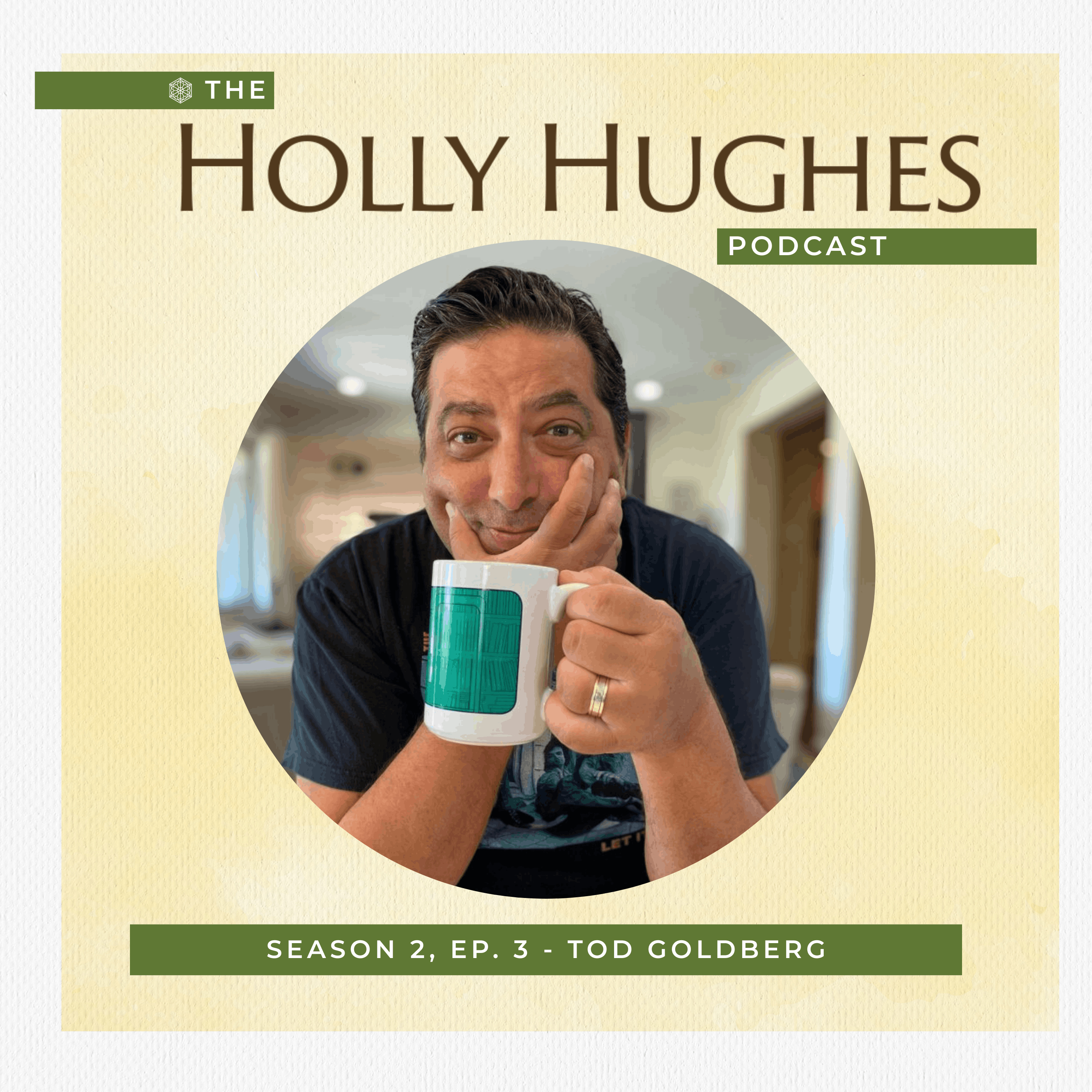
Today’s guest on The Holly Hughes Podcast is author and creative writing professor at the University of California Riverside, Tod Goldberg. Tod has appeared on the NY Times Bestseller list 16 times, and his novels (including the Gangsterland trilogy) have found widespread critical acclaim. Goldberg founded the Low Residency MFA program at California Riverside, and his writing students go on to become accomplished writers.
Tod joins Holly for a conversation about the path to becoming a professional writer, the need for critique partners when learning and using pain and vulnerability as fuel for creative growth. Tod also discusses the nature of the characters in his books, the impact of his youth on what he writes about and the balance of life and creativity.
Connect with Tod Goldberg online at todgoldberg.com.
Get your copy of Holly’s book, Real Not Perfect: How to Become Your Happy, Authentic Self.
Sign up for Holly’s email newsletter here.
Chapters
00:00 Introduction to Todd Goldberg
01:58 The Journey of Writing and Mentorship
06:04 Exploring Empathy in Writing
09:50 The Impact of Personal Experiences on Art
13:56 Cultural Connections and Identity
18:00 The Evolution of a Writer
21:55 Balancing Writing and Teaching
27:22 The Joy of Writing and Teaching
30:03 Navigating Personal Challenges and Writing Productivity
33:00 The Writing Process: Structure vs. Freedom
36:04 Finding the Right Critique Partners
38:51 The Value of an MFA Program
46:01 The Importance of Community in Writing
51:59 Exploring the Paranormal: Ouija Boards and Childhood Escapism
55:24 Childhood Fears and Mental Health
57:39 Writing About Bad People
01:00:21 The Nature of Hope and Reality
01:01:31 Personal Growth and Forgiveness
01:04:49 The Importance of Kindness in Writing Community
01:17:11 The Balance of Life and Creativity
0:10 So welcome to this episode of the Holly Hughes Podcast. Today, I'm really excited for a period of reasons to speak with Todd Goldberry. I even highlighted, look at that. That's your bio and your bio is way too fucking long to read. And I hate when people read BIOS. I had a Sherpa to read my bio. It's good, it's impressive. But like, for me, the summation is you're prolific, you're really good and you mentor other people. That's all I can think about. But I'm going to read some of it because it's it's well worth it. Todd Goldberg is a New York Times best selling author of 16 books. And of these books, many have been a finalist or won the Hammond Prize, the Southwest Book of the Year, The Strand Critics Award, International Thriller of the Year, and many more.
1:01 His short fiction and essays appear widely and have been honored with a selection in Best American Mystery, Suspense, and Best American Essays. Todd is a professor of Creative Writing at the University of California, Riverside, where he founded and directs the Low Residency MFA in Creative Writing and Writing for the Performing Arts Thank. You that all sounds correct, yeah. It does. I actually, like said it out loud before I'd say it out loud because like I had to cut out half the stuff. So people go look at toddgoldberg.com. He's really impressive. You didn't even touch on the modeling. You know, it's like all those years in Milan and it's just falling off of my bio. I know, you know, I reached out to a producer I worked with. He now runs a studio in LA, but he was also attached to Mad Men and the show that we worked on.
1:50 I'm not on the IMD credits, CB credits. I was like like none of my names are there. You don't exist. I don't. It's kind of fascinating how production has erased me, but that's I think it was like 2 names ago. It's fine. Slipped into a liminal space that doesn't acknowledge future romantic relationships. I think that's probably lucky with today's. Date. Yeah, well, yeah, you might be on to something. I. Might be on to something. So OK, I'd like to also tell everyone I Todd had the great pleasure ish of like teaching me how to write. I took your classes at UCLA extensions way back when. Over 20 years ago, I was a bait.
2:32 Like you should not have been listening to me. I didn't know what I was talking about. I was in my 30s still. Yeah, you were a baby. But like, my favorite, my favorite Todd quote of yours. First of all, I had taken Rob's class 1st and I thought I mentioned this with Sam Dunn. Rob, at the time he clicked his pen like like this, I was like motherfucker, like you need to stop, click like I make me. Crazy, yeah. I love him, but he was the first class I took and I was like, I don't, I don't. I don't know if I'm learning anything because I'm so distracted free, but he's brilliant. And he's also another mentor because like I got to meet him when he was with GAIL and the house and the Long Beach, the whole thing. Like he's got so he's got good talent. And I was terrible. Like I knew I wanted, I always had wanted to write, but I didn't write because my mom was like, how do you make a living? I'm like, I have no idea.
3:21 Obviously so. And even in college and journalism, they're like, maybe you want to get into lit. And they were so condescending about how they said that, that I was like, but I did realize at like 28, whatever, however old I was, like, I do want to learn how to write. So I'm going to try UCLA extensions. I did not know the pool of people. Obviously that would be in the room, right? I also didn't know how bad I'd suck. Like, I was so bad. So you are a teacher now. You created this MFA program. One of your first comments to me was it was about the big bad. I wrote about the Big Bad wolf getting out of jail early for the. Right. I remember this, yeah.
4:02 Which isn't your cup of tea. It's not really like your kind of genre, right? Which is like a hot button I want to talk about too. But you were like, see this sentence. This sentence is good. Make the rest like that one. And I was like, Ouch. That sounds like something I'd say. I know, but you were right. But you were, you know. It's a, it's a funny thing, like, you know, having run an MFA program for almost 20 years now, I founded the one at UCR in 2008, but I'd been directing the other program there for previous years, so it's been a while. What I found is I, you know, I, I don't read a ton of romance, for instance, like for pleasure or I don't read a ton of hard fantasy for pleasure, but I know what's good and I know like I can see talent outside of my, my entertainment preferences. And I think that's the thing that really separates really good teachers from not so good teachers is I've never, I've never looked at something and been like, well, I don't read that.
5:03 So there's no way I can help you. I can help you because writing is writing. Like it can take place on the moon. It can take place in a, in a diner. It can be aliens, it can be humans, it doesn't matter. It can be talking dogs. It shouldn't be, but it can be talking dogs and the rules are the same. Like you, you have to have the innate ability to convey empathy. You have to be able to replicate human life in an entertaining fashion. You have to create suspense or romance or whatever it might be. And that I think that's like one of those things that if you don't know it, you're never going to know it as a teacher, but also as a writer. Like you can't teach someone empathy. Yeah, I love that you're using that word because out of all the the 25,000 like post its I have in front of me of everything I want to tie together with you is like you were empathy and loyalty as a human, right?
5:53 You are. You are both things you are when you're super snarky at the same time and in your characters you have that as well, right? Like while reading your newest work, which I devoured, like, I think my family was a little worried. They're like, what are you doing? Like leave me alone. I have to finish this. I have to read about Todd's troubled people. Well, well, I like it because in your essays, like I'm, I really want to tie together. Wait, I really want to do this purposefully. I really want to tie together. Only way Out, which is your book that's coming out in December and your essay Let them bleed because like whatever my issues in life might be minor daddy right my your paragraph on your mother in that essay about her cruelty and waiting for her to die for 39 years.
6:42 I'm I don't understand how someone's so mean to his own children can still be living. Like that's literally a thought I have so to like to share that. And yet you are so kind and loyal to the people around you. And I find that ability to do be both things fascinating. Well, I think, you know, growing up with bad parents makes you intimate with your own vulnerable own own vulnerability. And if I didn't have good siblings who I love and who really took care of me, I was a baby. I'm still the baby of the family. Doesn't matter how old I am, I'm still the baby and I'm treated as such. Having those siblings in my life that cared for me deeply and really imbued with in me the sense that, hey, this is going to end.
7:32 You know, you're going to leave and you're not going to have to stay in this place forever with with mom or in these emotions. That was really important. You know, my brother Lee is 9 years older than me. My sister Karen is 7 years older than me, and my sister Linda's only two years. So my brother Lee and my sister Karen graduate high school. I went to college, left town when I was still just a, you know, just a kid, you know, just a, you know, a nine year old. And so to have them as sort of my de facto parents essentially, I think gave me ability later in life to look at the situation with my mom and also with my dad to somewhat lesser extent because he wasn't in our lives. And at this point, you know, I'm 54 years old to be able to look at them and realize, like, hey, they should not have been married to each other.
8:19 They should not have had children. They should not have been parents. But my mom was, you know, undiagnosed bipolar for most of her life. My dad was a sociopath. And here I am. I made it. And I have a lot more understanding of who my mom was now. Single mom raising 4 bad kids. Bad being that they were all super expressive published writers like I would have. I would have been a little angry too all the time. I. Get that? You know, and so the when I wrote that essay, when they let them bleed, I've been trying to write that essay for a long, long time.
9:03 It came out in a magazine 2013 and then was invest in American that that next year. You know, I tried to write that essay about it's. So for the listeners, you can find this essay on my on my website. It's an essay about really, it's about seeing my mother die, but it's also an essay about all the times I had been party to death in strange ways as a kid growing up and how it affected me. But most specifically in witnessing a boxer named Duke Ku Kim get killed in the ring when it was very, very young. And I, it wasn't like I was the only one that saw it. It was on television at like 10:00 AM on ABC. And how for so many years I had essentially what would probably be PTSD from seeing this guy get killed and.
9:52 Which didn't exist back in the day. It was like tough enough watch. Things in 1980 or whatever and how it wasn't really until I saw my mother die in front of me that that moment was finally eclipsed in my mind as like the most damaging thing I'd seen. But the actual result of writing that essay and having it be in that best American and and now it's taught, you know, in schools around the world is talking about it has divided it talking about the relationship I had with my mother and the relationship I had with these experiences with people who have gone through similar things. I get emails about that essay every week.
10:33 I was reading that. I was like, that's amazing. You respond to them or you just like sticking in a file that's. No, I always, I always respond to them because it's people that are writing to me because they finally figured out that they aren't alone in the experience that they've had. And like that's what we do as artists. Like we, we're sharing, we're sharing experiences and to share that story with people, you know, talking about the worst day of a person's life, generally seeing their mother die and having it be something that someone else can get comfort in is really important. And I think about something my friend Emily Rapp once said, you know, she wrote a book about her son dying of Tay Sachs, the Still Point of the Turning World, which is an amazing book. And I remember she was on the Today Show being interviewed by Savannah Guthrie.
11:17 And Savannah Guthrie was sobbing the entire time that she interviewed Emily. And Emily was like, she was present and she was there, and she was receiving Savannah Guthrie's reciprocal grief. And I asked her, like, what is it like to constantly have to talk about the worst thing that ever happened to you? And she's like, it actually allows me to be more present with it, to understand that there's an existence beyond that moment. And it is these moments. And that really helped me, like, to understand, like, why sometimes writing about traumatic experiences can be important. And of course, the weird thing is, you know, I write these crime novels that are not like that essay or about many of the essays that I write. And my, you know, the people that read these crime novels stumble on these essays and they're like, oh, I didn't realize that you had a rich inner life. Yeah.
12:10 I'm. I contain multitudes. I saw. I yeah, you are multi layered. I don't know. I saw a lot of parallels I think also. So I'm obsessed with Korea. This is an obsession you probably don't know about, but it is real. For me, it kind of like learning about Korea got me through COVID. I learned it was like a history I didn't know. I felt a. Lot of people at sourdough bread and you had Korea. I had Korea and now I've been twice and I wanna go back again. If I could live there for a while, I would. South. We're talking South. Obviously South Korea, obviously, but you sort of. Wanted to be a despot also and so in the North Korea. No, no, I don't have. I have enough trauma like when I hear you talk about and when I read that as day, I read it multiple times because it hit different levels because I have, you know, my own daddy issues, which is like what I always had in the back of my my head.
13:04 Like, when he does finally pass away, then I'll start writing that memoir about like that dynamic. But that's not what happened. I was speaking with a memoirist last week. She's 83 and she's amazing. Judy, another Goldman, a gold, a Goldman instead of whatever. So Goldberg. So she was like Holly, it's about home for you and home is a hot button in my own life because I lost it to fire, earthquake, divorce. It wasn't safe because his addiction like all of the things. So where yours is mom, mine is dad and I, I, I know the fear of becoming him, right? It's, it's massive. Like I didn't drink for like a year when I was young because I was like, am I an alcoholic?
13:44 Like is, is this what an alcoholic is? And I was like, Nah, I could just not drink and it's not a problem. But there's something about like Korea that when I visited, I say this often like I have no business feeling so comfortable there. I am keep trying to learn the language. I found out I'm dyslexic trying to learn the language literally like I'm like, how many coping mechanisms do I have? The amount of reading and writing that I do that I've figured out how dyslexic I am trying to learn a different language. Yeah, that's crazy. I also blame it on their letter yoke, which is looks like a rage, but sounds like, which is in that guy's name, which is Kim Doku, Right. When I was like, when I saw your romanization, I was like, that's not that's not right.
14:26 Whoever did that first romanization, it's like, whatever. But I feel home there. A stranger in a strange land. I don't know what that is to or if that is about how we connect or not connect. When we do have that brokenness or broken connection that allows us to be creative. I think once in a site class, like way back in 1987, someone was like every famous person has a tragic childhood. I was, like, fascinating. Probably right. I mean, look, you got to be intimate with like pain if you're going to be even if you're just an actor who has to be like a method actor, you know, if you've never experienced pain, then how do you know how to even fake it? You know, how do you model that behavior? I mean, great actors are capable of doing things, you know, that they've not experienced, of course. But I think particularly as a writer like yourself, you know, it's easy, I think when you've gone through some stuff to put yourself in other people's shoes, irrespective of the experience that they've had.
15:32 And so, you know, when I was writing about the boxer dying and looking back over the course of my life and in my mind, he had been, you know, this man because he was boxing for the, for a title, You know, he was, he was 22 or whatever. It's like had no one is an adult at 22. They, there's a reason they don't let you rent cars until you're 25. Like you should not be allowed to do. You probably shouldn't be allowed to vote until you're 30. I kind of really. I'm not going to lie, especially nowadays, I've seen a lot of these kids and like, oh boy. Yeah, I don't. Yeah, I've, I'm beginning to think more and more, maybe 50, maybe 50, but, you know, being able to identify with other people even though you've never walked in their shoes.
16:15 Like, that's why we're artists. That that's why, you know, someone can look at a piece of rock and carve out David from it, right? Because they they can imagine what something can be without ever having the proof that it could be. So how do you mentor that? Now write. The one down write that was a good line. Well, we'll have it on. We'll have it on thing. I'm kind of curious like so I get like I said, you were like this sentence sucks. Be better. I and then I actually came back. You also turn me on to Amy Bender. You turn me on to Sam, Don and Rachel, like all these other people who you thought could help and help me learn. I'm like, so I know I was terrible then I don't like, you know, not every whatever. I was definitely learning and wanting how. How old were you when you were in those classes? You were younger than me.
16:57 I was, Yeah. No, I'm older than you. I'm older than you. I'm 54 and you're you're. Only 56. So we were the same age. Yeah. Yeah, essentially. So you were in my class. I was like, this was like 2002 or something. And so I was like 31 years old, and you were 32 or 33, whatever it might be. So we were basically kids teaching kids about this thing. You know, I'd published by that point. I'd published two or three books. I know you hated Living Dead Girl. Afterward you're like, don't read it. I'm like, of course I'm going to read it. Of course I have. It was just so. Sad. But I've really come to appreciate that book actually over the years, because it's such, you know, I've been really lucky.
17:38 Every book I've written has stayed in print, you know, so my first book came out 25 years ago and you can still buy it, which is crazy. And Living Dead Girl, a book that came out in 2002, people still buy it and read it and want to talk to me about it. And I, I barely remember the plot of it or who did the bad things. Like if I can have a vague sense of it. Is it the spinning top at the end of What's That Movie With? Yeah, of inception or whatever. Yeah, that's it. But at the time, you know, I felt like, it's so sad. I don't want to put anyone else through what I was going through when I wrote that book, you know, and but I recognize now like, oh, that's a really good sort of picture of me as a, as a man, but also as a writer trying to figure out who I was and what I wanted to be. And you know, what I felt about things. I mean, there's so much buried personal stuff in that book itself of stuff that I was going through that's hard for me to look at it objectively because it's so filled with like, you know, all the stuff that I would later spend several years in therapy for and.
18:44 So well worth, well worth it. Several years ago, Soho Press put out a new edition of it. And they asked me to like if I wanted to update it, you know, go through it. And I was like, oh, and I read it again and I was like, there's like 5 sentences I cleaned up. There's a typo I fixed, but reading it with sort of the eyes of a person didn't really remember it. I was like, oh, this is a pretty good book. We lived in bed with a third act in it, but this is it earned the awards it lost. Here's because when I asked you about it back in the day at like one of your other book signings, you were just full of wisdom. Like I am like my brain is just going to all these quotes that I remember of yours and I can't remember why I go to my room sometimes. But like the quote is like you were you were like, no writer likes their first book that's published. And I didn't really understand.
19:35 I was like, but it's such an accomplishment, right? Like you did a dream and it was a dream and I didn't even know that I could write that many pages, right. So for me as a contemporary, someone my age, you actually lived your dream from the beginning. You're like, I need to go to be a writer and look at this shit. I'm a writer. That to me was, Oh my God, it can be done. It when I think about it, it seems crazy to me because my first book came out, I was 29 years old. So I sold it when I was 27 years old. And that seems crazy, you know, and looking back over the course of my creative life and now, of course, for all these years, having, you know, directed the lives of writers, including yourself, like to think that I knew anything when I was 27 years old that was worth being read by a living soul. I think you're.
20:26 Being too modest and I don't know his version of you at all, I just. Well, I mean, so it's just something that I've sort of when I, when I look back, I mean, as you can see, like there's framed photos behind me of a bunch of my books. Frankly, the wall's not big enough for all of them. And so somewhere back there, oh, it's right there is my first book. And sometimes I look at it and I was like, I don't even, I don't have any memory of writing it. Like I don't remember actually sitting down and typing that book. But what I do remember is that sense that everything was right in front of me, that if I did just this one thing right, if I, if I could write a book that people wanted to read, that it was going to open the doors for me to tell the kinds of stories that I wanted to tell for the rest of my life.
21:17 And like that was really weighty at at 272829 years old, like to recognize, hey, you know what, your future's here, what are you going to do? And The funny thing is, like, I think about it in relationship sometimes to athletes who, you know, a professional athlete, they get their dreams achieved typically by the time they're 22, you know, they're coming out of college or something. But athletes and artists like singers. There's a big thing about your 27th year like. Saturn return, baby. That's some woo stuff. It's Saturn return. Baseball players, football players, musicians, writers, they seem to like at 27 is when the shit comes together and they're finally able to do it and, and then replicate that over for the rest of their life. And so I look at that book and I'm like, oh, you know what? Like, I was 27 when I started to write that book, and like that taught me how to be a professional for the rest of my life.
22:14 And so I have a real deep appreciation for that experience, even if I don't quite remember it. No, I'm like really curious about your process because again, you are insanely prolific and you're running a program and you have literary, you have so many things like you're, you're not lazy by any means, right? Like, you're not the kind of person who like mulls. Like like when you were talking about, oh, do I rewrite a book? I did. I'm like, I have a book that I wrote forever ago. Got my agent the all that stuff. And I did the edit she wanted. And then we parted ways. And then I reread the book and I hated it. It wasn't my book anymore. So that was like an interesting experience.
22:55 I have very distinct memories of when I could tell when you love someone's writing and you had a favorite in the class and Anjali, Alex and I would all be like looking at each other in the room, be like, Oh, that's Todd's favorite this time. But like there would be a light and you were you would be like, I would I would turn him on to my agent, which is like huge, right? That's not like something especially I think people in LA do right when I left LA, people are like, oh, you just want to meet him. He's my friend. It was very kind of different than the vibe there. But you are a professional, you do it and you're mentoring. So like I don't know how you balance all of that. Like I when I'm researching, it's like, I don't know how you go from like researching to reading other people's work to running a program.
23:42 Like do you have dedicated days? Do you have ideas that just like fly out of your head all day long? You're just having to catch them with like tape or something? Like how does? That work, you know, it's funny. So I typically have a new book every 18 months now. So you write crime fiction, there's an expectation you're going to have a book every 18 months or so. There's, there's been periods where it's been a little longer, like I was working on ATV show that didn't end up getting shot, but I spent, you know, a year and a half writing scripts and working on the show and didn't write books for that year. But like as a professional writer, unlike in genre fiction, where or not genre fiction, literary fiction, or it could be 3-4, five years in between books and it's fine.
24:24 Genre fiction readers, they want you every 18 months. You know, a writer like Michael Connolly, for instance, or my brother, they'll do two or three books a year. But that's also their main source of income is, you know, from the books. I had always wanted to be a professor. Always. Had always wanted to do that. Yeah, always. No. Always. How did I not know that? It was, I mean, look, to have an audience staring at you, listening to every word you say with a personality like mine, like he was either do stand up comedy or be a professor. And I want people to know it's smart. Obviously, professor, it is. Because I was so when I was a kid, I had profound dyslexia.
25:07 Profound. Like I thought my name was dot for most of my life. Did you not know this? I did not know this. No really. Like I figured I was dyslexia because I couldn't see space between letters and I didn't see words anymore. I saw them as shapes, just the outline. Well, and that's, that was sort of how I was when I was very young, but I was, I was profoundly dyslexic. I was told that I wouldn't read or write above a fourth grade level. And which I can, I, I can be in that moment instantly like saying it. And I'm sitting there and I can smell the spearmint gum on the eye doctor's breath and my mom behind him and him saying that to my mom. And my mom, for all of her faults, she was a writer. And she was like, you can't say that about my son. You can't say that.
25:50 Like, we read and we write in this family. He's going to read and he's going to write. And so this is when we were still living in the Bay Area and she had me in all these special classes at like, Stanford and Berkeley with what I presume that must have been masters students where I got trained out of the dyslexia. By the time I was 11, I could read, but I couldn't read up until about 10. And so I was in all these special classes and they didn't know what to do with kids with dyslexia in 1979. No, I know that's what I'm saying. Like when I learned I was dyslexic and I was told like I was told that if you were dyslexic you couldn't read. I was like but I can read so that just means I'm not. Yeah, they didn't know what to do back then. And so I was in all these classes with, with kids, with, you know, with profound disabilities. And so I thought I was, I thought I had a profound disability.
26:37 And I also was treated like that by other second graders or whatever. And so I really had a chip on my shoulder from a very young age to let people know like, hey, you thought I was dumb. I'm not dumb. You thought I couldn't read. I can read. You thought I couldn't write. I'm going to write and I'm going to show you and to have wonderful teachers along the way that really edified that in me, gave me a strong, strong desire to be a professor. And so by the time you and I met, you know, I'd been teaching at UCLA for a couple years at that point. And it was only a couple years after that that I started working at UC Riverside. And then a couple years after that that I started my own Graduate School. But they're, they're related dreams. I couldn't be in this position if I didn't write books. If I didn't write books, I think I'd be a, a, an angry professor. But I, I, I really come to teaching with a lot of joy. I love it, You know, it's, it's, it's a dream come true for me. And so I'm able to compartmentalize my days pretty well, You know, when I'm working on a book or a script or an essay or whatever, typically right in the morning. So I you know, I used to write it in the middle of night, but. I remembered that part, yeah.
27:46 I can't do that anymore or. Too old for that, right? Too old and there's too much good TV. So, you know, I'll write from, from, you know, 10 until 4:00 and then, you know, from 4:00 until 6:00. I'll handle the business of the university unless I've got a zoom or some other meeting of the day. But I'm really good about saying, all right, I'm going to put in my 8 hours and I'm going to compartmentalize it and I'm only going to do X thing of X time. And what that allows me to do as a writer is I don't, I don't putz around like when I'm, when I'm going to write, I'm going to write. That doesn't mean I don't have the anxiety. I I totally still have the anxiety, but it means that when I sit down to do it, I actually fill up the page. Whether or not it's any good, you know, who knows? But I have a really like, I have a pretty sure method now, which is that I write and rewrite every single day. So I start the day by rewriting what I wrote the previous day, going over those 5 or 10 pages or two pages or whatever it might be, and then going forward. And I always stop when I'm hot so that I'm not. I don't stop when I'm petering out and I can't figure out what to do.
28:52 Like I'll stop in the middle of a sentence Even so that when I pick up the next day I'm in the middle of a sentence. That gives me anxiety. I know, I know, it's probably not the perfect way to do. Things No, no, I love it. That's a great. I think that's an amazing tip actually. Like stopping in the middle of the sentence cuz then you're like. Yeah, cuz I'm like, I'm eager to get back. And so it really becomes sort of a, a form of muscle memory for me now. And I sit down and say, all right, I'm going to rewrite. That's going to take me probably 2 hours to go through these pages and, and telling myself you're only going to look at what you wrote yesterday. Not because the the curse of the beginning writer is you write rewrite page one every day of your life. And so when I finally do do it, like sort of larger editorial rewrite of myself before it gets to my agent or my editor or whatever, it's not triage, you know, it's just sort of taking out stitches. But that, you know, that sort of compartmentalization has allowed me to be prolific, but also like when when I have to be, when I have to work outside of the guidelines to give myself, I can also really turn it on.
29:56 So last year, my wife Wendy had cancer, and I had a book under contract. And, like, you know, it's impossible to write funny, dark, weird stuff when you're sitting at the infusion center all day and when, you know, you're trying to be the person who's not losing their shit every single day. And so Wendy finally got her clean bill of health, was out of chemo and radiation like in October of last year. And my book was due in December. And I had like, I'd written like, you know, 100 pages or something, 100 good pages. And Wendy was clean on October 30th. And I said, all right, well, I got to finish this book. And so I said two months, like let's go. And I wrote that book in two months. I wrote another 100,000 words in two months. But I have so much pent up, you know, from the fear and the anxiety and the worry and all that stuff. When I was released of that and could just write, it was just like, and so by the time December had come along, I had written, you know, 450 pages of a book, 350 of which did not exist when I, you know, on October 30th. And then I was able to go back and cut and rewrite and do all that stuff.
31:22 And that's, you know, that's the book that you read the other day that's coming out. In I devoured it. I didn't read it, I I sucked it up. I have written all my favorite lines down because like some of them are just and my name is in it so. I felt so. That's true. Your name is in it. It's like, oh, I'm somewhere in his subconscious. That or another tart name, Holly, but fine, it's fine. So, you know, the, the, the reality is like as a, as a professional, sometimes you just gotta like, say, all right, well, I know how to do this. I'm just gonna fucking do it. I'm just gonna go outside of the sort of the system of writing that you've created for yourself in the past. So thank you for talking about Wendy. I didn't know if we were going to go there or not because that was a lot.
32:03 And that was one of those things I'm like, does he know me well enough? Do I say something? Do I not say something? Like while it was all happening, I was like, very with my own dramas, I was like, maybe I'll just be quiet. Like I'll just be quiet and I'll watch from here. And then I'll just be happy that she rang the bell 3. Times no one's ever upset to find out someone's thinking. About it, OK, that is true. Unless you're thinking of killing them. Right, that is that is very true. Anyway, I was watching that and I I'm in that situation. So and I was very envious of your healthcare, but that's like a whole other conversation. Let's we're not going there. We're so not going there. The benefit of. Being a professor at the University of California is. You get good healthcare. Yeah, so do. You have like is it your process the whole time?
32:46 Like are you I'm assuming structured and you write linear because I am the most non linear like I'll have a beat outline, but some days I can't go like emotionally to the space I need to go for a chapter. So I'll run and hide over here or I'll write multiple things so I'll have an essay going while I'm working like so I can just hide for the most part I. Write pretty linearly, but that doesn't mean I write everything at the same time, you know, so like I'll, I'll get 100 pages into something I realize, oh, I need another chapter here. I need another chapter here. Chapter 5 is really chapter 2. Chapter 2 should probably not exist. So, you know, I, I really allow myself the freedom to minority report stuff, you know, really just move stuff around and, and, and rewrite and not, and not feel too precious about stuff.
33:32 I have the benefit of having a great editor for many years for the, the series of books, the gangsterland books that I wrote in the short story collection, the Low Desert, Dan Spatenka at Counterpoint Press, who, you know, really encourages me to write big. And then the two of us can figure out, you know, where, where the good stuff is. I was going to ask you about that. What? What's that? What that has done for me is it's giving me the freedom to not be concerned that I'm going to fuck it up, that we're going to find it together. But then like the last book that I wrote, he's not the editor. This was sort of a one off book with a, with a different publisher. And I had to sort of apply Dan's edicts to myself.
34:14 And really, you know, question like, OK, can I edit myself the way that Dan has edited me in the past so that when I turn this book in, the readers aren't going to notice that it reads any differently because there's a different editor or whatever. But more importantly, that it's the best of me because what those four books I wrote for Counterpoint, and I'm writing another book for Counterpoint right now. What those four books did at Counterpoint is it changed the course of my career because for the first time in my life, I'd really had sort of a profound editorial experience. And it frankly raised me. It raised me as a writer, but it raised my profile, as you know, sales wise, yeah. And awards and all that stuff actually give to that series.
34:55 To people as gifts, I just give them the whole series. It's the perfect. Holiday gift it is though, everyone. Gangsterling and like gun toting Rabbi, come on, it's it's the perfect. Thing so you know, I I don't typically write fiction and non fiction at the same time. I used to do a lot of book criticism and I don't as much anymore because I just don't have the time. But I do write sort of usually two or three big essays for magazines every year. So I have a have an essay that's coming out in Ulta shortly after this airs about my own writing mentor, a man named Tom Fyler, and my relationship with him and sort of these strange things that he had saddled with saddled me with as a as a younger person. And this is an essay.
35:45 It's like 4000 words I wrote for Ulta, but I wrote it over the course of an entire year. So I with my nonfiction, it's a whole different process. It's typically something I write a paragraph at a time or a page at a time or a line at a time, because I think dissecting your own life requires a different skill set than creating fictional lives on the page. I love so part of like why I. Started this podcast is like what about the creative people who are intermediate or advanced, but not like making a living or like like, because there's lots of us right? Like I sold a bunch of essays. I I was on a roll with it for a couple years. I was making 100 bucks an essay. Like you're not making whatever to go to. Go back to your other question, like how? To find a peer group, it really, you know, the nice thing about the Internet is it has opened opportunities that wherever you are, there's someone who has the, that shared affinity that lives somewhere.
36:39 And so there's so many, you know, good online programs now that you could join just to get some friends and to start doing stuff. So like where, where you and I were, UCLA extension, it's primarily online now. You know, there's, most of their classes are online. I, I, I think it's probably 70% online. So a place like the UCLA extension riders program or the new school or Stanford or Berkeley, a lot of major universities have extension riding programs. And so at least what you can do is find some people online that you're going to be friendly with. Or, you know, there's so many of these critique groups you can find on, you know, Facebook or whatever, or Reddit that are good. But the hard thing is, is like being bold enough to go out there and look for it, being willing to pay for it sometimes I think is a challenge.
37:29 And like if like by nature, if you want to be a writer, doesn't mean typically that you're loaded. You know, going to writers conferences, I think is a crapshoot. Most of those are just money grabs by the people throwing the conferences. So like your, your best bet, I think typically is those sort of classes that you can find locally, even at, at a local Community College. There's going to be creative writing classes that you can take where you can find other people, but you know, you just need that one other person that's cool and that is smarter than you, that can read your work and is is willing to talk to you about it. But online has created that ability to have that community. There's so many good places that are out there, but you know, I there's also so many scams out there.
38:16 There's so many predators that feast on riders I think about. I don't you were already gone from LA when there was this writer named Anna March that was operating out here. Did did you hear about her? I don't remember her. So I think he had already moved. To Colorado by that point. That's where you were. I did. Oh, no. Oh, that's so funny. That was the starter. Marriage, divorce. Yeah. So I was in Colorado for two years, and then I came back to LA Yeah. So this woman, Anna. March, like she had published like a couple essays. She had been in Modern Love in the New York Times and she moved to LA and like, she sort of anointed herself like the non fiction guru, I can get you into modern love. And she threw a party.
38:57 I remember this very vividly. She threw a party at like the Roosevelt Hotel in LA with free alcohol. And she invited like every writer in Southern California to come to this. And so every writer's like free alcohol. I'll go. And as soon as I met her, I saw exactly what she was. I was like, I know who you are. I know who you are. And she started, like, getting all these people wrapped up in her circle. And she would have these, like, writers conferences in Italy, and then everyone would fly out to Italy and she wouldn't be there. She's like, oh, I got sick or whatever. And so like, the whisper network started, like, there's something wrong with this person. I was like, well, yeah, she's a grifter. Like I I sense that immediately.
39:46 She then got Anne Frank's Auschwitz number tattooed on her arm. Shut up. Yeah. Because. She imagined herself as if Anne Frank had grown up, that she would have been Anne Frank's daughter. Like this was part of the story, the mythology that she was telling about herself. And she started a magazine, all this stuff, and she would reach out to me all the time and I would ignore her completely because I saw exactly what she is. And finally, like, she had scammed enough people with this Italy thing that people started looking into her. And of course, it turned out that she was this profound grifter with like 30 different names who'd gone around the country defrauding NPR stations.
40:32 Like she would go into an NPR station and set up their, their pledge Dr. and steal all the money. And, you know, it'd be such a small, you know, amount of money for like, you know, Bozeman, NPR, she stole $9000 and something, but it accumulated. And finally when she got to LA and she was pulling this grift in LA, people start getting wise. And the LA Times wrote this giant expose on her and she just went poof. But she's, she's just one of those grifters who like, like got caught and actually stopped. There's so many grifters that are out there that continue to do it. So, you know, I, I encourage writers to actually do a thing that you might not think I would encourage them to do, which is reach out to an author and say, do you know of any critique groups that like that? You are like happy about it or, or editors that you think someone should work with because I've always got access to folks and I'm always telling them, hey, you need an editor, talk to Gina Frangello.
41:29 You know, you need a class. Take this class at UCLA Extension, whatever it might be. And you know, not every author's going to respond, but nice ones will say, hey, you know what? Oh, do you live in my same town? Cal State Fullerton's got a thing. Or, you know, whatever it might be. But like, you can't write in a vacuum anymore. You need to have that other person that looks at your work. That's true, and you know it. It's a funny thing, you know, I write about bad people. You do like That's my. Job but I like. Them. I like your bad people. How do you do that? But try to write about. Bad people that are trying to be good ish, you know, often times good ish better. And I think a lot of that comes from like recognizing as a young person, like, oh, this person's not great, but they they don't know that they think they're good. They think they're good.
42:16 They're the hero of their own story. And so I think I often times write about bad people who think that they're good or think that they are the arbiter of morality or whatever it might be, because it also creates a wild card. Like, you know, if someone believes that they're good and they're objectively horrible, they'll do anything on the page. And for me, that's, that's the fun thing to write. That's the fun thing to read about your work, you. Evoke sympathy of with these people. Bad people, yes. I don't. Know how you do that? They do, and you're unflinching. With it, you're like, no, they're bad. I'm not even going to show you where they're really good. Oh, this one I'll all right. I won't let you bleed to death. I don't want to give anything away, right? I won't let you bleed to death 15 years later.
42:57 What? What did he just do to me? He didn't even finish or wait. I have like 3 favorite quotes in your book and I really want to like go there. I love that. The opinion on Oprah in your book, your newest book, Like I laughed so loud when I read that. I also loved about punching the poet, which was like, because time in proximity. Yeah, that was like the best. And then. And then for the emotional part, my favorite line of Rodney's is missing is dead. This is truth. But truth and hope, they don't, they don't match so good because that's like so much of my adult life, right? Like the truth and the reality of something in relationships that they're not always the same, which is why I actually don't like hope too much. I think hope is shit.
43:43 You know I. Have a friend, Michael Scott Moore, who was abducted by Somali pirates and wrote a book about it. A very good book and kind of famous. Yeah, and then he was also. I just saw a documentary about it too. But I, he came to the Miami Fair program and just spoke and we were sitting in my room drinking and I was like, like, how did you, how did you survive it? And he said, I gave up hope. And I was like, it's like, if you if you wake up every morning thinking you're about to be saved, every day is going to be the worst day of your life. And that, that like him saying that has really resonated with me over all of these years.
44:29 You know, just to like as a as a notion of character and a notion of, you know, what I sort of knew intuitively about how people are. It's like, hope might be that thing with feathers, but it's also the thing that, you know, that can lead to delusion, you know. Oh, I hope I'm the queen of the planet. I hope that's true. Yeah, I ain't talking about. Joan of Arc with my like my woo. Woo thing like, you know. I'm like way out there, but I'm strangely grounded and like I don't like bullshit and I absolutely hate liars. Like those are like my, I did a ChatGPT and I asked it to give me a bio and it was hysterical because another guest had done that. And I was like, oh, you know, it was the warning label, which I'm about to ask you. It was like in my ChatGPT, she's like hates liars.
45:10 If you're full of bullshit, leave. I was like, I don't sound soft and fuzzy at all and I am slightly woo woo, but I just, I don't, I think because I lived in hope. I hoped my dad would love me more. I hoped he would pay attention to his own family. I hoped that his love would stop being so painful or cruel. And that got me nowhere. So I'm I'm not about hope. I had this strange practicality to it. Like the only thing that's going to change is you and your outlook and that you can control hope you can. So, all right, so Todd, thank you for talking to me. There's 7,000,000 questions. I have more, but now that I know your door's open, I'll just knock. But if you came with a warning label now in your mid 50s, awesome. Welcome to the what would it be? Gosh, my own warning.
45:53 Label forgives but doesn't forget I'm the same or acts on retribution. Say that again. You laughed out of it. Acts on retribution. I don't, I don't know. I mean, I, I think I know that I'm not everybody's cup of tea. What? You're wrong. I know that I know that I have. A tendency sometimes to say exactly what I think and that that can be bracing to some people and it can be offensive to some people. All right, Well, thanks everyone for. Listening to the Holly Hughes podcast, I hope you go write something today or make yourself a next.