Oscar Producer Left It All to Film a War | Bob Dogus
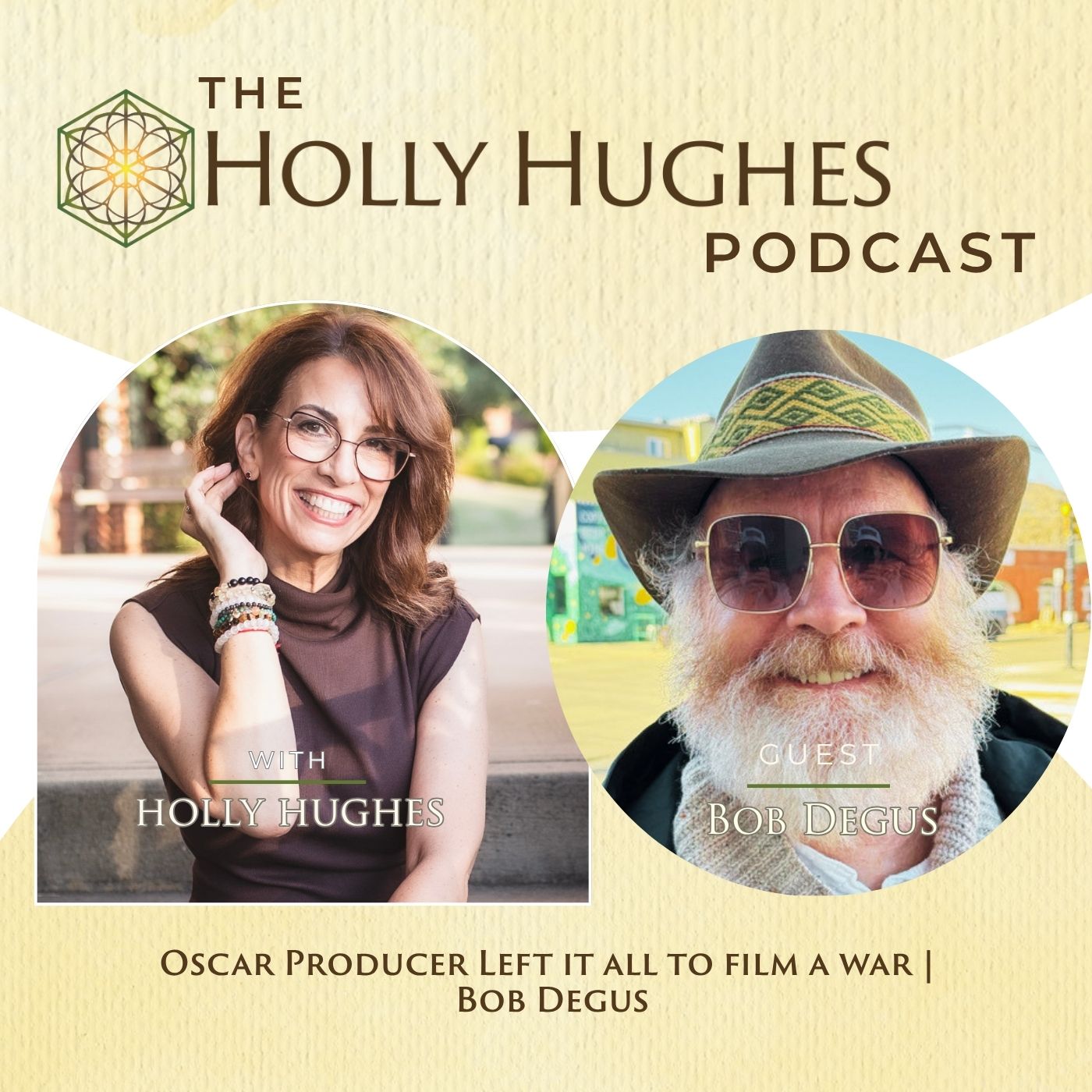


Hollywood burnout and spiritual awakening don't happen overnight, and no one knows that better than Bob Degus.
After more than a decade producing Oscar-nominated films and overseeing blockbusters at New Line Cinema, Bob hit a wall that no amount of money or credits could fix. If you've ever wondered whether the life you built is actually the life you want, this episode will shake something loose in you.
Holly Hughes, TEDx speaker, intuitive healer, and author of Real, Not Perfect, sits down with her former mentor for an honest conversation about what happens after the dream you chased turns into something you barely recognize.
Bob shares how nearly 100 nights of ayahuasca, a spontaneous trip into a war zone, and 35 hours of interviews with Ukrainian yoga teachers led to his most meaningful work yet: Yogis of Ukraine, a documentary and companion book now available on Amazon in six languages.
What you’ll learn in this episode:
-
Why Hollywood burnout often has roots in childhood trauma, and how Bob connected his tolerance for chaos on set to the household he grew up in
-
How Bob went from saying no to Ukraine to boarding a plane three days later, and what that moment taught him about following an inner voice
-
The story structure principle Bob used on Pleasantville that still shapes every project he makes: start with the ending to build a powerful arc
-
What happened when Bob sat in ayahuasca ceremonies nearly 100 times in Peru, and the single moment of self-compassion that ended the entire journey
-
How Ukrainian women practicing Kundalini yoga in bomb shelters and on military bases became the subject of a documentary that leaves audiences talking for two hours after the screening
-
Why Bob conducts film interviews in languages he doesn't speak, and what that forced him to rely on instead of words
-
The "surrender" moment Bob experienced in a Kyiv hotel during an air raid siren, and how it mirrors what the women of Ukraine live with every single day
We talk about:
00:00 How Holly and Bob met working on low-budget Hollywood productions
04:00 What Hollywood in the 1990s actually felt like from the inside
07:00 Why friendships evaporate the moment you stop being able to hire people
09:00 Did working on Pleasantville feel different from other films?
11:00 What made Bob walk away from producing and start over
16:00 How your Hollywood training prepares you for everything that comes after it
17:00 How did a two-day phone call turn into a trip to a Ukrainian war zone?
20:00 What it feels like to interview women when you don't speak their language
24:00 The subtitle editing challenge: feeling sentence endings you cannot hear
26:00 Yogis of Ukraine: test screenings, the book, and the World Peace Tour plan
30:00 Why Bob said yes to ayahuasca and what nearly 100 nights in Peru revealed
33:00 How Bob found Laia and chose which 35 women to interview from 250
35:00 What a Ukrainian yogi said that stopped Bob from trying to rescue anyone
40:00 The Kyiv hotel air raid siren and the moment surrender became real
44:00 Theatrical release plans and where to find the book right now
47:00 Bob's warning label: a bike accident, a brain injury, and a flat face that fooled everyone
Connect with Bob
-
Instagram: https://www.instagram.com/bobdegus/
-
LinkedIn: https://www.linkedin.com/in/bobdegus/
-
Website: https://www.bobdegus.com/
Connect with Holly
-
Instagram: https://www.instagram.com/holly_hughes_intuitive/
-
Get Holly’s book here: https://hollyhughesintuitive.com/my-book/
-
Website: https://hollyhughesintuitive.com/
0:10 So welcome to this episode of the Holly Hughes Podcast. I am exceedingly excited and slightly sweating, honestly, to interview today's guest, who is Bob Degas, who is a director, a producer, A screenwriter. He was one of my mentors way back in the day. So I feel like I'm 23 again. It's what I told him before we started recording. He makes home in New York, in LA, in Colorado. I get it right. And one of my favorite things about his own bio on his website is he followed the yellow brick road of those old Kodak yellow orange boxes from New York to LA to make his dream come true. And today we're going to explore what that kind of dream actually is and what it became.
0:54 So thank you for coming today, Bob. Yeah, I'm excited to be here. It's like a old reunion from from a long time ago, so. It's great. Whoop, whoop, Chanticleer. I have so much I'm so fascinated about with your career trajectory, but I am so curious about how you see story because you are a producer and a director and a screenwriter. I think those perspectives are quite different and I'm wondering what is the most innate way that you feel and want to express stories? Two things come to mind. So first would be a bigger thing that I really believe that the stories we tell ourselves as a society shape who that society is in what that society becomes.
1:44 And so if I look at a lot of the movies that I was involved in years ago, there's ones that I don't think send the right message or empower people in the right way. So I think as storytellers, we have a responsibility to tell stories that help all of us in the audience watching them see their best and highest purpose. And so that's the more creative background, the more technical thing is that I think stories for me thematically come through structure. I really, for whatever reason, gravitate towards structure and then can build this sort of creativity on top of that.
2:27 That's fascinating. What do you mean by structure? Do you mean the process of telling the story or the structure of the story? I think it's both things. I think it when you're thinking about story, it's easy to explain it this way. If you think of The Wizard of Oz and you think of the end of The Wizard of Oz and Dorothy comes back to Kansas and what is her big realization, but that there's no place like home and she's not going to leave home. So structurally, that means that the beginning of the story has to start in an opposite place, which is what is she doing in that movie. She's trying to get as far away from home as she can so far, even over the Rainbow. So by knowing that's your journey, you can then arc a really powerful journey for an audience.
3:12 If you don't know the ending, then it's hard to position what the beginning of the movie's about. So for me, that's why I like to start with structure first. I know there's other people who really like to start with character first. I love that when I start writing a story, I start at an emotional truth and then I wind my way forward and back to see what is the beginning and what is the end. So I can't really be motivated until like I am connected in some honest way, which I think is like what you were talking about storytelling, Which is fascinating because as a person who I think was quite successful in Hollywood in LA back in the day, right in the 90s, like when it was a very different animal than I think it is now.
3:58 Like we had low budget movies where people could learn the craft and I, I don't know that that exists anymore. Like I gave up my producers Guild membership, which was such a ego thing for me. I was like, oh, I worked so hard to get that. And when I let it go and it was part of my owning all of my creativity. It was part of me taking all of my stories and being able to like, at least craft them in a way that I was no longer chasing a younger version of me's idea of what it needed to be and how it needed to be. So that was an interesting ego reckoning. But when we worked together, you had already been there. You were. You are, I'm assuming because you still feel the same way, very direct, dry and driven. And personality wise, how much playing the game did you have to do to kind of get ahead or could your work stand on its own? I think when I knew you then, I didn't even know who I was. I mean, I was just clueless about so many things, practical business things, but then more, what I'm even talking about is who I am and in what is important to me. In there was that Hollywood period, and then I kind of took the spiritual walk into a bunch of different paths that now on the other side of that, looking back at that era, there was so much I didn't know about about anything. There was a sense of the movie that you're working on is so important.
5:30 Like it was so, so important. Yes, it was. And I find that place hard to find now. And I can find it in, you know, I, I directed a movie that we're just finishing called Yogis of Ukraine. And it's about these 35 women in Ukraine, these amazing, amazing women. And it's a story about war told by women. And I can get excited about being the vehicle to tell their story and bring their story out to the world. But that's very different than who I was at Chanticleer and after Chanticleer and where the movie was the whole world. And I remember coming back from Ukraine in the middle of a war with these extraordinarily amazing women and coming back to the US And it was when Barbie opened. Oh, jeez.
6:22 And I just thought, Oh my God, we're so clueless. Here we are celebrating this doll in this pink movie. In here are these real heroes, female heroes who have so much that they've learned during this war to share with the world. So for me, that Hollywood era of my 20s and 30s, it's almost like a different lifetime or a different person. For sure. I think also my remembrance of you was like, I got to be your assistant on a movie, but you were thoughtful. You were dedicated. I also think Chanticleer was such an evil machine, right? It really taught you the horror of Hollywood.
7:04 But I think what was fascinating about that era was the inability for any grace and your life now and my life now are very much filled with offering grace and vulnerability. And I wonder like what the journey of the amazing deadlines, the working 20 plus hours a day which you no one really believes, the hustle and the pressure of getting all those shots in the can, I don't even know pose that well. But and then all of that after is such a different way to have your nervous system be. So when I walked away, I think it took me 3 years to even enjoy a movie because all I could see when I watched was I know that location, I know how much that cost, I know the trucks are parked here, I know we need extra St. Like my brain went into line producing mode or problem solving and I realized like I went that way even though I always wanted to be creative just because my own personal trauma.
8:05 I was like, oh I know this trauma let me step into it. Did you have any reckoning of yourself that way as well? I didn't know this then, but I think the trauma of how I grew up made the trauma of Hollywood comfortable. I mean, that the stories that you read about in newspapers with people throwing phones at you and chairs at you across the room and screaming at you, that was just normal because that was kind of the household I grew up in. I guess you just accepted it. And then I think there were occasional movies where everybody kind of realized, oh, we're making something special here. Like The Pleasantville was like that.
8:46 We realized we had this rare opportunity to tell a really powerful story. Everyone showed up with their best selves to make that movie. But a lot of times you were, I think, excited to work on a movie because that's what you wanted to do. Like I said at the beginning of what messages is sending to the world, How am I helping people discover their best selves were secondary. So what was the moment for you that made you switch? Because from an outside perspective, looking in, there you were, you came in, you worked your way up pretty quickly. New Line was huge back then and you got to do Pleasantville And what was the 10 Seabiscuit?
9:31 You mean you did major movies that were well made, you had a really good reputation. I don't know if you know that, but you had a very good reputation of being quite fair and reasonable to work with, which is, I mean, how many people can say that? And then you walked away like if people are just looking from the way outside in. So I'm like curious what the new line machine was like that gave you space to then evaluate yourself. You know, New Line was was the smallest studio. It was this upstart studio. So it had similar energy to Chanticleer in that I think it was a little bit understaffed. I think if you said you could do something, they said go do it.
10:13 And that was a really good environment to grow. But it also was bigger and it had all of the toxic dynamics of all of Hollywood. I think for me, after working seven days a week, 16 hours a day for so many years, more than a decade, I got burned out on it. And that really started me on a journey. It was around Seabiscuit, and I really wanted to tell different stories. I really wanted to tell stories that would help people become the best versions of themselves. And this wasn't one day and the next day, but it ultimately took me on a journey into exploring spirituality, into exploring energy, into exploring consciousness.
10:59 And around that time there was 911. So the industry kind of stopped for that year. Those things kind of pushed me on another journey. And then I think you're talk about Claire, Claire audio, all those Claire, Claire Sentient, all those sorts of. Things, yeah. And all those things. It's so fun. I think there was a process of listening to that that took years to be able to hear it not and and I you would use it on sets, but I didn't know I was using it. And I also didn't tune into the stations clearly enough where now I hear it within 5 or 6 minutes. I listen, where is Then it would have taken a much longer period of time.
11:45 I love that. I think I did too. So as like an empath and coming out of an alcoholic home, right. So you're just wired. You're wired for that. And you're, I was always trying to guess what someone needed so that the upset wouldn't come, the disappointment wouldn't come. And I think people who survive in LA learned to live with that. And my breaking point was there were many women who became bitter and mean in the industry, and they weren't helpful to other women when I was there. They were even meaner than the men sometimes. And I heard myself one day and I sounded like one of them.
12:26 And I talk about my starter marriage and I was like, I am becoming what isn't me. And I had an epiphany, like, I can't live like this. I don't want to become what I hate. That's when I left LA and people were like, you can't leave now. You're just kind of like hitting the groove. And I was like, can I though? Like, can I? Because I showed up here not knowing anyone, I guess I can leave knowing. And I think part of the detox and the heartbreak of it was once I became a person who couldn't employ all these people who I thought were my friends, all those friendships, of course, disappeared because I was of no use. And that evaluation was brutal. That was really brutal.
13:08 That that thing almost word for word was my experience because I switched from I was producing and I had always thought I would be a cinematographer and director, something creative. And I ended up in producing and line producing because I was very, very good at it. And then I kept trying to get out of it and I kept being offered more money to keep doing the job. And so I would do another job and another job in it. Some point I decided, OK, that's it. I'm, I'm going to just switch to directing, writing my own stuff, directing my own stuff. And I stopped being the person who would hire people and all those people who I thought were my friends weren't.
13:51 And that was like the floor fell out at that point because everything I had thought was going on wasn't. And then I actually did learn who my friends were. And those were actually people I hadn't even seen in in the other structure. But but word for word, I know exactly what you're saying because that was my experience. Yeah, it's a fascinating and painful thing. I mean, like one of my worst favorite stories about at the end of a friendship was a friend of mine's getting married back in LA So I hop on a flight and my makeup artist air quote friend was supposed to come get me. She just never picked me up. Welcome to Hollywood.
14:31 So someone I'd known for like 18 years, right? 15 years. I was like, yeah, I'm coming to get you. And then just didn't. That was her way of saying we're not friends anymore. So I was like, oh, I guess it's good that I am not here. I did move back to LA because 911 happened and I didn't want to go back to New York. My joke is I don't identify as a New Yorker. Even then, that's where I was like born and like I grew up way out on Long Island. It's just never my thing. I felt like my weird was so not weird in LA that that part was easy for me. So I went back and that's when reality TV started. And some of my really old friends were like, well, do you want to just coordinate our show?
15:14 I was like, yeah, but you have to let me produce because I left being a producer, but I just need a job. It's fine. But then the same thing happened. I pitched them a dancing show because I love dancing. I was like, this is what I want to do this, this and this. And the EP of the Food Network show was like, no, I'm like, yeah, but if you don't want to do it, can you introduce me to whoever? Because I can make this happen, right? And they're like, no, no, no one wants it in two years later, dancing, show, dancing, show, dancing show. And that was one of my also moments where I was like, did I not fight hard enough because I just was still beaten down? Or was God giving me a gift and saying move on? I don't know. I think when I'm in a good mood, God was giving you a gift and saying move on.
15:56 I'm feeling not good. Then it's the other answer. But think about what you're doing now and how your podcast is impacting people and changing live. That's you're able to do the podcast because of the training and what you did in LA And so I think these things are evolutionary. I look at Los Angeles in my time there as a training period for what I did after it. I know when I went to Ukraine, I was approached by someone to edit some social media footage because I like editing. I'm a very good editor. And in this call, I learned about these women in Ukraine who are on the front lines working with soldiers, doing yoga. And I went, wait, stop.
16:41 What? What, what did you just say? And then I said, someone needs to make a film about that. And this person said, well, I'm going to Ukraine in two days. Do you want to come? And I, and I said, no, I don't. I literally didn't even know where Ukraine was. And that night, again, these voices, these Claire audience, Claire, all those voices, I had this very clear sense. Excuse me, you're the one who's supposed to go. And I had been doing all of this sort of extreme travelling, like into the jungles of Peru, into Bhutan. And everything was packed to leave.
17:22 Like, I literally almost could pick up my suitcases. And I thought, I know how to do cinematography. I know how to create a situation to talk to these women that will be safe. And if I don't go, no one will tell their story. And so the next day, I called this guy and said, OK, I'll go. And three days later, I was in Ukraine. That training that we got in LA may be challenging as it was. It makes the things we're doing now easier because it expanded our bandwidth so much, if that makes sense. It does. I love how your starting points are so similar to mine where it's like, did you ask me to what?
18:05 OK, because I say my driving force in my life really is my curiosity. I'm curious about things and it makes me want to learn and dive in and peel it apart and experience it. I think again, like that's how I do story as well. I have to say, you just said that you are able to make safe space. Like this will make me cry because I watched a lot of what you have available on the OES of Ukraine. See, I'm going to cry to see safety on camera, like that amount of honesty and care while being real about what is going on is like, so antithetical to storytelling in LA, right?
18:49 The performative carpet, which is part of the business that everyone has to cheer. I really can't stop crying. It's just because I don't know, like I am very awkward in front of camera unless I'm just talking to someone. Like I'm always trying to figure out social media, like how do I talk to you and convey me? But I am also very protective of who I'll let see that part. I don't, I don't let that in. So when these women look at camera, when I'm seeing the victims of bombings and these men who are missing limbs and are I'm going to call it yoga, holy space because like, I've done yoga for a long time, right? So you're in this space of oneness that these guys have goosebumps. It's quite powerful.
19:32 It's beautifully unnerving and welcoming at the same time. Yeah. So the funny story is we get to Ukraine and there's a whole long story about how you get to Ukraine, but takes four days. So we get to Ukraine and we're staying in Kharkiv, which is right on the frontline of the war. And the Americans I'm with, we finally can sleep and we have a lovely night. It's a distant thunderstorms and it's so nice. And we just fall asleep to the Thunder. And then we wake up in the morning and we discover, no, that was actually not Thunder that was bombed. So that's the the funny story. But Speaking of the safe space, I really quickly had the sense that these women really had something to tell the world and share with the world.
20:20 They had figured out something. Very holy, very spiritual that they wanted to share. And for some reason I was the conduit for that. And so the thing for me was get out of the way, set up a place where they can talk. The interviews were done in either Ukrainian or Russian, depending where in Ukraine I was. I didn't know what they were saying. So all I could do was feel how truthful they were being. And what what became frightening for me was not the bombs because the files were too big. I couldn't upload them. I needed to physically get them out of Ukraine until I could back them up. That was really the urgency for me. But really, living where you might die, this conversation right now that you and I are having is incredibly precious because one of us might not be here in two hours. And that changes everything.
21:19 And they've had to, I guess, become aware of what's an intellectual concept for us. They live it, which is this present moment is precious. So that was what the journey was. And then I didn't know even what they were saying till months later when we finally were able to do the subtitle translation. I love that. The other thing that I find amazingly fascinating is that I watch a lot of foreign shows. I watch a lot of, I read a lot of TV is what I tell people. So while I was watching that, I don't know if it's like my ability to multitask, to be able to see the eyes and the stories while reading.
22:01 But it's also a talent to create and share story in other language, especially when it's not yours, but sharing the truth and trusting that and knowing that people are going to read and they might miss something. So how do you go about editing that way? Do you have like a translator next to you? So when you speak, you have energy that people can feel that you don't get. It's that whole conversation. When you're texting, you're missing a whole chunk of the conversation, so there's the energy of what they're speaking. Then the Ukrainian language or English, has a specific word order.
22:41 Ukrainian does not share word order. Word order is not important in the way it is in English. So that made editing really challenging because I couldn't tell where the ends of the sentences were. So I had to feel where the ends of the sentences were. And then I worked with the first set of translations that were done by the Ukrainians that were limited to their knowledge of English. So that was the kind of the first pass was was getting that. And then the subtitles went through multiple revisions until AI and AI was really able to look at the entire thing that was being said and then suggest subtle word changes that would be able to say the same thing but with fewer words. So there were a number of passes where we worked on the subtitles so that we could condense down what was saying. And I think I knew early on, because I watch a lot of international films, that there's a powerful thing when you're reading and watching because you're using different parts of your brain.
23:58 So that was how to edit the movie such that you had time to read the subtitles, you had time to take in what these women were saying. You could then also look at the, you know, the buildings and the other sorts of things. But the subtitles were a huge, huge, monumental process. That was a learning curve. I shared your website about the movie with my Ukrainian friend. So she's like, amazing. I was like, yeah, I thought, I thought she's like one of the kindest people. We, there's actually quite a number of Ukrainians here in Charlotte now. There's like quite an interesting population that we've met. So that was kind of cool.
24:41 That is the beauty of connecting with someone not like you is to like learn and then realize how much you may have in common still that that humanity that you keep talking about. So do you think you're going to keep doing this? Like where are you in the process with Yogis of Ukraine? We just finished recording the orchestra score. There's a woman, her name is Sandrine Ruda, and she's a female film composer, which is probably one of the rarest things in the entire world. And I met her four years ago, and I knew immediately she was who I wanted to write the score. And she fell in love with the movie, and she wrote this gorgeous score that took us a year and a half to raise the money to record with an orchestra.
25:28 And the music is very important because you have the energy of what the women are saying that you feel. You have the subtitles that's giving you the gist of what they're saying. But the music is the missing piece to that. So it was really important to me to really have a musical score that was helping to support the stories these women were telling. And so we just two weeks ago finished recording the orchestra and we're in the process of mixing the music. And then we need to raise the money to mix the movie, do the color correction. And so that's where we are with the with the movie, but it's really, I've never had an experience. We've done test screenings all around the world, from Berlin to London to Kiev to Mexico to Costa Rica and then around the United States.
26:22 And I've never had a movie where the audience stays two hours after the screening to talk about what they experienced. And so that really keyed us into, oh, this is really actually, people are really connecting with this. And that was the genesis of the book because the movies 90 minutes or 96 minutes, and I have 35 hours of interviews with these women. So the audiences were like, where can we find out more? And that became the idea of my writing a book about that's checkerboards their stories. And then my sort of the American goes to Ukraine stories. And that was just a way to really expand on it.
27:05 And then there was an interesting thing that I didn't expect. The book is in multiple languages and from the Ukrainians perspective, from these women's perspective, the book is extremely valuable because it's a printed version of their story that won't be lost. And I got letters from a number of them saying that this is one of the most precious things because they now know that their story and what this will make me cry that they're going through, we'll be told so. So it's, it's been this very spiritual journey. All because you said yes. Yeah, rare for me to say yes, but yes, because I said yes. It Is it rare for you to say yes? Is it? I always say no first, and I've gotten better at correcting my no. My Yeah.
27:50 Because do you want to go to Ukraine? No. Next day. OK, I'll go. I fell in love with it, and then I wanted to edit the movie there. I was convinced I needed to go, and I couldn't figure out how to get the editing equipment there. And so it didn't happen. But then when we took the movie there last summer to screen it for the women because I wanted to make sure they were happy with what the movie was saying. And as soon as we got there, all the other producers like, oh, I see why you wanted to come here to edit. Because it's a gorgeous city. And if you're somebody who feels energy, it's one of the most astoundingly beautiful, energetic places I've been, especially but the whole country. Now I'm going to have to put it on my list, but I'll wait a little longer. Just personally, if you're enjoying the stories about my friends from all over the world, I know you're going to love an upcoming episode with Tara Konigan. She is an Irish Sessions musician and her podcast is Sessions Etiquette.
28:46 Go check her out if you're at a transition point in your life and you're wondering how do I go from point A to point B? I'm tired of being defined by what other people think of me. Read my book Real Not perfect. How to become your happy, Authentic self. It's a step by step guide to help you reclaim your voice, your passion and yourself worth. Available at all booksellers and in the links below. So how did you just show up in a yoga class? What got you on the spiritual journey? I was in a shitty apartment in Brentwood, although I loved my apartment and I got a postcard come to yoga class and I could walk to it and that's what got me started. Totally random. I've done yoga for about 15 years, both Kundalini yoga and Hatha through Jivamukta Yoga.
29:32 It when I was in New York City, and those were obviously very opening to me in introducing Hinduism and other world traditions to me, Buddhism. But I think the biggest thing for me was I was invited to a friend's 40th birthday party and she wanted to do ayahuasca. And so my first reaction was no. Obviously that's your go to now I know. And the next day I said, OK, I'll go. And it really was. I ended up ultimately going down to Peru and over the course of the time I was doing ayahuasca, I did almost 100 nights and you know.
30:12 Over of Iowa, you did 100 nights of. Ayahuasca. Shut the front door. Every one of the experiences was horrible. They just were like. You should have said no sooner. But it was interesting though, the final experience. I'm down in Peru and I'm having this horrible experience. And I'm curled up like a child. And you're kind of your consciousness is separated. So I'm sort of looking at myself and I'm aware that I'm in this cowering position. And I thought, wait a minute, I know I'm in an extremely safe space. I've been down here a number of times. It's a very safe place. I am. Why am I cowering?
30:54 And then I went and I realized, oh, my father's beating me. And then I thought, well, that was like 20-30 years ago, 40 years ago, so that's not happening now, so I need to rewrite that. And then I thought maybe I need to hug myself. And so I had my arms up, 'cause that's lying on my back. And I hugged myself. And there's a point, especially in Peru, where the ceremony comes to an end. And as soon as I touched myself in a hug, ceremony came to an end because I had learned the lesson that probably took all that time to learn. And then like the next day or the next day after that, I was told, OK, you're done. No more ayahuasca, you're done.
31:40 And that was the end of it. But it, I think it, it really prepared me to be able to go to Ukraine without fear. It prepared me to be able to listen to these women. It really changed me from the me who was in Hollywood to the me now. It was a very big, big journey. The thing that was so interesting in Peru was you could feel the shaman holding the space. So the space was extremely stable. And then you could have these realizations that took you from where you were to the next place. But I counter that with experiences sitting in the United States and other places where they couldn't hold the space. So that's where I think ayahuasca is very powerful and useful.
32:25 Who you sit with is really critical. We were, we were way, way, way, way in the jungle where there was no electricity, except there was electricity, which was very sad. They had solar panels which allowed them to charge cell phones and allowed them to get Internet. You know, I was down there with a group of Americans the first time and we're like, no, no, you don't understand. Don't let that come here. So I want to go back to your yogi's though, so there's a guru there. Do you connect with her? Are you in touch with her or was that just part of the experience of shooting the Do you call it a documentary? I mean, I would. Yeah, it's a documentary.
33:07 I had the sense I'm supposed to go make this movie. And so I I go to Ukraine. It's a long trip. You have to fly to London. You fly to Warsaw, then you take an 18 hour train from Warsaw to Kiev. And when I met Lacia, who is the, the film centers around her, but there's a whole group of women doing it. But there was this boy, it was like a soul recognition or it was like, oh, OK, now we're here doing this. Lacia really helped me meet the because I met 250 of these women who are the 35 I'm interviewing. And so she guided me through this. And then I talked to the different women and I took a couple trips to Ukraine to film them. And I'm went with them.
33:55 They had a the yoga festival in France. And I, on another trip, went and filmed the yoga festival in France. It's not in the movie, but I filmed it with them. And when I was in France, I had by this point in time, gotten to know these women really pretty well. And I really cared about them. And I had this very male American sense about like, I can't let these women go back to this war. And I was really upset about it. And I was crying, and I had this. I knew it was a fantasy, but a fantasy, like we could all run off to the South of France and they'd be safe. But I'm upset that I have to say goodbye to them and send them back to this war where they might die. And this one night, there were five or six of them talking to me.
34:39 And one of them said, Bob, this is a quote. We have trained lifetimes to be in this dark place, to be able to bring light to it. We want to go back. So I was like, OK, you're way more advanced than me. Making me cry again. You're making me cry. Well, it was funny because we cried. Like the joke is that they were like, what's wrong with all these American men who are constantly crying? But there is this energy that is in this movie. There is the energy of this women in there. It's in Ukraine of this spiritual awakening, and the film is very much about women taking leadership and women stepping into leadership not on male terms, which was those women in Hollywood who had a really hard time getting into a position of power and then had to yield that power as men.
35:35 But these women in Ukraine are powerful as women, feminine, using their feminine power. And that's also a message of the movie. So I don't talk to all of them, but I probably talk to half of them. And they're very interested in the progress of the movie that I think has taken longer than they would have expected. But. Because it's a movie, I think I call that power of women. Like when I coach people or like when I'm giving an intuitive healing. I call it surrender and a lot of women fight me on that word, right. What do you mean surrender means weakness? I'm like, it doesn't mean that. It means letting go of the idea of what it should look like.
36:18 This is something I struggle with obviously, because I could still be, I used to say I'm type A+. Now I'm a minus. When I work, I forget it. I'm focused. And when I don't work now though, I'm like a nothing. And that took me forever to learn how to not work right, just to relax. But when you surrender, you're letting go of what you don't have control over, and you're welcoming in a powerful healing that soothes you. So you're not fighting. You can be that soothing thing, and it doesn't mean that you don't have the ability to do all the others. But it's like this subtle shift of releasing the idea of control of how it's going to be ongoing lesson in this life for me.
37:00 Like this is how it's going to be. This is what I'm going to do, and this is how it's going to turn out. And then it's like, haha, it's like, no, it never works that way ever. But I still start like, that's my little hiccup. I'm so curious when I'll get that one through my thick skull. But the idea of surrender and seeing the vulnerability that they hold and that you hold in this movie, again, for the people, it's war. Like in America, I don't think we understand the war because we think of the political maneuvering, but not the humans, not the people. We're losing our humanity a little too fast. And I often ask the world because I pretty much pray everyday and I definitely pray before I go to bed. Like I give gratitude and I thank you for whatever my health, thank you for my like all the things because I know what it's like not to have. So I'm just like, why did I choose? Now this ride is crazy.
37:52 And then I have to go back to my sarcasm and deflective mechanisms. I was like, before I was born, me and God were hanging out and I was having a cigarette and a cocktail and I was like, so God, this time, let's, let's bring this karma in. And I want to know what this loss is. And I, I want to know all of those things because I've been through some crazy things and they inform me, but I really do my best to make them not define me right 'cause it's easy to get into that victimy woe is me. I'm angry. It's easy to flip there as opposed to it's so good to see you and look at you and let me see you and not all the noise. So I hope we find a way and I really hope you get gobs more money so that can come out sooner. So what is the plan for that and can people get the book now? The book is available on Amazon.
38:51 It's available in six languages. And if you just go on Amazon and search Yogis of Ukraine, it's there. It looks like this. I happen to have a copy right here and there it is. It's a really powerful book. There's a story in it that speaks to your surrender concept you mentioned. So fly to London, London to Warsaw. Then on the first trip there, we drove from Warsaw to Kiev. And for a whole bunch of reasons, the trip took 20 hours instead of the 16 it should have taken. And we get into Kiev and we check into a hotel at 6:00 AM. So we've driven through the night and at 6:00 AM and we check into the hotel.
39:36 And it's very overwhelming because in Ukraine, Ukraine is probably like Korea, where you can't read the language. And so we're checking into the hotel and signing the thing to get the room. And then they hand me an English language contract. And the English language contract says if you are killed or injured in this hotel, you can't sue the hotel because it's a result of the war. And if you want your room, you have to sign this document. And so that was when the war became really real for me. Up till that point, it was just like, and so I have to sign this thing and I'm exhausted. So I sign it.
40:18 I go up to my room and I hear my first air raid siren. There's incoming missiles to keep. And I thought, what am I doing here? I have to get out of here. And I had this panic, but I can't even go to the train station to get out because I can't read the signs. And so I'm trapped. And I went through this 15 minute thing that all of the Ukrainians I think have gone through where OK for me. I took a four day trip to get here. I chose to come here. I, I chose to be here. So if it's my time to die, it's my time to die.
41:01 And if it isn't, I'm going to do what I came here to do, which is to make this movie. And that surrender to the situation and that surrender to, well, maybe today is my last day became actually really empowering. And that's what they've had. That's what the Ukrainians live with all the time, and there's something really vivid about living that way, where you're just fully owning. I chose to be here, I'm here. There's incoming missiles. The chances of them hitting me are probably pretty small, but they're still coming. And that was the flip for me. And then the rest of the trip I just lived from that space and took my pointers from them. But that's that surrender piece.
41:47 So if people want to contribute, they can. There's ways to contribute on the website. You can read the book and leave a review. That would be very helpful. And you know when the movie comes out, you can see the movie. Do you want to do theatrical or do you like looking for the Netflix deal or it doesn't matter? We really want to do a theatrical release because the movie plays extraordinarily well when you give over to the 90 minutes of it. If you're on your phone, you can't hear what they're saying because it's unless you speak Ukrainian, because it's in Ukrainian. So you have to give it your full attention.
42:28 And when people give it their full attention, they're transformed and they have an awakening and they have just like you kind of got from the little bit of stuff that's on the website. It's powerful movie. So our plan or our hope is to be able to do what we're casually calling a World Peace tour, where we take the movie around to conflict zones around the planet and we show the movie as a way to help people who are going through trauma. Here's a way that if you use meditation and yoga, you can create a sanctuary for yourself in the middle of all this chaos and trauma. So that's our hope is to take it around to to that. And then obviously ultimately it will be on streaming and stuff. But the initial thing is to really lean into the theatrical screenings.
43:20 This was actually the hardest day for we went to Kiev to screen it for them. We went to the theater and the theater told me, you know, if there's an air raid alert and we have to stop the movie. And so I just you should. Need AT shirt that says that if there's an air raid alert. So I just, I wanted these women to experience the whole movie because the movie has some chapters to it. It sets up some things in the first part and the second part that land in the third part. So I wanted them to just experience the whole 90 minutes of it. And fortunately, we did get a couple hours without an air raid, so they did get to see it. But that night, we were part of the worst bombing on Kiev. And the following morning, we're leaving Ukraine and the Ukrainians texted us and said, congratulations, you're no longer a virgin.
44:12 You've had a missile hit, you've had a drone hit. You've had. So there's a lot of a lot of humor. But we went to the train station and literally there's anti air missiles blowing things down. And we're rushing to get to the train station so we can leave. And I had this moment where I thought, how selfish we're running to leave and they can't leave. And it was this sort of reflection of I don't even know what, but but I think it was to be able to bring their story out to the world. Yeah, I think you're all definitely linked for that. I love that I went on talked to you for four hours, but I'm going to honor my commitment to keeping it to an hour. So I just want to tell people like I did go to Yogis of Ukraine online and bobdegas.com and please, if you can experience it for a few moments, I think it is well worth your time.
45:11 And as you can tell, Bob has always been quite generous and kind of strict and funny all at the same time because like kind of strict, but like you did, I don't. I had this memory last night, popped out of bed. But when we worked together, I got into a bad car accident doing a run and we were in Pasadena and it was raining and some guy. Rains the A with this story. Yeah, right now. So, but the front end of my car came off and I came back to set and I think I was crying, 'cause, you know, it's what I do. And I got on the walkie cause everyone was mad at me about second meal. I think I was supposed to pick up second meal, but I don't think I was successful. Hate second meal and never ask APA to do that again.
45:53 So I was just like, hey, like Channel 2. I was like, I was just in a big car accident and you're like, oh, in the front end of your car. So you were just so Bob about that. You're like, well, can you drive home? I was like, yeah, probably shouldn't have, by the way, total state of shock, but that's OK. It was my normals. And then you're like, I'll pick you up tomorrow. And like from that day on until this show wrapped, you would pick me up your assistant to go to set. And I just thought that was like, I don't really know of other people who would have done that in. It was never weird or creepy. So people who are thinking Hollywood, it wasn't like that. You were just like, that sucks. So then even production helped me fix it, which was miraculous for Chanticleer.
46:36 But I was just like, I was like, wow, I totally forgot about that story. And I think somehow it connects with the spirituality. Maybe there was a spark that neither of us knew then of a higher calling that was there looking out for us through that whole Hollywood ordeal. Although I don't regret it, it was just not fun all the time. That's a nice way to put it. But it did lead us here. And I'm glad you're still telling stories. I think you have quite a skill for it. So I just wanted to say all of that because, like, how could I not share those fun memories? But I would love to know what is your warning label? Two of them, so there would have been one when I was in my 20s and 30s, which is I don't have any clue who I am, so be careful.
47:26 The one now would just be that I don't smile. And it's not that I don't smile, it's see, it's not that I don't smile. I had a bike accident in 7th grade and I was paralyzed on the left side of my body and I had traumatic brain injury, undiagnosed and I learned to walk again. And the the final outcome is that there's sort of a paralysis about my face. And so for me to smile, like when I'm laughing, it's like I've learned I have to like laugh like hugely.
48:07 So when we're just having this conversation, I have this very flat thing that is a result of that bike accident in for years, I didn't even realize it was intimidating and people couldn't read what I was thinking. That actually turned out to be an advantage as a line producer, but for sure. But it's not. It's like I think I'm being effervescent and, you know, and I'm just just flat. I love that because it's true, because you're really funny, right? Like that's also like, I'm like, I think you're funny, my sense of humor. But I did not know that about you. And now I have more reasons to invite you back next year. After though, I talked to another heavy metal drummer, which is a joke between you and I, but there will be more.
48:51 But thank you so much for sharing your story on my podcast. Again, everyone go find Bob Degas and Yogi of Ukraine online and if you have questions or curious about it, like comment, leave us feedback. We want to hear about it. So thank you again, Bob, everyone. Thank you, everybody. OK, bye.