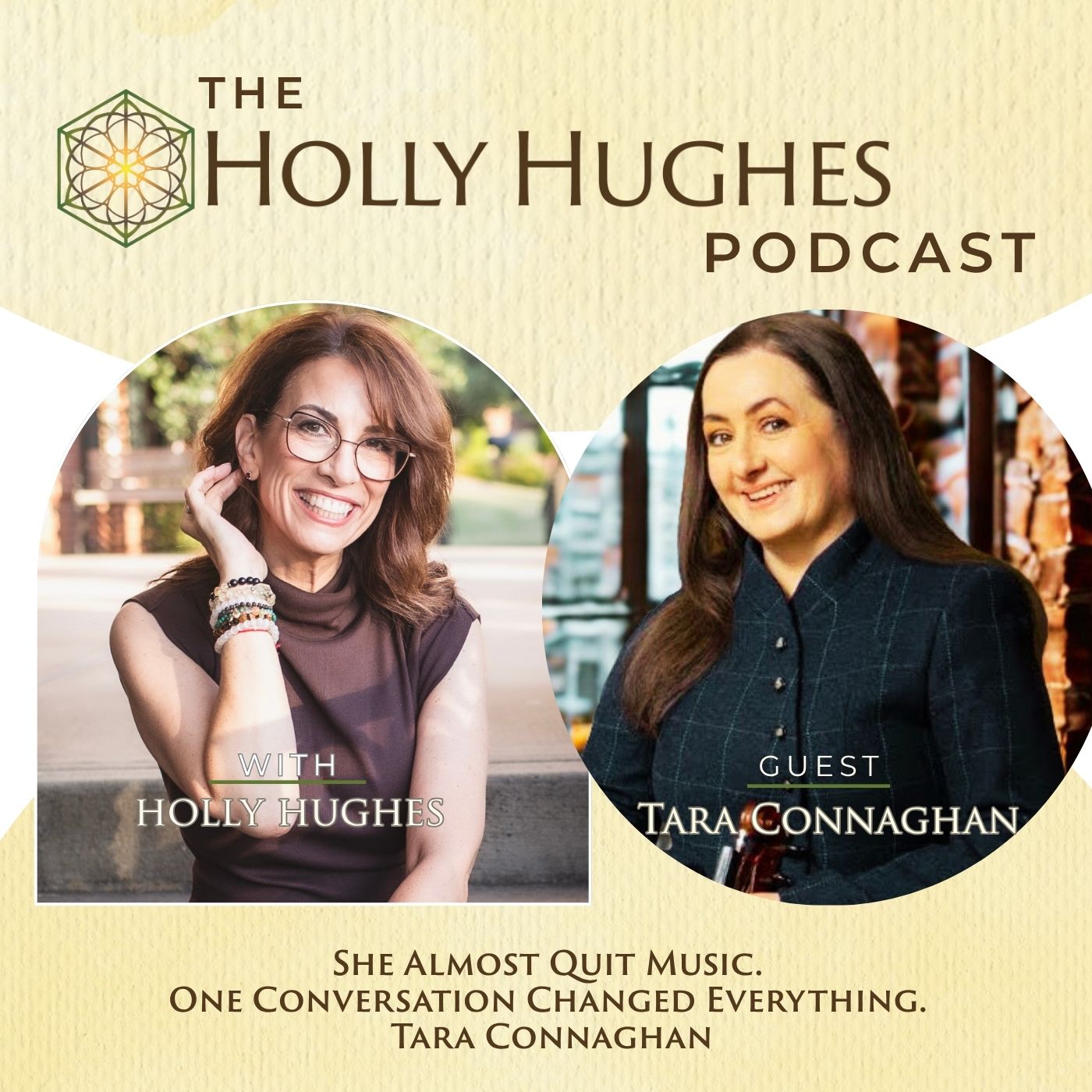
She Almost Quit Music. One Conversation Changed Everything. | Tara Connaghan


What does it really take to become a confident creative?
In this episode of The Holly Hughes Podcast, Holly sits down with award-winning Irish fiddle player, educator, and podcast host Tara Connaghan to explore the connection between creativity, confidence, community, and personal growth.
Tara shares how one challenging lesson from her music teacher completely changed the trajectory of her life, why creativity is about far more than natural talent, and how Irish traditional music became both a form of healing and a lifelong calling.
Together, Holly and Tara discuss performance anxiety, artistic growth, finding your creative voice, overcoming the fear of being seen, and why surrounding yourself with the right community can transform both your confidence and your career.
Whether you're a musician, entrepreneur, artist, writer, podcaster, or simply someone searching for the courage to create, this conversation is filled with practical wisdom and inspiring stories about embracing who you are and trusting your creative journey.
What you’ll learn in this episode:
-
Why confidence is built through practice, not perfection
-
How creativity helps us process grief and difficult emotions
-
The surprising connection between community and artistic growth
-
What Irish music sessions teach us about collaboration and belonging
-
How Tara built an award-winning podcast from a simple idea
-
Why fear of visibility holds so many creatives back
-
The mindset shift every artist needs to keep growing
If you enjoy conversations about creativity, storytelling, personal growth, podcasting, and authentic living, be sure to subscribe for more episodes of The Holly Hughes Podcast.
We talk about:
00:00 Meet Tara Connaghan and finding your creative path
01:25 Losing her sister, discovering the fiddle, and finding purpose
05:17 The tough lesson that completely changed her work ethic
13:20 Why music became an outlet for grief, healing, and emotion
19:01 What Irish music sessions really are (and why community matters)
20:38 The surprising reason Tara started her award-winning podcast
24:36 Winning five podcast awards and embracing creative success
30:18 Creative confidence, visibility, and overcoming the fear of being seen
38:20 Why partnership beats sponsorship for creatives
46:15 The biggest mistake aspiring creatives make
54:10 Tara's warning label, perfectionism, and final advice
Connect with Tara
-
Facebook: https://www.facebook.com/profile.php?id=61576848312798
-
Instagram: https://www.instagram.com/tarafiddle/
-
LinkedIn: https://www.linkedin.com/company/session-etiquette/
-
Website: https://www.sessionetiquette.com/
Connect with Holly
-
Instagram: https://www.instagram.com/holly_hughes_intuitive/
-
Get Holly’s book here: https://hollyhughesintuitive.com/my-book/
-
Website: https://hollyhughesintuitive.com/
#CreativeConfidence #IrishMusic #PerformanceAnxiety #CreativeMindset #CreativeCommunity #ArtistMindset #IrishTraditionalMusic #MusicianLife #Podcasting #Storytelling #CreativeJourney #OvercomingFear #FiddlePlayer #PersonalGrowth #AuthenticLiving #CreativeProcess #WomenWhoPodcast #HollyHughesPodcast #TaraConnaghan #IrishCulture
0:10 Welcome to this episode of the Holly Hughes Podcast. It is where creative people come to have conversations about living a life outside of that corporate box. Today I'm very excited to have Tara gone again. Wait till you hear her. First of all, her accents. Amazing. She's a highly regarded traditional fiddle player and host of her own podcast, In Tune with Tradition, perspectives on session etiquette and Irish traditional music. Welcome to the show. Hello, Holly. And don't listen to a word she's just said. She's just bumping me up. No, it's true. It's true. I love how I'm meeting people around the world. That was very intentional for me to make sure that I cross borders because creative people, we all have the same little quirks. I'm trying to own that word because people used to say that to me and mean it like, oh, you're quirky and in a bad. Way they just didn't understand it was completely outside there. Yes, they couldn't understand anything. And I'm like, how boring is your life? Like meaning in the and I'm really mean that. I was like, if you can't go outside and see faces and things in the clouds or you can't be touched by someone else's creativity, I think you must be missing out on a lot because like, how long have you been playing the fiddle? You were born.
1:26 It was your first lovey, right? It was the first thing that went into your hand. No, it wasn't. I wish, I wish I could say it was. It was actually the last thing that went into my hand because I started playing the guitar first. Actually, I had a sister who was a year younger than me and she learned the fiddle and I was learning the guitar at the same time. So she would teach me what she had just learned. So I suppose she was my first teacher. And then I, you know, I never really did much with it. She would teach me what she'd done and then I would never see it. I would never practice or anything. It was just as kids, You're like, oh, I can do that, you know, pretended to each other. But the guitar was my first love. And then I did the classical flute and the classical piano. And then my sister passed away and the fiddle teacher that had been teaching my sister had reached out to her mother to see if she would sell her three quarter size fiddle because he was in need of them.
2:14 And, and I think maybe he realized it was maybe a bit of a touchy subject because she had been maybe only died a year earlier. So. Still a bit touchy. There is no. Yeah. So I think he maybe said, or maybe Tara would like to take it up as a kind of a I shouldn't have said this and this is an escape route because I'm sure he probably saw the distraught on her face maybe. But so she asked me and I was like, sure, why not get hurt? So why not? And I started and then we started with the Suzuki method was like twinkle, twinkle and lightly roll. And she taught me all them. I was like, we don't move on to something else, something kind of pretty soon I'm I'm out of here, you know, give me Irish music, give me anything. Just do not but give me this shit. I went back to piano as an adult but I had to relearn to read music and I forgot the bass Clef. So like, do you know what I mean? Like I had to count all the time. I was like, I really practice hard to learn a pink song. Just give me one reason.
3:20 Just give me like I Can't Sing. Sorry, sorry everyone about that. But I was so proud. It took me like a month to just get like into the intro and the but I was, I was like, yeah, I'm I don't think so. I don't, I think if I never stopped, it would have gone. But my whole point is I didn't start with twinkle, twinkle, you know, after not playing music for a really long time. Well, he did. He did. He gave me my first Tran tune, which was, I think it was Sacco's cheek. And I was like, Oh yeah, that's all right, I can do that. And and then quickly I got into the next class, which was more advanced class that had one of my best friend's, Denise, in it. And she was a great fiddle player. So I was like, wow, yay.
4:04 But I was lazy. I was lazy, definitely. You're not supposed to admit any of this, but I love that you are. I call a spade a spade. It's not a big spoon and it's not something else. It's just a spade. I was lazy because I, I think when you're lazy, you discover what you're good at and you focus in on that and maybe it's efficient. That's the magic. I love that, actually. When you're lazy, you discover what you're good at, but then you have to put the effort in to be really good. Yes, Oh, absolutely. So I discovered that my ear was really good that I was like, I can pick this up pretty quickly. So I being very, very lazy, would get my mother to drive me the 30 seconds to the class. It was like at one end of the town we have a small town. It's at one St.
4:50 Village and so we lived at one end and then the music class was at the other end. And so it was 32nd Dr. I had taped the Chandler beat beforehand. I'll put the tape into the tape player. I would listen to it and I'd walk in the door kind of half knowing it. So it was kind of, it was familiar, but not it wasn't always 100%. I didn't get it great and I wasn't fooling the teacher. So the teacher when I was about 16 then Denise's father brought us to a couple of festivals that were brilliant, you know, with musicians that a bit like by ourselves now, that would be going around playing festivals and things and people were just having such a good time. And I was like, oh, oh, I could do this. I think I could do this.
5:34 So that was around 16. And I came back to the fiddle class the next week on, Oh, Seamus. Oh my God. I, I, I, I want to learn this tune. I'm sorry. I told them the tune I wanted to learn. He goes, oh, yeah, brilliant. I'll have that for you. I'll get that for you. And so the next week came and he didn't give it to me. And I was like, oh, maybe he just had time. Maybe it took him a bit of time to write it out or whatever. And maybe he just didn't have the time. So the following week, my friend Denise is playing the tune. And I was like, Denise, swear, where'd you get that tune? And she said, oh, Seamus gave it to me last week. And I was like, what? Sheamus So I marched up to Sheamus as a bold 16 year old and gone. Why didn't you give me the tune?
6:15 And he was like, Terry, you don't practice. When you practice, I'll give it to you. And that was a boot up the bum. I needed that. But I love that you like, followed it because you could have just been lazy. I could have, but I was hooked at that stage. I think you need the hook. So if you haven't got the thirst and the hunger I was hungry for, I mean I wanted it and I really wanted it badly. So I was annoyed with him for about two weeks and I put on the CD of the track. It was, it was an Alton. Alton is a brilliant group from Donegal that play from where I'm from and they play lots of film music and they're just brilliant. So high energy and I really, really wanted this Gen. So I put the CD on and I started playing along and it took a while and it took two weeks.
7:06 I wouldn't even go back to the music class for those two weeks. I was so annoyed. And then I said he was right. I had to eat humble pie. I had to crawl back with the tail between my legs. I said you're right. But I've learned it myself and it was a good lesson and I practiced from then on it. In fact, it wasn't even that I it was an effort or it was punishment or something. It was like the freedom. It's like I can do anything now if I just practice and I just go for it. It was great. I needed it. I needed that boot up the bum. I think that's the thing about any artistic in Denver, right? There is this drive that like, I want to be able to do that. And then you have sometimes the Herculean effort it takes because I think people don't understand practice. Practice is embarrassing.
7:53 Practice is right. Like when I think about dancing, like if I fall or I I'm not as good as everyone else, someone's picking up faster. Even now when I take a dance class, it's absurd in my brain. I'm like, I'm not learning it as fast as that person or why isn't my foot going exactly where I want it? And I know it at this point in my life. It just takes me a little longer to pick it up. A little more injuries, a little more wear and tear on the body. But the gumption and the termination it takes to get good at something is so much more than people on social media, especially now with clips that just, it looks like, oh, I saw that and 30 seconds later I am an expert at it. And it's not that. And I, I love that he found the right thing to draw you in and keep you hooked. So for people who don't know, what's the difference between a fiddle and a violin?
8:43 Nothing. Yeah, that's what I thought. Right. The exact same instrument. It's just terminology. As a folk musician or an Irish traditional musician, we normally use the term fiddle and most classical musicians would use the term violin. That's fascinating. Are those instruments usually handed down in family members in traditional music would be like a family plays music and then or is that just like a myth? It could be, yeah, if you're, if there was family members, my my granny was a, an accordion player or her a Malaysian player. So I have it behind me actually, but I can't play it. It just baffles my brain. One, one note when you pull it and and push it, it has different notes each way. It's just.
9:26 My neighbor played the accordion. Is that strange? Is. That your first time you heard music? I think my house always had music. I can't remember actually. There's this, this family mythology in my house when I was I was probably two or three, like a baby. I was still a baby and we were in in our apartment, and my mother would play Simon and Garfunkel. Do you know the song Cecilia? Yeah. Cecilia. Yeah. Anyway, wherever I was in that little apt, I would run into the living room and do a little dance like it. Like I could be in the middle of something. And my mom says I would stop and I do this little dance where I go in a circle up and down and.
10:06 And like, it was the Holly dance at the time and I have a memory of running into the living room at very young age and just being so happy. So I think I was always a dancer. I think I'm actually I became a dancer before I became a musician. Did you? Yeah, it's probably not widely known. Let. Me hear, I want, I want to have the secret. Well, I, I started dancing I think when I was like 4 or 5, Irish dancing. So most like little girls go to Irish dancing. I loved Irish dancing. I mean, loved it did. You do the curls. Yeah, yeah. And the hair. Oh God, yeah. Except now you're not. Just send me a picture, I want to see that.
10:47 I don't know if I have any pictures. I do probably somewhere with the fish and the makeup. Actually, I wasn't really, really good at dancing. I loved it, but I wasn't good. So I didn't got to didn't get to go to all the big fishes where you needed to wear all the makeup. A fish is a like a competition for Irish dancing. And I didn't get to go to too many of them because I just wasn't good enough. I had really good rhythm. So the dancing teacher would she'd always showcase off the best dancers and say, oh, look at this a dance year, whatever step and show off to this person or that or the dancing teacher and whatever. And I was once pulled it and I was thrilled to bets. She once brought me out to another dancing teacher who was also a musician. So he had really beautiful rhythm. But so she said to grab, grab you by the scarf. Then I go come on out.
11:35 And I want you to dance your hornpipe step, which is a very rhythmical and it's a heavy dance step where you're wearing the the tap shoes. Yeah, so. Oh no, I'm I'm familiar with Irish dancing. I'm in there. OK, just for listeners. So I remember it was out of fashion. It was in Dunlow and it was above a pub. And so she brought me downstairs to the pub and there was like flagstone floor around the fire or maybe even tiles or it was slightly raised. And she said dance on that dance your hard web step on that. And she turned around to the the dancing teacher and she said, now don't listen to this, never mind the feet. Because you had the rhythm, I got the. Rhythm, but just not the feet, and that's fine. So you they say that about a lot of people, right? Like they have they have the steps, but especially on the stone, I bet it sounded amazing.
12:29 You know, later on people say, oh, she was teaching someone she want. No, no, that's not how you do listen to Tara's rhythm. So it was always the she'd teach it to me how she wanted it, and then she'd get me to teach it to the better, the better dancers. Because that's so funny, I'm taking a tap class now. I started a new tap. I know. And it's the first time I put tap shoes back on. I felt again like a little girl. I'm loving it. And anyone who at any age, by the way, if you go walk into a dance class and they have lots of open dance classes for adults, I highly recommend it's, it just reconnects you to some sort of joy that if you enjoy dance and you don't mind like learning again, it's super fun. I think when I was young, it was the best way I could express myself. I had so many things that I couldn't say and that I was coping with like internally.
13:16 Like nowadays I think they call it anxiety and ADHD and my dad is an alcoholic. So like I had all these things and I didn't even know what they were. So I think it always just gave me a way to use my body to get it out. That's why I always ask musicians, like, where does music live in your body? Because for me, when I feel music, it moves me from the inside out, right? My daughter can sing, so she feels music in a very different way than I do. So how do you feel music? I think it depends on the mood. I mean, I remember times where I'd be very, very sad or very possibly despondent to the rest of the world. But when I was in music, it was like, it was like when I was playing the fiddle, I was crying into the fiddle and it was coming out and people would say, wow, you're playing amaze or whatever. And, and I was like, I might not have worn it on the outside, but I was really, really upset.
14:13 It was after like I was really grieving and I was just pouring it into the fiddle, the fiddle. I mean, I was going through all those phases of grief and there was anger. It was all coming out through the fiddle, coming out through the music. So I so you're just not, you're in a different world. You're not really in the room, even though you're in sitting physically in the room. You're just, you're in all the frustrations. Yeah. And it's all just going. So we were doing the same thing, just a little bit different. But I think that's one point where like that creativity like that, we all have that same thing. I call it an emotional truth in that it had to find a way out. It had to find a way. Out, yes, Yeah.
14:54 And I think that's part of the magic of music, actually. It's like why we have our favorite breakup songs, our happy song, our whatever, like our little playlist on Spotify or wherever you're listening. I think that's the thing about music that's singular, right? Even like I studied African dance and then in the drumming and the krill and all of their other instruments, there's something that comes into my body and I'm just like, yes, I feel that. It's amazing. So for you as the musician, if you're not having that emotional truth, how is it coming through? And I think that's how we connect. I love that. There's a really sad tune that I play. It's a slow air and it's about the drowning of it's called Wachu or Maya Wachu, which is either the drowning of Matthew or Mary's Matthew.
15:42 And Mary is supposedly the mother of Matthew who drowned. It was a, a young couple that I suppose around the early 1900s, late 1800s and there wasn't have been a lot of employment or anything in Ireland really. There was a, a young couple from Kilkar, another area and Donegal not far away from here. And so there were about 16 and the girl had access to, I suppose, a bit of money for a passage to get across to America. So they agreed that they would both go, but he didn't have the money yet. So he was going to try and save it up and she was going to send him back the money. And so he was waiting after she left and waiting. And when they were in love and, and he was waiting and waiting and think he waited quite quite a long time. Months and months and months had passed and still nothing back from her.
16:27 So nobody knows whether she lived or, or maybe she died on the way over. But he never heard from her. And he decided he would start swimming because he couldn't afford to passage across. So we all know what happened there. That's why it's called the Drowning of Matthew. I think there are words for it. And it's from his mother's perspective where it was the drowning of her son. He drowned on his way to try and swim to America. So yeah, when I play that tune, I have to go into a really dark place almost. And I'm not aware of an audience or anything. And like, I wouldn't play it in a session, but if I was on in a concert and I was playing solo, I would definitely maybe play that tune. And I have to go into a place and then I have to exit it as well because we don't want to stay there forever. A friend of mine, her friend of mine's in. It's all right to wallow in that because especially if you get an Arts Council funding letter where you just go where they go. Sorry you didn't get it.
17:25 It feels like a punch in the stomach sometimes. I remember her saying that's grand, but take that and allow yourself to, to sit with it for one hour, maximum 10 minutes to one hour. And then you move on because otherwise you'll just shower yourself. And this. Yeah, you just sink. Yeah. No, it's. Tricky. I tell people I'm very Moody, but I own my moods right. Because even when I'm writing story, if I'm writing something or I write essays and I'm, I'm tapping into that emotional truth, I can call it grumpy. I get grumpy. But even when my daughter was younger, what I did for her was I told her I was like, sometimes I'm just in a mood and you did nothing wrong and there's nothing for you to fix. But I just need a little bit of time and I'll feel better. And I think just teaching her that from a young age has been really helpful, even as she is a teenager. And sometimes she's like, I'm just in a mood. I'm like, OK, OK, there's nothing I could do with it. And you got to work your way through. I think as a perspective, as a very Gen. X person watching the world online and everyone just justifying having an immediate emotion and just thinking that's truth.
18:36 When it's just something to process, it means you have to, you're aware of something, something is bothering you, but you got to go a little further. There's more to it than just the visceral part of it. So I am curious how you went from this finding love and telling Sheamus to go bite you that to this career that you've built and like. For people who don't know what session work is, how can you explain it to them? A session, an Irish music session, I should say, is it's just a gathering of Irish musicians in a corner of a pub usually.
19:18 And, and we there are Irish music sessions around the world everywhere. I think there's like 8485 countries listening to my podcast at the moment, which is crazy. It's like, oh, I love that. How did they, how did they find out about it? But Irish music is just so popular all, everywhere. I suppose if you think about it, there's Irish pubs all around the world. Sometimes we don't even care whether there's people in the pub. In fact, sometimes we prefer if there's not because you're just playing, you're having like a musical conversation with your friends. And that's kind of what it is. It's just, oh, do you know that, Jane? Oh, and then we start playing. You're bouncing the music off each other. And to me, I much prefer playing the music with people and bouncing the music off each other rather than being on a stage.
20:01 And if you're, especially if you're playing solo. It feels to me like it's musical masturbation in front of people and it's just embarrassing. That's fascinating. You're so very cool. That's just being humble. I think is it? I don't think so. Maybe it's just like I can play. I can play at home anytime. Like for me, it's about you. Can't have people just sit and pay you to play. I guess you could. Well, you could open the door. But that's not what turns me on. Like it's about what turns me on. And what turns me on is playing in a session with other people that are, that are just as good or even better than me. And that's where I get the inspiration and I go, Oh my God, how care do we note? It was like I'm almost almost orgasmic and. No, I totally get that.
20:43 So etiquette, why did you start with etiquette I? I would love to know that. It's one of those topics that's a little bit of a taboo topic because it's behaviour. It's about behaviour and people don't really like to be criticized about the behaviour. It actually started with my federal class. It's all adults and I seem to be always helping them, I thought with their performance anxiety about going into sessions because almost every week your teacher at any summer schools, you'll always hear somebody saying oh, I'm allowed to do or what am I allowed to do? Am I allowed have enough tunes? Am I good enough yet to go into the session? So there's always questions. I'm allowed to sit in that seat and how many tunes am I supposed to do? Is there other tunes that can be put with the set? That's always about so that they can get into. It's kind of like that, this prestige, once they feel that they're good enough to get into a session. So I had asked one of my federal students is a retired doctor, and I asked him if I write this book on performance anxiety, would he be my medical advisor?
21:40 And he said, absolutely. But what I think we really need is a book on session etiquette. And I said not a fucking hope. I said I wouldn't touch that subject with a barge pole, not if I was paid millions. Never will I ever touch that subject. And he was like, but you know, that's what we really, really need. He was like, because the performance anxiety that we're experiencing is mostly about sessions. So if we remove that etiquette, sort of worry and anxiety and get understanding, then we don't need the performance anxiety. We wouldn't have performance anxiety. So he talked me around and I took him a good few months and and I was like, OK, I'll do it. So I then said I'll write an application to the Arts Council for funding here in Ireland to see if I can get funding to write a book because because I thought it's going to take quite a while and I'm not really working at the moment because before all of this I had actually taken over my dad's construction company when he passed away quite suddenly. My brother or sister weren't interested and I'm just a doer. I'm like, well, I'll do it.
22:49 So I took over the daddy role for quite a while, for about 9-10 years. So I'm not afraid of doing things. So I would had I'd just finished that, I'd given up the construction company and I said I will apply for the funding. And it was like a was begging up the, the, the application form and saying I don't want it to be just me, my as in my opinions. I want it to be the opinions of the community at large because anybody can just write a book from their opinion. So this has to be a broad community kind of thing. So I said, and I thought I would have been having conversations with other musicians obviously, and I might record those conversations and release them as a podcast. Throw away comment.
23:30 The epic amount of work a podcast actually is. It's like dawn, dawn, dawn. That didn't dawn on me until. Afterwards it didn't dawn on me until I was three months in personally so. I get it. Yeah. So I, I didn't get the funding because I hadn't enough written on the book yet because I'd only eat like half a chapter or something. So they said you don't have enough written. So I started releasing some of the conversations. I did a kind of a big launch and said I'm going to launch a podcast. And, and then it just took over my life. As you would probably attest to as well, it takes over every waking moment and probably you're sleeping moments as well. Oh. Yeah, yeah, I know. And then and then you're always like, oh, then there's the marketing of it and there's the, it's like a circle of work, right?
24:15 And then you're like, but with my real work, what happened to that? Like, and then I have to really make myself not work on some days because most other people don't work. But I also think that's a creative life, right? Like we don't have a normal schedule and we can have fits and starts and sick like these successes and then not but one of your successes, or should I say several because you are, I'm flipping my hair. If anyone is missing the video, you're missing out. But Miss Harriers, you've won awards for your podcast. I haven't even applied for anything. I'm just a chicken, honestly. But now you've inspired me and I'm going to, I think I should go forward too.
24:55 Why not, right? Yeah, I wish I had them here to like show you, but actually they were just a prototype at the time. So I have them ordered and they will be ready. I've been nominated for a Shorty award as well, which is pretty cool. I'm, I'm really excited, very excited. So it did win 5 awards, which is can't believe it at the New York City Podcast Awards. So going over in May and hopefully the awards will be ready then. And I have 3 audience Choice Awards and two Libby judged awards. So the audience one, one of the audience trophies will be going to my local pub where the session is and they're all excited. So we're going to have a big night when that when I come home, will you? Post pictures of that I want to.
25:37 See. Oh well, they'll be on my Facebook. I'll be like, I wait, so you're on Facebook mostly. I'm on Facebook and Instagram and LinkedIn. If you're at a transition point in your life and you're wondering how do I go from point A to point B? I'm tired of being defined by what other people think of me. Read my book Real, Not perfect. How to become your happy, authentic self. It's a step by step guide to help you reclaim your voice, your passion and yourself worth. Available at all booksellers and in the links below. So my question goes back to your music and your session. Now that you have this thriving, award-winning, multi multi award-winning podcast because you got a hype up people doing the work I want to know about, what's the one mistake that everyone has to make in order to learn it that you can't warn them about?
26:25 I think they need to need it. They need to want it enough. I and I can't give them that. So if they like, they don't really want it. Like the way I wanted to learn the music or the way you want to do. We all have something that is like, we've been hooked. And if we don't have that hook, then you're just coasting along. I think that's what it is. You're kind of like, oh, I'd like to do that. Yeah. And there's lots of things I'm like that the Irish language. I mean, it embarrasses me that I don't speak the Irish language enough or that I can't do it enough. We learned it at school for 14 years and we still can't talk it. Yes, it's disgraceful. Letters. You have a lot of letters. OK, So they have to want it. And is there like a most embarrassing thing you've ever seen anyone do?
27:10 Like I want to know the good juicy one. Like someone do they just get too drunk? Like are they too pissed or or do are you drinking while you're playing? Is it like social too or are you really focused on the music? Oh no, it is very social. I mean, that's the whole point of it is that it's social. And so half the time you're, you forget that you're even playing music sometimes because you're maybe you, you've played a tune and then you've, you sat and you've chatted and you're just talking about because you've maybe haven't met your friend in three weeks or something. You're like chatting away. Oh, I met so and so. Oh, and then you're like, oh geez, we better play a tune. And then you might, you might play for like 2 hours non-stop. But it kind of, it's supposed to be a nice kind of chilled out environment. Although I think it does change when you're maybe paid as well.
27:51 So if you're there, it's almost like you're on the clock. Then you're, there's a more of a pressure. You're like, well, the bar's paying me. So therefore they need to make money. So I can't be sitting here talking because I can't be paying me to talk. And that's fine. But it just puts a different pressure on things. And I sometimes say to the the local pubs and things maybe don't pay me. I don't want to be paid for that because I just want to be able to enjoy it and it'll be under pressure then so, but I'll be there. Wrong thing to say. No, but to me, music is the soul. It's a part of my. Soul No, I get it, I get it. But we have things to pay for because your empire is starting. And then I will I, I will be your friend in the background saying, Tara, how is your empire today? And that will be my text to you.
28:33 How's how is it? Because I want to cheer you on. I want, I want to dance in the background. I will learn the Irish dance. I'm there, I'm there. I want that. I think you should maybe accept it as an offer of partnership instead of being paid. Think of it as that. I think that lanes. Easier for you. I actually heard somebody, I read something in a Facebook group today about podcasting that somebody was asking for how do you look for sponsorship? And one person said, once I change the word to partnership, I seem to be able to see it differently. And I was like, wow, I love that. So twice in the one day. Must be.
29:14 Partnerships is the way to go forward. Partnerships, yeah, I think, I think that way because I think you invite people in, right? You her lovely individual, right? And you're easy to get along with and you're, you can make some good music. So that's all the wins. Win, win, win. So yeah, I think you should enjoy the partnership because also if you always say no, they'll feel awkward. Yeah, that's true. Or they'll take advantage of you. Either way, that's not really what you're going for, so. OK, what about? OK I'm going to ask for some advice now I I'm really scared to do video. OK, of what?
29:57 As in my podcast, I record the same as we do here on video, but then I extract the audio, I edit the audio and then I put the audio out and I just can't do the video bit. I look I totally 100% a billion times understand that I am not comfortable in front of a camera, but I am not looking at me, I'm looking at you. So that's how I get over it. And then when I have to watch myself back, I'm like, why is my hair sticking out like that? Why didn't I like when I when I become rich and famous and I get hair and makeup, I can't wait for them to like, what is this curl like? What is this like? What just anyone else care? And if you're paying attention to that, then I think you're missing the greater message. I think seeing myself aging that and no filtered like that is can be hard.
30:46 I want to see you play your expression, who you are, your personality. Like I've listened to your podcast, but I'd seen your face first. Yeah, right. So now I know a little bit more about you. So I think you're beautiful and I think you should do it. Do you know what I'm just from what you've just said, I can hear like it's what I'm teaching others. It's the I'm not an ego. Get on my way. Yes. It's internal. It's all this internal. Oh, and there's the bags and then I'd have to do makeup. It's just excuses. It's ego. It's ego. My ego is worried, that's all. For sure I saw a recent picture, me and my friends got matching tattoos and where mine is is it's on my shoulder.
31:33 And my mother doesn't know about that one but now she does anyway. So when my friend came to sorry, my friend came from Copenhagen and we took a picture of our matching tattoos and hers is like on her wrist. And I saw this photo of my back and I am covered in freckles I never knew I had right because I'm aging right. So like you have all your little spots coming out. So I was like, that is the strangest thing to have an ego about. What are all those freckles? What is that? I think if we maybe get more honest about it, it would like, it's a good thing I'm I'm vain enough that it bothers me. Like do I want to save money to do whatever I do? But I think at one point we have to accept who and what we are. I really try, but it's it's a struggle. The magic of you is all those things. I think the magic is all of your story and the history of your family and that you step up, that you step up. So why not be seen if you're the one stepping up? Now if you could tell me that, because people are always telling me I should do speaking gigs, but you put me in front of an audience alone with a mic and I have nothing to say. But if you sit next to me, I could talk for hours like I I can't.
32:39 That hump is something that I hope to get better at. Why don't you just speak on the floor? Don't get up on the stage to speak on the floor. That would be lovely. I guess I don't know really what message I want to share yet. Bradley, for a long time I was like teaching how to heal from your past and don't let your past define you. That is like a huge part of my own personal journey, like things that I've overcome. But what do I want to say now? A lot of healing gurus who are like self-care people. I know them or I know about them behind the scenes. And so I don't want to be associated with that exactly, but they're killing it. And I'm like, how are they doing that?
33:20 I have so much to say. I don't know where to start. Do you know what I mean? As a keynote speaker or something. OK, Well then you're going to be one of the keynote speakers for this conference because that. Now you made me sweat like the second you said that. My pits are sweating like see. So we'll help each other with this. Yes, we will. Help each other because again, two good musicians make more music. 2 Powerful people make other people feel good. We can use our power for good and not always bad. The whole is greater than the sum of its parts, yes. Yeah. Totally for everything. I re met a woman at Hagana University with and she went on to be a very big famous person in broadcasting and we reconnected briefly and she said what I remember about you was you were good, but you always stepped back.
34:10 You always let other people, right? So that was very much me forever. So I am not 100% comfortable even though I, I think people can't believe this about me, but it's really true. All those eyes, I'm an introvert. That's a lot of eyes. That's a, and I feel all that energy, right? As an intuitive. So that's a lot of eyes and a lot of energy. It feels like this. So I, I, I don't want to disappoint. And any time that I've gone to do public speaking, so far in my vast career of things I've done, I haven't enjoyed it. I haven't felt supported by anyone backstage and coming from person who used to support people. So I think that's why I guess I'll have to create the environment.
35:00 That's really interesting. Now what you said about the lots of eyes and, and stepping back, I always step back and let others because I keep thinking I don't need the, the visibility or of having to be the person. If somebody else wants that visibility, I'll let somebody else have it. That's fine. I'm not. I don't love to be. I'm the owner of that or I'm, you know, I feel a little bit more ownership of over the podcast definitely, because it's totally me from scratch. That's well, apart from my muse who pushed me into it, my fiddle student. Yeah. I think today's a big change day for both of us. I can't wait when this airs in the summer, like July, August. I can't wait to see what we've made happen.
35:41 By then, how many awards will we have gotten? Well, yeah, well, now I guess I have to submit, but they are pricey. Can we say they are? Where does that money go? Do you get it money at the end or do they just paying the judges? I presume that events are quite expensive as well, so they have the the process. It is probably a money spinner for some of them. It's probably how they earn their money. So they are quite pricey. I have put it aside as it's a, a marketing must because even though I am a musician for the last 35 years and, and traditional music for the last 35 years, I, I need to get it out there as well and I need people to trust me. So I'm seeing that as a trust thing, a trust building exercise. I'm going to do it.
36:23 Are you going to do a webby? I did I apply, I applied for one before before Christmas and I didn't get nominated because I I was only still started. So I had now I have a lot more since then. I was like, oh, if I had only known about this. There's, there's music schools in the states who have set up podcast clubs. Do you not like a book club? Shut up. To listen to, you know how you'd normally get a book and you read it for the week and then you meet up and discuss it. They've now set up podcast clubs to listen to my podcast, an episode a month and then they meet up and discuss it. It is crazy. How did you even? Learn about that. That's amazing. Because they contacted me to see would I be OK with it? And I was like, what I thought they said.
37:05 I thought they meant, oh, they were going to listen to my podcast along with all the podcasts. Would they mind if mine was included in it? And I was like, oh, yeah, of course you can include mine. And he's like, no, it's not like to include yours. We're actually just taking one episode from yours every month. It's like. That would that would make me cry. I think what he was saying is that these kind of behaviours that are the norms that are accepted a general sort of how to behave in a session, They've been saying it for years to the students. And the students are like, yeah, yeah. But you know, who are you? You're you're American. You're not Irish, blah, blah, blah. They're like, wow, actually Irish people are saying this with Irish accents. Oh, my God. And so everybody's gone. Oh, so this is actually right. This is real. This is not just grumpy people saying, oh, you're not supposed to do this, you're not supposed to do that. And Irish people are.
37:50 So we won't say anything out straight. We're so indirect. It is painful. And it's that's how we act. If we say something direct, we either feel like we've got notions like who does she think she is? We'd hate to offend people as well. Yeah, arrogant. We hate arrogance. We hate being boastful. Oh my God. That's why we're all kind of like shy and kind of not. We're not maybe shy shy, but we're kind of like, that's why we give others the credit and things because we just like, ah, no, it's glad you take it. No, it's OK. It's OK because I don't want to offend you or I don't want to put you out and that's why. You're saying no to the money at the pub. Yes, I know. And you know what? Can you wait? I I call, I want the American Irish hybrid etiquette thing. It's OK to take the money, no?
38:39 Please please fund me. Two hands out. Thank you. Please Sir, can I have some more? Some more. I love that. So I would love to ask you my favorite question, which is how I end each episode, which is if you came with a warning label, what would it be? I just read this just about 1/2 an hour ago before we started. If I'm really really really tired. If I have a bit of sleep deprivation. As a musician, you sometimes suffer from sleep deprivation because you're playing late at night and then if you get up early the next day or yeah, or you've maybe been to a festival for maybe 5 days, three days to seven days or 10 days in a row.
39:21 And when I'm suffering from sleep deprivation, I'm likely to say anything. My filter is completely dropped. Yeah. I, this is the reason why I've done the podcast and why I've set up my, the podcast in tumor tradition because it's like cathartic to say I'm sorry for what I've done to some people. I'm sorry for saying something. Yes, if I'm tired, I, my, my, my temper goes from zero to 100 and very short time. And I'm not like that as a normal person, ever. I don't know. I've heard about those Irish tempers. Now, now. If they're all sleep deprived ideas, oh God I have turned around to a person in a session and it was. Bear in mind it was day 10 of a festival and so we you can feel when you're exhausted, you're almost like having an outer body experience because you're so tired and every cell in your body is exhausted.
40:19 And so there was a guy playing, I take the word playing back. There was a guy with a fiddle in his hand and normally he wouldn't he wouldn't be haired because he's pretending to play. So he he's putting his hands up and down the fiddle and pretending to play, but there's no rosin on his bow, so you wouldn't hear him. So that's OK. It's harmless and it's it makes him. See there? That's annoying me. It makes him feel good, obviously, but he's part of. It #101 don't do that. And maybe he gets a few free pints and that's a way of getting a couple of free pints, maybe at a session, because sometimes you get free pints. Not always, not, not always nowadays, but you used to get free pints quite a bit. And so he was doing this, sliding the hand up and down the strings, whatever.
41:04 And somebody must have put rosin on his bow because all I could hear and he was directly behind me, like right behind, right at my shoulder. And it was like, it's the hallway through the session. And I just at one stage I went, what the fuck are you doing? I can't believe it. Look, she's bright red if you're not watching the video, she just turned bright red from second hand embarrassment and just remembering that we've all had that moment. Oh my God. I even feel it. Oh my God I've had so bad. There's a difference at professional versus you're doing it for your enjoyment, right?
41:49 So like, I cannot be the best dancer anymore. Or I could dance at whatever level I am at and I can love it and I love love it. But am I getting on stage with a professional? No, no, no, I'm not. I'm not because I can't keep up and I can't do any of that. And it's OK to love something and have a hobby and not be the best. That is OK. But what we're saying is don't piss hair off and can't play after, you know, 10 days, 10 days, rigorous work and go. I love that. It's the worst. I think that you're making like those horrible little hairs on the back of my head, No? Do you know the kind of the time before that you can just feel it beforehand where it's building off you? Hear the bow like being pulled.
42:39 Can't you hear that? Yeah, I think you can. I think you can because your head is full of music. So yeah, actually that's one reason why I haven't recorded a solo album, because I can hear the bow, the hairs touching the string and it and it great to me and I can everybody else not hear that. That's annoying. Most people can't. Yeah, so maybe I should just record an album, but. This podcast and I want this conference to have and you've gave me things. I gonna finish the book you're gonna finish. And my. You'll start yours. I can send you encouragement. Did you get a word? Just one word on the page is a win. Want to say thank you, Tara, for coming and being a guest on the Holly Hughes Podcast. You can tell people why I'm so excited to have her here and why I am so glad we connected because I don't know. I adore her.
43:28 And one day we'll meet. Now I have a new goal. So TuneIn, where do you want people to find you? They can find me on www.sessionetiquette.com and the podcast is there forward slash podcast or on Spotify, where else? Apple, any of the podcast, pocket casts, all those kind of things places. And you can contact me through the website as well. There's also questionnaire there for anybody who has if they're in Irish music sessions or struggling to go to an Irish music session. So put their challenges in that questionnaire. There's it's just a a questionnaire with a few different questions on what the challenges are. I've also go to start, this is the bit that I'm worried about start answering some of the questions because there are hundreds and hundreds and hundreds of questions and I'm going to start addressing them because I only usually ask guests 2 questions.
44:18 And so it'll take me forever to get through all the questions. And so I need to do the video. I'd like to do it as a video kind of series where I answer the questions. I've been saying I'm going to do this since last November. No, we're good. We're good. It will. It'll be happening before this comes out. Excellent. Thank you so much.
