Independent Filmmaking, Reinvention, and Coming Clean About the Industry | Vince Duqué


How do you make your first feature film after spending decades helping other people bring their creative visions to life?
For filmmaker Vince Duqué, the answer was to stop waiting for permission, buy a camera, and begin shooting before he had a finished screenplay.
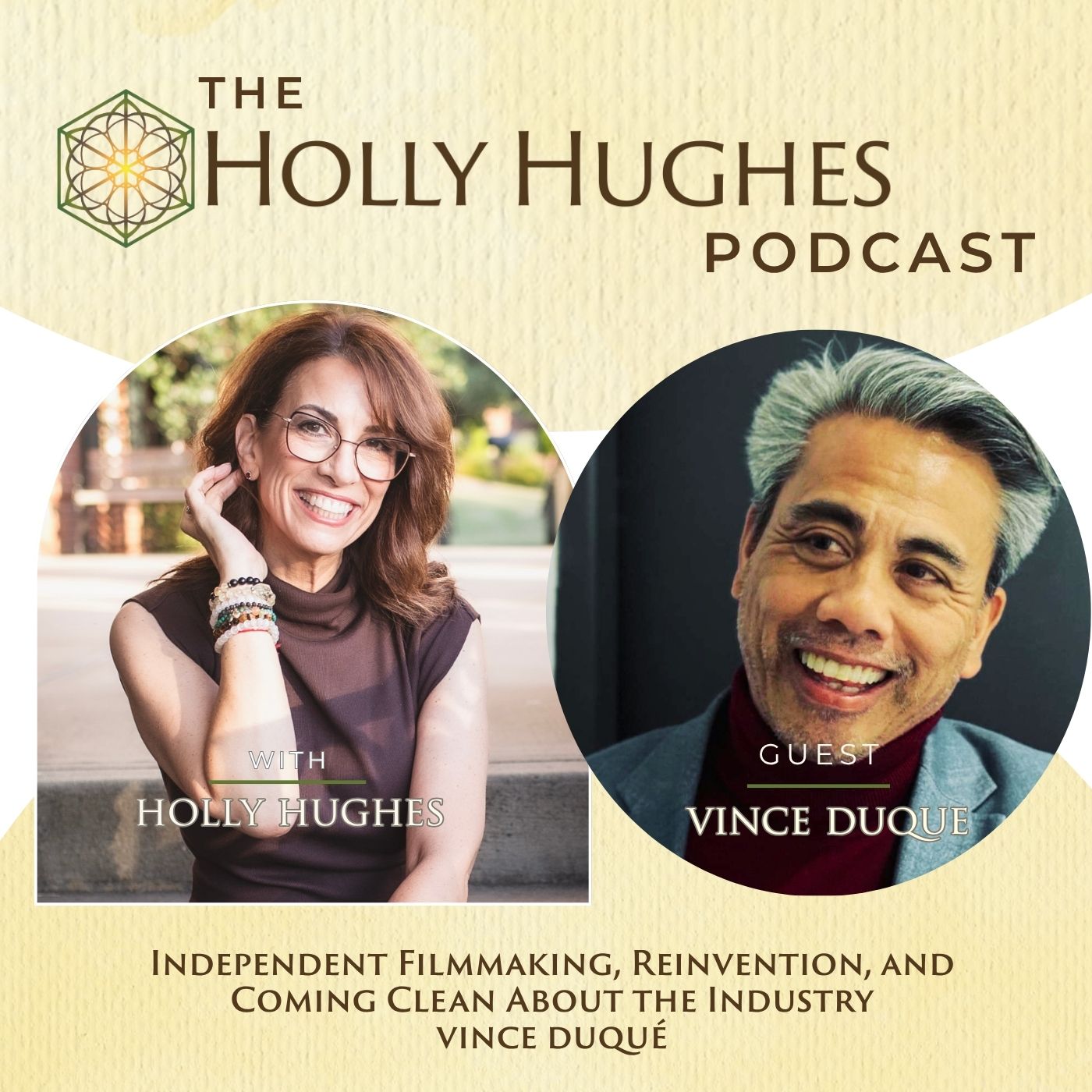
In this episode of The Holly Hughes Podcast, Holly sits down with Vince, a Filipino-American writer, director, producer, and former Hollywood assistant director now living in Paris. After more than 20 years working across studio film and television, Vince is completing his first feature as a director, Je m’appelle Alvie Balicoco.
The autofictional independent film follows a Filipino-American immigrant living in Paris who takes his French friend on a road trip across America to see U2 at the Sphere in Las Vegas. What begins as a concert trip becomes a reckoning with loneliness, identity, abandonment, people-pleasing, and the emotional cost of reinvention.
Holly and Vince also explore the unseen realities of filmmaking, the creative compromises behind Hollywood productions, and why making honest art sometimes requires accepting that not everyone will understand or support it.
This is a conversation about independent filmmaking, creative courage, immigration, depression, belonging, and what happens when an artist finally decides to come clean.
What you’ll learn in this episode:
-
How Vince Duqué began making his first feature film without a completed screenplay.
-
Why decades of Hollywood experience can make it harder to stop seeking permission and trust your creative instincts.
-
What autofiction is and how Vince combines real people, fictional characters, and lived experiences in his film.
-
Why Vince left Los Angeles for Paris and how becoming an immigrant transformed his understanding of reinvention.
-
How loneliness, abandonment, people-pleasing, and depression shaped the emotional core of Je m’appelle Alvie Balicoco.
-
Why an unexpected mistake on the road to Las Vegas gave the film the conflict and emotional tension it needed.
-
How Vince directs himself while simultaneously writing, producing, improvising, and thinking about the edit.
-
Why emotional truth can matter more than traditional protagonist, antagonist, and conflict formulas.
-
How creative rituals can help actors enter and safely leave emotionally difficult material.
-
Why coming clean, rather than appearing perfectly authentic, became the central message of Vince’s film.
If you enjoy conversations about creativity, storytelling, personal growth, podcasting, and authentic living, be sure to subscribe for more episodes of The Holly Hughes Podcast.
We talk about:
00:00 Introducing filmmaker Vince Duqué
01:42 Creating an experimental autofiction feature film
08:43 Je m’appelle Alvie Balicoco and the journey toward individuation
11:39 Finding the confidence to express your creative voice fully
15:45 Starting production before the story was completely written
21:20 Guerrilla filmmaking and no longer asking for permission
24:00 Navigating fear, depression, and doubt during the creative process
25:56 The reality of being a Filipino-American immigrant in Paris
27:12 Why reinvention is not always inspiring or romantic
35:42 The real-life mistake that gave the movie its conflict
39:16 Trusting emotional truth over traditional storytelling formulas
48:21 Why Je m’appelle Alvie Balicoco is ultimately about coming clean
If you are looking for a way to actively journal to reveal and heal the thoughts, emotions, and truth you’ve been hiding your whole life check out my guided journal, Heal to Real here: https://linktr.ee/hollyhughesintuitive
Connect with Vince
-
Instagram: https://www.instagram.com/levinceduque/
-
LinkedIn: https://www.linkedin.com/in/vinceduque/
-
Website: https://www.vinceduquestories.com/
Connect with Holly
0:10 So welcome to this episode of the Holly Hughes Podcast, where creative people come together for conversations and community. And today I'm very excited to introduce you to director, writer and producer Vince Duquet, who has an amazing history from California to France. Although I guess I should say that you S to France. I mean LA, you know, I I mean, I was born in New York. But you know, I always forget that part. I was born in Queens, Flushing. Flushing. That wasn't that far from where I would grow up so. What were you? Where did you grow? Up way out on Long Island, South County. Yeah, My, my joke is right. I don't identify as a New Yorker. Oh, really?
0:50 Yeah, no, I don't. That's not my vibe. The only thing is that still New York about me is my love of mascara, a good leather jacket. I love a good leather jacket. And I think that's totally like my era of growing up there. And I like to say fuck. So that other than that, there's no New Yorker. No, I felt way more at home in LA when I lived there. So I want to say thank you for coming. You and I have had a conversation previously, but we got way too personal about some stuff. And I really wanted to share you with my audience in a way that I don't know that highlighted you in like what you're doing and your process because you know, you've been there, done that, and now you're doing a really intimate project. And it's brave of you.
1:37 So I why don't you tell people about this project in your own words? I am writing, directing, producing. Starring. Playing the lead role, that feature film that is a traditional narrative but is experimental. It takes from different genres. It's a road movie, but it's also has a video or sort of tone poem, video essay aspect to it. I like that it it does so I would also call it like close to the Bone fiction. Yeah, yeah. So auto they, they call it these days.
2:17 I mean, some people call it auto fiction. So it's like an autobiographical, but it's fiction because I'm playing a character that's not my name. And I have, I have characters who are real people, but they're not trained actors and they're playing heightened versions of themselves. And I have a couple of actors playing other people, but they're based on real people as well. So, you know, I felt like I, I was the only one who could play the role because I was going to demand a lot of work in terms of the process that I, you know, it was really wanting to try an iterative process to refining the story from the beginning because I didn't want to do the typical thing. I think when you are in Hollywood and you want to make a feature film, you want to make the script perfect. You know, people always ask you on the street, what's the log line?
3:12 Give me the elevator pitch. And I think I was so in my whole life of trying to make a movie. This is my first feature film that I'm directing and you know, I have a 20 year 20 some year background 30. Just saying I did the math. I was thinking, I was like, I know, isn't that mean? Crazy, crazy. 30 years of experience, I mean 30 years of assistant directing experience in different genres, feature films, comedies, what hour dramas, sports. Yeah, you've been there and done all that. But what I loved because you sent me some stuff so I could like sneak peek, one of the fascinating and beautiful things about you is your vulnerability. You always are.
3:58 If someone meets you, there's an aspect of vulnerability and then you have that wicked playfulness. So I just like, you know this interesting teeter totter. It's just me throwing you off. Yeah, I know, I know you like that. But you also have this thing when I think of you and your your storytelling, not like when you're working for other people, helping them do things, but you are about safety, belonging and identity. And then when you help other people make movies, like you even have this clip in your movie now when you're standing on Hollywood Blvd. right? And you're like, I'm here to make it safe. Like we had to lock down the street. We got to do this. We got like all the mechanics of something.
4:38 It's like a beautiful dichotomy that I don't know how to express to people who haven't been in film, who don't know the madness behind. That people don't really understand that. And, you know, it's interesting because I am in a city that is madly in love with cinema. There are so many movie theaters here. You can watch every classic that is in the 100 top A5 movies, and they're all playing in a theater somewhere at some point in the week. And I love that. And so people really get, you know, they get really touchy about the movies, as if they were betrayed by the actor or the director. And then I'm always, I'm often having these kinds of conversations to kind of tell them the reality of things. An example was, you know, quickly yesterday I was having a discussion with someone about Elvis and Austin Butler. And Austin Butler is a, you know, kid I mentored when he was 17.
5:43 And so the the guy was going on and on about his acting. He was overacting. And I know Austin spent two years trying to be Elvis. We had conversations on the phone while he was in production in Australia, freaking out like, I don't know what I'm going to do. I'm playing this icon and Elvis is watching me and I've everybody's expects me to do to play Elvis and do this. And he's going bananas in his hotel room. So, you know, it is so difficult to do these kinds of things. So when I hear people get into the movies as if, Oh well, it you should have done better, or this, it's the director's fault that the writing isn't any good and they don't even know the stories about the studio, the compromises you have to make.
6:27 Maybe you didn't have any? Phases of just the day, right? Just the day, I mean, you know, and everybody has decision making abilities that you don't as a director sometimes or even as an AD, you know. So anyway, yeah, I mean, completely resonate with what you just said. Yeah, I think people need to remember there's like the story, there's the idea, the spark that started the script, and then there's the business of filmmaking. And then there's everyone on set, every department head, everybody on set has a dream of making that thing come true, like craft service does too. They're there keeping you going, right? There's like so. Many. Yeah, intricacies trying to give you this shot, this beautiful shot.
7:12 Yeah. And then at the end of the day that we, you know, we being the crew are really dedicated in a way that is inspiring to me because you just don't see that kind of care. I mean, you see that kind of care. Like I think when you, if you're a professional athlete or if you're doing something where you're, you have to win something in that way, but everybody's getting paid a lot of money. So there's this this kind of vision. I, I think I would even go as far as to say that a film crew is much more passionate and much more honest and more and what I mean honest, not honest in you're not telling a lie or something like that, but more in terms of work integrity in that we just all love what we do, or at least need to show that kind of love because it's so grueling.
8:03 Yeah, it's you have to be driven. Driven. That's a great word, driven and I would say even more so than than a military unit and having been in the military. So I can say this as an Army officer, I would say. West Point grad, Let's drop that. Come on. Come on. I would go out on a limb to say I would take my film crew over my tank platoon to war just because of how they handle. I got some PAS you definitely can't take, but well, that's like a story for another day. I want to go circle back into your your movie. Now I want to know like your working title and I want to know what is with the main character's name.
8:43 The title of the movie. For now, I think it's going to stick, but it's called the Gemapelle Alvey Balacoco, which is in French. My name is Alvey Balacoco. So it's a bit of a declaration. It's a bit of a play on word. It's me saying here I am, this is who I am. It's a story about coming finally to that place of full individuation where you really acknowledge your shadows as part of who you are and you really absorb the whole spectrum of your soul, not just the good parts or the parts where people reward you or make it conditional for you to behave in that certain way. You just have bad things that you to go through. Like for example, you know, me having a lot of abandonment issues or people pleasing things that I don't necessarily struggle with the way, let's say I used to in my 20s, thirties, but it's still there.
9:47 You know, I still feel these feelings and where I'm feeling them presently is in terms of my movie rejection wise. So I'm really somatically feeling and checking in with myself all the time when I put these. I've been putting these clips out and they're just first draft. They're good, though. I'm not that nice, you know that wait, I would like to tell people I have a really critical eye. And that's because I'm always being judged, right? Like just from writing, reading, all my friends who are still in entertainment, and I get sent scripts from them. Just people asking me for feedback. So when I saw your clips, what I was so excited about, I'll get emotional. I love your storytelling.
10:33 I love your eye. I love the angle in which now see, I'm really getting. I didn't pack a fucking tissue next to me. No, because I've always seen you as the person like I was who made things happen for other people. I knew what you wanted to do, but I I hadn't ever really had the opportunity to see you fully, your story, your vision in any way like out there like that. And so for me, I was like, I get it. And then I'm like, oh, I get it. And then like a whole other level of I get it right? There's so much more to it. And you haven't even put the music all in and you haven't done the pretty cut or whatever. But I think what you're representing is just like how you speak is the multi layer of an individual and a story and you're somehow simultaneously putting it out there, which I think is daring. Nowadays, when we flip through our phones for a 32nd clip, you're asking people to sit in themselves. Well, I don't know if it's that singular, I think, or binary in the sense that it's good or bad.
11:38 I I'm really leaning toward the idea of how do I embody the spirit of I don't give a fuck. So in order to you have. That thought while you do it, like honestly, is that what you think? I don't think that I don't say that in the in terms of being rebellious or rejecting the rejection. It's not defensive. It's confident or trying to be confident, but it's also I just want to come from a place where I am expressing my voice fully. Yeah, you are. So what made you do it? What made you jump off that Cliff? I've been wanting to do it for probably 20 years now.
12:18 I just didn't know how to do it. Or did you know too much about how to do it and so you didn't do it? I I think I'm not look, I was trying to be a surrogate white guy. For example, I have, I have just stumbled onto a pitch deck like a kind of a sizzle reel that I did for a West Point series that I wanted to pitch like 15 some years ago. And this is at the time that sort of like the new golden age of television was starting to happen, right? What that series with Kevin Spacey on Netflix. But that was the first show that Netflix like said, hey, we're here, we're making production. You know, Hulu was making stuff. And so I was at the at the precipice of that with this series.
13:01 And I wasn't clever enough to write it in a way that was just this kind of heartfelt, what I thought was going to be a kind of a Dead Poet Society television series. I was so wishy washy because I was open to pivot. Is this ACW show? Is this a is it for Fox or is it for NBC or is it for CBS or is it for Netflix? Like does that. Even exist anymore, and now it's right. So you can change that kind of stuff. And I made the lead character a white guy. Yeah. So I was literally writing a vanilla version of what I would have written today. And I just didn't know how to be someone who was going to tell my own story because I I it was also supposed to be a way of life.
13:48 Like, you know, I was supposed to. I wanted to direct for a living. And part of I don't give a fuck is, I mean, you know, I'm broke. I went all in. And it's scary, you know? And so this I don't give a fuck is a kind of it is a an engine for me, but again, not rebellious, but more like, OK, you know what this is? If you really want to embody the idea of I don't give a fuck or like you want to be that artist. How do I become the Snoop Dogg of Vince UK? How do I become the PT Anderson of Vince UK, whatever that is, or, or Wes Anderson? Are all these my, you know, my art?
14:29 Not oh, I'm inspired by this director and or I'm wanting to emulate this director. Know who who am I as a what's your voice? And I was never going to be able to do it before because I just wasn't ready. I needed to be more creatively ready. And being in Paris has allowed me to do that because I'm just going to the movies all the time, and I'm studying all the time. I'm listening to watching French movies. I'm watching so many different movies from all over the world. I'm getting a perspective of art. The kinds of conversations that I have here about cinema I never would have had in Lai didn't have access to those kinds of people.
15:10 Like they just didn't seem that way. Or maybe they're around. I mean, I have these kinds of conversations with, you know, Austin Butler, very thrilled to, to be in touch with someone who, I mean, talked about a guy who just like, he did it, he's making it. And I'm hearing about his struggle creatively. I'm hearing about the demands on him. So it's reflecting on me as well. It's like, and I'm projecting the future, you know, because I, I don't think I'll ever be able to make a movie like this again. Well, you you would have told the story, so you get to tell another one. Yeah, yeah. I'm just saying like I because I had this is my own money, I could just do whatever I want. I could slow down.
15:51 I mean, I took, you know, in terms of the iterative process. I didn't even start with the script. I started with an idea. I wanted to buy the camera. I said we got to shoot. We have to just do something because I'm I don't want to do the thing where I'm writing a screenplay for the next 10 years because I might be dead. I was going to ask you that. So it was like, was it an idea that just like bolted you up in bed in gay Patty and like you're like, give me my phone. I'll use this if I have to tell the story. Or were you? I mean, yeah, I mean, look, I think I've been doing that, I think projecting these ideas since 2014. I was selected in the Walt Disney ABC Fellowship and I was one of the 13 directors. Ryan Coogler was in my class.
16:35 He went on to do Foodville Station, which was so smart. And I thought I was the one who was like, hey man, I've got 20 years of experience. I'm going to be good. I'm going to be I'm on the fast track. Nope, certainly wasn't on the fast track at all. So at the time I thought I wanted to be, I was going to be an episodic television director where I would just pay the bills, do some really good work, be on shows that allow me to practice and be creative, willing to play traffic cop for showrunners, for really interesting showrunners for sure. I mean, I was open to anything. Obviously I wanted to start my directing career and then the be part of that plan was I would save enough money to make my own independent features. And then the hope was, you know, if I did 4 episodes, as if getting 4 episodes is so easy, I would do 4 episodes a year and four to five different shows hop around, and that would be living all right, Then saving money to do this independent feature. And then when I was going through the Fellowship, I realized I didn't want to be an episodic director. It's a really.
17:43 Interesting thing, again, for people who don't know, episodic directors show up for an episode. Like there's a production crew, there's a producers, there's like corporate, there's all that stuff and you pop in and pop out. Sometimes you pop in a couple times. The smartest gig to get is directing a pilot 'cause then you get paid forever for that show. The director doesn't really have that much power, I think on episodic. I mean, they do. They can definitely rattle the cage. Some of them do just 'cause they can, but it's an interesting way to like have a vision, but you still have to fit into what the show is. I mean, you have to just, I think there's just a television mindset that you have to have. I mean it not just in terms of creatively, I think in terms of how you get your gigs, really understanding the protocol, you know, and in terms of if you wanted to make some creative choices, how do you go about doing that? There's a way to go about doing.
18:37 That yeah, there is. There's one episodic director. I loved him. He showed up on I guess we're what were we on then? You and I. Yeah, I. Think heaven. Was it 7th Heaven? It might have been 7th. It might have been Malibu shore. I don't. Remember I was in on that. Well, you're I'm putting you there anyway, but this guy was so cool. I want to Richard King. I don't know. He did a lot of Buffy after, but he came on he made friends with Crow. He, it was like, this is how we're doing it. I'm going to fight for that. I'm going to fight for someone to respect you. I respect this person, this person, and we're going to make that happen. And he really rallied people in a way I hadn't seen in years. I was like, I like this guy, like he's going to go far. And then him and there's one other, David Semwell really blew up too.
19:22 But it's kind of interesting. When I met these people, they were at the beginning, more at the beginning. I was like, oh. Yeah, so I, I felt like I could get into David Semel territory at some point, right. But like, I was going to start here. That's what I, this is kind of what I'm talking about, these kinds of things. I think you have to be really skilled to be a good community man, community person. You know, I don't even like calling it networking. I think you really have to be immersed in the community in the right ways so that you are visible and you get on the grid. You got to get on the grid. So if you're not on the grid, get on the grid. You're you got to get on the grid And every you know, ABC has a grid, CBS has a grid, everybody has their grid. And then next thing you know, the person that was hiring you at CBS leaves the gig, leaves the network. Now you need to re.
20:16 Yeah, you got to find your where they're going, where they're leaving. I was like, I know no one. Like did you know I showed up? I knew no one. I did some like super low budget stuff at Shanna clear. But I remember when I was at spelling and that like a lifelong friends, like my friends moving to town can get him APA gig. And I kept thinking no one ever did that shit for me. You didn't like right, But I I gave the guy because he was such a good guy. I gave him a shot and he was fine and he's lovely and very sweet and everyone remembers him. But I was like, damn, imagine your the first gig being at spelling. Hey hey welcome. I know you don't even know how to know that Pico and Olympic run parallel, but here's a job like what is that? Well, I mean, to be fair, I got into the director skilled training program. So that was, yeah, I mean, that opened all the doors for me. That's a very significant movie.
21:04 That's pretty significant. OK, so wait, I want to get back. I want to stick to this movie because like you and I can go deep in the back, but we're here, we're making this thing happen. So do you have like, did you have a timeline? You're like, OK, I'm going to shoot this. Obviously you're not shooting on film. What are you shooting on? I'm using a Sony A7 S 3 and you know, it's raw digital files that I that the A7 puts out and I wanted to go with an A7 because it was, it was compact. I've seen the A7 being used on series television for B roll shots. So it's broadcastable. Yeah, I wanted to have a small footprint wherever I went. I wasn't going to get any permits. I was just gonna shoot and the thing. Is I like how you say that, so lonely you don't even know, but you're like you licked your teeth in your tongue like I'm running under the radar.
21:59 Here, Well, look, the reason you can do that now is because there's influencers everywhere shooting. So I mean, I can do the same thing, but I'm making movies instead of, you know, 32nd videos. So I wanted to be able to be mobile and I wanted to have buy a camera that was that I was going to be able to afford to have because my feeling was I wanted to just shoot stuff. And again, the push for this idea is because when I was an assistant director, I felt like I was always asking for permission to shoot. I didn't want to ask for permission anymore. I just, again, this is all part of that. I don't give a fuck.
22:45 So it's like I'm just going to do whatever I want. That's like that's so your journey, right? Like the whole thing with this personal story is again, when I talk about like belonging and identity with you, right, and safety. It's I think you have to be broken in a very specific way to make it in film and TV, right? We are. Or America. Right. Yeah. Well, I think especially there, I think for me like the neurosis, the people pleasing the use, the comfort and abuse of some kind because the the environment isn't kumbaya. It's really not even when there's. It's a jungle. It's a jungle, you have X amount of money and X amount of time and you got to get it done. And so survival of the fittest sometimes at.
23:28 Sprinkle in the politics, I mean. Yeah, and the talent and then the no talent and the all of the things. But I think like in listening you just to say that where I wasn't asking for permission and the way that you're doing all of this is that individuation. Like you said, it's that liberty, like let's pick a French word. You don't want to hear me speak French. But like that liberty, that moment of I am Vince Duquet and fuck it, this is me and this is the story and this is how we're doing it. I love that. There's like there's no meanness in it. It's just empowering. You know, I do want to say this and I appreciate you saying that because I think if we're creating the myth of Vince Duquet, certainly that's how you would want to tell the story.
24:09 But it's survival. Look, I still have days where I'm like what the fuck am I doing? There was a time I shot the those like a leg 3. Going back to LAII didn't have a great experience. I came back home to Paris completely depressed. I spent two months in my bedroom. Basically I was in a dark space and it took me a lot to get out of it. It was a friend IA friend. I met dear friend, her name is Gene Rooney and I met her in Dublin and she was very supportive and incredibly loving to me and she's Irish. She was just the kindest person, you know, to me and got me out of the dumps and I got back on the saddle again. I don't get up out of the saddle and look in the mirror and go, you got this.
24:56 You know, I don't do all of that. It's so it's for me, it's like just what's next, OK, So I and I, you know, really going, OK, what do I have here? What do I need? How do I do it? And meanwhile there's the voices going you're an idiot, you suck, give up, get a day job. Why did you do this? You don't have any talent. The liar in your head. Well, it's like the, but this is what I'm kind of saying about the shadows, which is I think it's like. Is that what your depression sounds like? Or it is like depression more energetic for you? Like, does it just like weigh you down and it just makes everything hard or is it a voice in your head?
25:36 That's all it's off of it. I mean, it's, it's loneliness. You know, the depression comes from loneliness. I mean, I don't have my friends from Lai don't Miss America per SE, but I do miss the comforts sometimes. You know, I miss being able to talk to my friends. I miss people who know me. This is what the movie is about. If you're at a transition point in your life and you're wondering how do I go from point A to point B? I'm tired of being defined by what other people think of me. Read my book Real, Not Perfect. How to Become your Happy, Authentic Self. It's a step by step guide to help you reclaim your voice, your passion and yourself worth. Available at all booksellers and in the links below.
26:17 The movie is essentially about a Filipino American immigrant in Paris. This person has immigrated from a first world country where you're supposed to be able to chase your American dream and said, fuck it, I can't live here because I'm just going to blow my brains out literally. And it's not Emily in Paris where OK, I'm going to, I'm going to. It's coffee, caffeine, croissants. No, it's like, I love it here in the sense that it's just there's so many great things, but I am an immigrant. I don't have my friends. I can't speak French the way I want to be able to articulate myself. I speak like a 7 year old, you know, and you know, it's frustrating a lot.
27:02 I'm four years in, 4 1/2 years in now. So essentially if you think about it like I graduated high school after the four years. So I'm now in Paris college. I'm a freshman in Paris college. You know, it's like I know stuff. I know where things are, which is great, but I, you know, it's, it's not easy and it's, it's lonely. And I mean, for me, I can't speak for anyone else who, who Americans who live here, I can just only speak for myself. But it's not, it's not easy. Anyway, the movie is about really taking an honest look at the idea of reinvention. That reinvention, at least for me, is not the you got this, you know, I don't give a fuck.
27:44 It's more like it's day-to-day roller coaster of hanging in there. There's the things that you need to keep you afloat. So in this particular case, it's Alvi's dedication and love for the band U2, who is basically his saviour. He goes to AU2 concert at the at the Sphere in Vegas. He brings his French friend, the Floral, who is kind of his friend. He's never been to any family events with this guy because you don't get to go to family events with your French friends because that's not you're not part of that. And but he wants a wingman because maybe if he has a wingman who loves you too, he's now going to have somebody who can be his homie. He's looking for a homie, right To make a detour to Los Angeles because he needs, he needs to get some gummies because they don't have good weed in Paris.
28:40 I noticed that you you say that in the movie. It's in the movie and it turns into, oh, let me tell you my life story. And so for him, subconsciously, it's let me make an insta best friend by let me just tell you everything about me. Let me have. Let me try a bond and give you everything I know about myself. Right, Olive. And as he's doing it, he's has to confront his past, the ghost. They he opens the Pandora's box and the ghosts kind of come out. There's a whole thing about LA at at present day 2024. Because look, it's a bad time. And are we charting that? Are we really, we need to really commemorate this period of Hollywood?
29:23 It's really like 20 years from now they're going to do studies about this time and how it all went to hell. So weird. It's so weird to me. That's a that's a whole other episode. Like that's a whole other thing. I think I want to know what U2 song pulls you out when you're feeling down. So I got I. Know you actually. Right, so. Many. Anyway, go on. But do you have like a A1 like like the go to or not? Like if you opened up your Spotify, like what's your top song? It just depends on how if I want to feel melancholy or if I want to rock out so that I can. I want you to rock out. I want to know about rocking out. It would be a song called Acrobat from the Acting Baby album. In fact, in the in the movie, Alvin goes on a mushroom trip and he embodies being Bono, and then he does the whole song. So I have, I did the video, I shot it. So I have the whole music video as Acrobat. The whole thing's not going to make the movie, but you know, I'm in full bond out of it and in fact, hold on. Somebody, somebody.
30:26 Gene Rooney, by the way, she did it. She made this for my birthday. That's. Epic look, it, it's got a journal because you know, he writes in his journal. It's got a camera. It's. The glasses. I mean, he's got. Look at that. I mean, this is epic. It's just my SO. Anyway, the magic of the movie is that the movie has really opened the doors for me. It, it was artistically a place for me to really sort myself out as well because I had to really be honest. I really wanted to be honest in this movie and I didn't want the idea of reinvention to be to, to betray the the incredible difficulty it is to uproot yourself mentally, spiritually, physically.
31:20 And it's not romantic. Again, it's not. It's not Emily in Paris. Now you know what it reminds me of a bit. There was right now, like as you're talking, I'm trying to rack my brain. It's the name of the movie, but it was one of the movies. It came out when Ed Burns started becoming something right in the late 90s, early 2000s, when independent filmmaking made movies that big studios wouldn't because they had their they did the things that you're talking about, right? They told a smaller story, an individual story. Everything didn't have to blow up and explode. It wasn't like Marvel 10.10 times the 10th power. And there's a time and a place for all that. I'm not saying go enjoy it like I'm like, I'm good.
32:02 I I got Guardians of the Galaxy figurines on my desk. But the point really is, is the human element of the Guardians of the Galley is that human element, that emotional truth, Right. So gosh, Roger or something, I'm going to have to look it up. It was like a dinner table scene. And what I loved about it is they didn't do coverage. They literally just tracked around the table. So sometimes you were listening to dialogue and it was like the back of their head. I want, I want to say it's not Roger Corman, obviously, but it's, it's, it's, it's, I know who. It's not the Nashville director. Hold on. Anyway, but like watching the bits that you shared with me of your movie, that's what it reminds me of. Like what I think movie speaking needs to go back to is like storytelling. Robert Altman.
32:47 Yes, thank you. Like, I think what you're doing is storytelling, and I think you were reckless and brave at the same time because you said fuck it, I'm going to tell this story. What point did you actually have a script so you weren't just shooting rambling? I was doing two things. I was already shooting a couple short films. In fact, I wanted to test the idea of having this camera everywhere. So the Olympics happened in Paris, so I shot all over the place. I brought my camera everywhere and I started to develop this character Alvey, and it was me. So I was just kind of creating this idea of this character and how I would work in the camera. I I wanted to understand what is it going to be like to direct myself?
33:35 What was the infrastructure by which I needed to allow me to do this thing, which was direct and act and also write? Being able to almost improvise on the fly for myself, but also think about the editing and think about, oh, I got to remember I was on this angle and I have to, I need to say that which I got into trouble a lot on this movie. So the editing has been quite an adventure. But it's OK because it it has a style, it has a personality that I don't think you could have gotten if I was doing it conventionally. In any case, about the story, it was originally going to be kind of a mockumentary about this older Filipino American guy who was so obsessed about you too.
34:20 He called himself an art historian. So I thought it was going to be kind of a spiral tap where you were going to interview me as this obsessive. And we went to Dublin. So we went to Bono's house. We went to where you 2 first met. We went to Bono's mom's grave. She died when he was 14. And that event is how the band became to be. A lot of his music is based on the loss of his mother or the struggle, the family struggle. I mean, there's so much on a lot of the songs that people don't know, but it's really, they're really about his mother anyway, So we shot all this stuff.
35:01 That was December of 2023. So we had the concert. So we were going to do the concert in April, go to LA or road trip to Vegas. So it was because it's a road trip movie. So it's it's it's LA, road trip to Vegas, Vegas concert, shoot the concert. So it's taking smaller cameras, a small compact camera into the with a microphone into the venue. Then we went to Seattle to meet up with a friend who I met through see a concert in Hawaii. I didn't know why. I just wanted to see him. I wanted to shoot that. I didn't know what the connection was.
35:41 So we were just kind of like, he had a YouTube man cave. He's a white dude from Arizona, but they live in Washington. He's married to a Thai woman. So it was like this really interesting combination of things that I just, OK, I just wanted to instinctively capture somehow. And so we did that in April. I had a bit of a scriptment, so beats possible dialogue, but really flying by the seat of my pants. Something real happened on the road trip to Vegas in which I somehow got the wrong date for the concert. Oopsie. I thought it was going to be the next day because I saw I was like, OK, we're going to chill. We're just going to moseying on into Vegas, have a good night, have a few cosmopolitans, whatever. And then they had the concert the next day, but it was in three hours.
36:34 So it was weird because it was like surrealistically weird because I was getting into like reality show mode. I was living the experience of being stressed about the situation. But I was also saying to my to my camera guy, we need to shoot all of this because now we have an obstacle that we didn't have before. It was just going to be going. You know, I was always thinking we don't have anything that's worthy of like giving the audience some surprising adventures. And so I was almost kind of again inclined to give into the idea that, OK, it's just a tone, tone. It's just my first movie moment in an art film. It doesn't matter. But with this situation in the story now had some surprises. Yeah, you had your conflict, you had the, you had your obstacles. Your character had an obstacle.
37:24 He done messed up. Exactly right. Done. Messed. Up a a Ron just messed up. So then I play that entire night, right? OK, we need more. We need more. So I get into this frenzy acting wise. OK, we're going to get into this. It's got to be something. It's got to be something. How's this affecting him? So I'm getting into acting mode and I'm not a trained, trained actor. So I'm just like going deep into the into my dark black heart and going thinking about my mom dying, thinking about my grandmother dying, thinking about my cat dying, thinking about I'm going to miss this concert. It's my fault. Fucking Paris sucks. Like just really working myself in a little frenzy just are paw thing.
38:06 And so now I'm in the zone. So no longer am I Vince trying to get this space. I'm now Alvey and it just took my body over and then we had to shoot coverage. So I had to get his coverage and I couldn't get back into that space. So I had to manufacture yelling at him So that because I just wanted his reactions because the the main idea instinctively, again, not written was I thought, Oh, this is where the cold French guy isn't vibing with what's going on here. And Alvy American Alvy needs this guy to comfort him and he's not doing anything. So now there's this there is even more conflict.
38:48 There's even more tension, right, which is great, great for the movie. Good. And then and then we go to U2 and it's like amazing. We we grab some stuff. So again, that's April and I knew we had to come back. I didn't think we had the whole movie when I came back because I was going to shoot the beginning, which is in Paris and the end, which is in Paris, but I didn't really know what that beginning and the end was yet. So I wrote a script we're going to shoot in November and I have a pink version of the script. So that's how it many iterations, you know that it was going through, right. So I not only had a production draft, I had a blue draft and then I had a pink draft going into shooting knowing full well that I was still open-ended to things.
39:32 And so to the point that you asked so long ago, how did I come up with a story? That's how it came into being is a lot. Of. Trust a lot of I oh, I was also working on my character, so I was going to LA to these master classes of feeling and behavior. Movement work. I was doing a lot of movement work with a story specialist named Joan Scheckel, who was the consultant on Little Miss Sunshine, and I love that movie. I learned so much about storytelling from taking those workshops. They were expensive, hell, but I thought they were going to be incredibly worth it because it was going to be something that I would have forever, right?
40:17 These lessons, the two of the biggest lessons I learned from those workshops, was one not to think of story anymore from protagonist. Antagonist conflict. Protagonist antagonist conflict. It was more like getting the character through a complex emotional journey and then get through the truth of whatever the core of your movie is, but going through the mountain of that as opposed to going around it. So for example, if you do a love story, you can always change the durations of the process of let's say falling in love, but you can't skip the moments or we go like this is this is not working.
40:59 This is how I work when I write. It's when I write fiction because it doesn't work the same when I write nonfiction. But for me, there's always the difference between plot and emotional arc. Yeah, yeah. And the plot's harder for me because you have to hit beats, otherwise the story won't work, right. Midpoint is midpoint. Like there's certain things that you have to hit. I don't abide by those anymore. I really, I think instinctively I do, but like I have really thrown out for me. I am not pushawing the American approach approach at all. I mean, like there's a gazillion people that are working, doing quite well, living high on the hog with these, with these methods. But I don't think they work for me because I can't. Let me give you a real funny story.
41:40 So I was as a producer who I respect very much, and she wanted to read my script and she ended up only reading the 1st 5 pages, but whatever. And then she said, you know, what's missing is the quest. It's missing the quest. And I wanted to say to her, well, maybe if she had read page 6, you would have seen the quest. But there was really no quest. I mean, the quest was going and she was, I know it's to go to the U2 concert, but what is the quest? And I thought, well that's the point is I didn't want to write a story where somebody knew exactly what they wanted in 1st 1020 page. That is the emotional arc. Like what you're saying is the emotional arc. I'm saying for me, I always start with an emotional truth of my character, whatever that longing is, that pain point. But for me making the plot on like how to make it worse for my character, just like you're saying wrong date, road trip. I need the love of my French friend here, right? Like all of that, those are plot points. And so for me, just like you, you're the struggle is the plot point not but like then when you see it and recognize it, you're like, that's the magic.
42:49 I just think I love how you were like, so indie film making it. A man with decades of experience can still have the passion and the creativity to come at it with fresh eyes. I think that's my whole point. That is amazing that you can do it. But what worries me as your friend is that I know that you go into those dark places and I'm like, come back. I'm much better now because I, you know, one thing I did was I actually talked to Austin Butler about this. I said, you know, when you get into those spaces, because you're such a method type actor, what does, what are some of the things that you do? Like, do you have rituals by which you couldn't come out of those situations? And yeah, so we talked about it a little bit. So, you know, I won't get into that here, but it's basically you're in a container, you go into the ritual and it's kind of paganistic notion of like it's time to start. And then when you're ending, you're saying, OK, I say goodnight to you.
43:42 And then you come out of it right somehow. I mean, it's talking simplistically. I know, I like that. That's good. That's good enough. That's still hard to do. It's so hard. I mean even. When I was like working with people as their coach, right? Being in that vulnerable space with them and then having to leave that behind and then like, go live my life is really. Hard. Oh, really? Hard, yeah. Like what would what would you latch onto that would? I could feel their pain as an empath so I could feel your pain. But you would be thinking about them. Is that what you mean? You would then start looking at articles or thinking about how else you could help them. And while I think. It was more of a like. Personal thing. I'm connecting to other, I'm connecting to something high and spiritual.
44:23 And then you come back to the world and it's disconnected and disembodied and not whole and you're not on a higher vibration. So now you're just dealing with assholes like for lack of a better world, we'll just go simplistic. Someone's coming to you because they've reached a point where they've tried so many other things, therapy, doctors, whatever. Then they'll see an intuitive be like, what do you see and feel? And then I'm so honest in my approach of that, I'll tell them, but it is an emotional wave that goes through my body. So to leave the wave behind and like leave the person who wants to help someone so I can then go be me and go right and be a parent and be like a partner. Like all the things.
45:03 That was really hard because I'd be so drained. I would just be empty. And it took me a while to learn how to connect and not feed it with my own energy, which is not what I do when I work on my podcast, is not what I do when I write. It's all me. I'm like, just like, oh, I love this. Like I, I want to connect. I want stories. I want people to know about other things in different perspectives and get out of your own way and just like do it. So like what I love about your story is you came on today and shared how you were like, I did it. I'm doing it. So do you have a deadline for yourself or when you want it done? Well, it's constantly moving. I mean, I would like to be finished by the end of the year, for sure.
45:47 I'm editing, but I have a French editor who I would call my creative producer, so he and I talk ad nauseam about the story. We just can talk story and meaning and all those sort of things. So what's happening with the movie now is that it's taking its own personality. It's becoming whatever it wants to become and I just want to listen to it. Right, the movie like the script you sell the script you shoot the one that comes out after editing. Yeah, yeah. And I really love this process because I really see the movie now, like the I really see that I have a movie which makes me feel so nice, so good these days for sure.
46:33 And I love shaping the performance. I love editing. I love the idea of taking moments I want to show you just visually so it's easier. Like if you have three scenes 123, I go, well, what happened? What happens if I put it over here? What happens if I overlap this a little bit? And I go and I take the, I take the sound from here, use the sound from here to continue. So the, the editing isn't conventional at all. It, you know, there's a really unsettled balance about it, which I love because it, it just forces you to pay attention. Things like the dialogue might be going, so Alvie's saying something, but I'll cut to a shot where you don't see his mouth syncing up with the thing.
47:22 It's just another dimension of what's going on. So you see like a second layer of Alvie. And so I'm feeling a lot of emotional truth, which I it's really me writing a song, you know, and it feels like I'm writing an entire album now. And each sequence is a song are. You going to ask you 2 to give you the score? That is in the plan because there's a lot of youth doing it. So I have a plan on if I can't get them and I'm going to lean into that idea by even like I, I think it's so quirky this movie that there's just all kinds of stuff going on. And one of them could be I could literally have a frame or three frames that says this is the film.
48:07 I'm sorry, this is not the film it would have been. But what can't afford you to And then you go back to the movie. You know, just things like that that I think in that Ferris Bueller kind of way. I love Annie Hall in the way they break the 4th wall. There's animated things. You just, you just do whatever you want because you just want to tell the story. And I, I, I love that. I, I've always said that the movie to me was always going to be my first album or it was a punk album. It was going to be dirty. It was going to be, you know, pretty wrong. Witty. Yeah. And not in a way that is honest. It's honest. Well, it's really a movie about coming clean and the idea that the the main nugget of the movie in the way that, you know, in Wizard of Oz, the nugget would be there's no place like home. That would be the nugget of the movie. So in this movie, the nugget is the working nugget, I should say, is your suffering is never going to end until you finally come clean.
49:06 And I think that's such a universal theme in the world now because nobody is coming clean. There's just lies everywhere. Everybody's curating their authenticity on social media. Like, I know, let's come clean. I know, that's why I liked your movie. OK, so can we use that as your warning label? If I gave you a warning label, how about a warning label for your movie? For a viewer? Yeah, it's a it's a movie about coming clean, for sure. It's a movie about America. It's a movie about Hollywood. It's a movie about being Asian, being Filipino. It's going to be tough for people to watch, I think. Welcome walk into the mirror.
49:47 I love that. It's going to be really interesting because I, I think we're really going to see who are going to support my movies. Like so last thing, which is a big part of I don't give a fuck really also means if I lose people, I lose people. But this is who I am. This is the story I wanted to tell. This is me coming clean. And if you can't be empathetic or understanding, or I mean, ask me questions, don't cancel me right away. Just ask me. I don't know, I, I think you're speaking my truth. I live that every day. I'm like. I don't. Know why I rub you? It's like what is that? Or the come and go or the betrayal. Like I, I don't know how I inspire that in so many, but that's been my experience.
50:36 It's it's bizarre. But you mean like a lot? Less now because my circle's much smaller. I'm pretty introverty, which is why I do this. So I would say yeah. I think one of the last times I really let someone in, they ended up just being a wicked narcissist. I just got. When was that? That that was bad, that's another story. Year wise, when was that? Two years ago. OK. Yeah, that makes sense. Yeah. And then I was like, I kind of like, yeah, I mean, I might have been more neurotic and more broken and not quite healed, but like, I'm pretty much still me. I'm just grown. Do you know what I mean? Like I'm a grown up version of me, so ish, you know, grown up just as much as I want it anyway. But thank you, Vince, for joining me and from Gay Parry. And I can't wait for it to come out. And I'll just whatever you need, I'm here. I'll put you on the list of new clips as they come out, yes? I would love that.
51:30 Great. Thanks. Thanks for listening to this episode of the Hollywood Podcast. We'll see you next week.